
RekoNewsNews that matters

Discover

Your workspace

After the Third Sunrise cover
ORIGINAL NOVEL

After the Third Sunrise

By RekoMile Official
0.0 0 reviews
Reads
0
Chapters
100
Status
Complete
Read preview

About this book

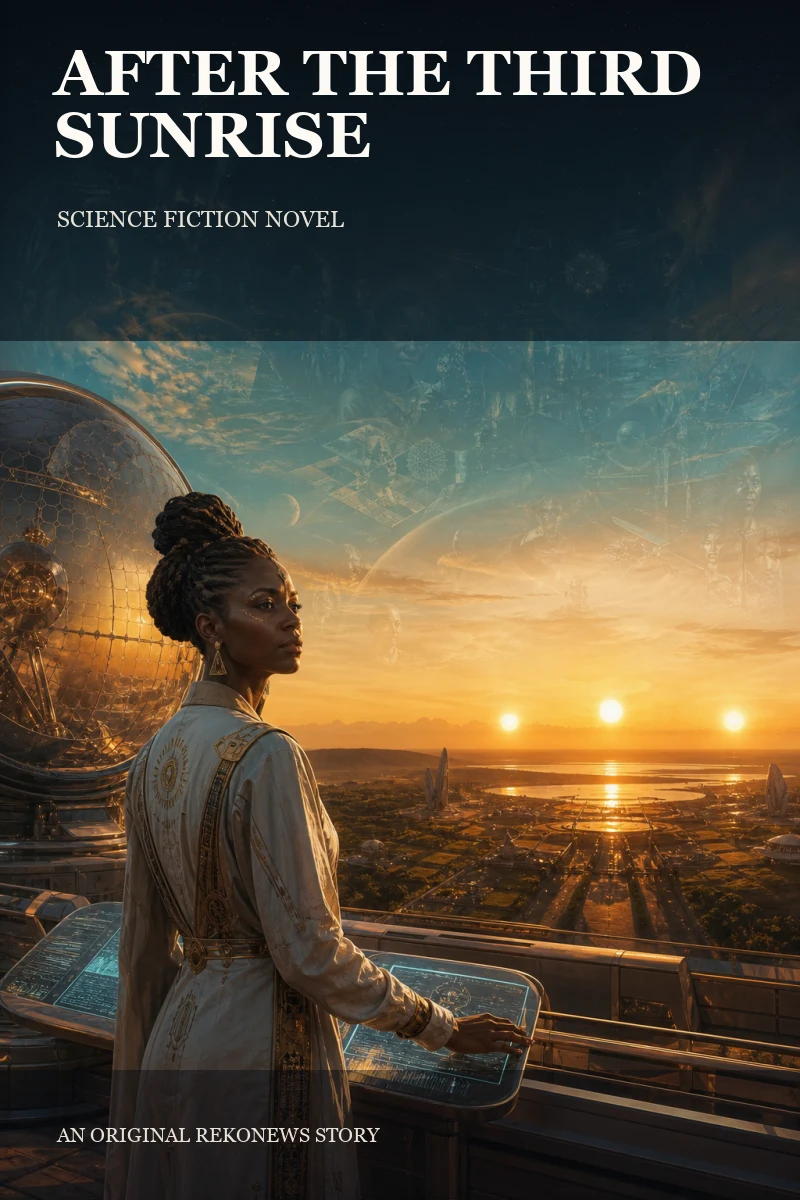
After the Third Sunrise follows Dr Kelechi Nwosu through a climate-engineered West Africa in 2091, where an artificial sun that begins transmitting human memories. A science fiction novel about loyalty, consequence, and the stories people choose to preserve.

After the Third Sunrise

  • Reads

    0

  • Chapters

    100

  • Rating

    0.0

After the Third Sunrise follows Dr Kelechi Nwosu through a climate-engineered West Africa in 2091, where an artificial sun that begins transmitting human memories. A science fiction novel about loyalty, consequence, and the stories people choose to preserve.

The content and image provided by the third party, does not represent RekoNews's position

READ CHAPTER 1 PREVIEW
CHAPTER 1

Arrival: The Unwelcome Message

The morning of Arrival: The Unwelcome Message began without ceremony. In a climate-engineered West Africa in 2091, Dr Kelechi Nwosu had learned that dangerous days rarely announced themselves. They arrived through an unanswered telephone, a door standing open, or a familiar street made strange by one missing face. Today it was a message written in a hand Dr Kelechi Nwosu did not recognize. It named an artificial sun that begins transmitting human memories, then offered a place and an hour. Around the words lingered the chapter's recurring signs: three shadows, heat glass, and archived dreams. Dr Kelechi Nwosu read it twice, folded it carefully, and understood that ignoring it would also be a decision. Outside, the city carried on with the confidence of people who believed the ordinary world was permanent. Traders argued over change, engines coughed in traffic, and voices crossed one another beneath the hard light. Dr Kelechi Nwosu moved among them while testing every possibility. The message might be bait, warning, confession, or all three. At this stage of uncertainty, certainty was a luxury. What mattered was choosing which uncertainty could be survived. By the time Dr Kelechi Nwosu reached the meeting place, three routes of escape had been memorized and none felt sufficient. The person waiting was an old friend with divided loyalties. Nothing about the meeting began honestly. A name was withheld, a question answered with another question, and a harmless detail repeated too precisely. Yet beneath the performance sat genuine fear. The stranger described a recent event connected to an artificial sun that begins transmitting human memories, supplying one fact that had never appeared in any public account. Dr Kelechi Nwosu listened without interruption. Experience had taught that frightened people often mixed truth with whatever story allowed them to keep breathing. The difficult task was not hearing the lie; it was discovering what the lie protected. A small piece of evidence passed between them. It seemed unimpressive at first, the kind of object a hurried cleaner might throw away, but it carried the weight of deliberate concealment. Dr Kelechi Nwosu examined its marks, its damaged edge, and the faint smell clinging to it. Each detail opened a different line of inquiry. One led toward money, another toward memory, and the last toward someone Dr Kelechi Nwosu had trusted for years. The stranger asked whether the object meant anything. Dr Kelechi Nwosu said no, because the truth had suddenly become too valuable to share. They separated before the hour was complete. On the return journey, Dr Kelechi Nwosu noticed the follower: never close enough to confront, never far enough to dismiss. Reflections in windows gave brief fragments of a face. Footsteps paused when Dr Kelechi Nwosu paused. The pursuit transformed familiar roads into a sequence of choices. Rather than hurry, Dr Kelechi Nwosu entered a crowded place and waited beside a family sharing food. The follower remained outside. For several minutes neither side moved, and the silence between them became its own form of conversation. Memory supplied what the evidence could not. Years earlier, before an artificial sun that begins transmitting human memories had a name, someone had warned Dr Kelechi Nwosu about the habit of institutions to hide their crimes inside routines. A stamp, a timetable, a receipt, or a polite instruction could carry more violence than an open threat. The recollection returned now with uncomfortable clarity. Dr Kelechi Nwosu compared it with the object from the meeting and found a pattern. The discovery did not solve the problem. It made the problem larger, reaching backward into decisions that had shaped several lives. At home, the safest room no longer felt safe. Dr Kelechi Nwosu checked the windows, disconnected a device, and spread notes across a table. The arrangement formed a rough map of people, places, promises, and contradictions. At its center sat an artificial sun that begins transmitting human memories. Around it gathered the images of three shadows, heat glass, and archived dreams, recurring too often to be accidental. One connection suggested that an ally had concealed important knowledge. Another suggested that the supposed enemy had tried, clumsily, to give warning. Dr Kelechi Nwosu resisted the desire to choose the kinder explanation. Evidence deserved patience, especially when affection argued against it. The ally arrived after sunset and immediately noticed the changed room. Their conversation began with ordinary matters, each person waiting for the other to admit what was truly at stake. When Dr Kelechi Nwosu finally placed the evidence on the table, the ally's expression shifted only once. It was enough. A denial followed, detailed and reasonable, but prepared too quickly. Dr Kelechi Nwosu asked a question whose answer was already known. The lie came smoothly. In that moment the investigation stopped being abstract; whatever waited ahead had already entered the circle of trust. Anger offered simple instructions: accuse, expose, leave. Dr Kelechi Nwosu followed none of them. Instead, the evidence was returned to its hiding place and the conversation allowed to continue. The ally revealed an old debt and a recent threat, not realizing how much the combination explained. People imagined betrayal as a single dramatic choice, but it was usually built from smaller surrenders. One compromise made the next seem reasonable. By the time the cost became visible, the betrayer was standing somewhere they had never intended to reach. Later, alone again, Dr Kelechi Nwosu wrote down what had been learned and what remained uncertain. The list of unknowns was longer. That did not mean the day had failed. A useful investigation changed the quality of its questions before it produced answers. Why had the message arrived now? Who benefited from fear? Which record could not be altered after the fact? Beyond the window, a climate-engineered West Africa in 2091 settled into night. The ordinary sounds returned, but Dr Kelechi Nwosu could now hear the spaces between them, intervals in which another listener might be waiting. A call came from an unexpected number. The voice offered proof in exchange for silence, as though truth were an object that could belong to only one person at a time. Dr Kelechi Nwosu kept the caller talking, noting background noise and the rhythm of interruptions. Somewhere a generator started, a bell sounded, and water struck metal. Those details narrowed the possible location. The caller set a deadline and ended with a personal fact that should have been impossible to know. For the first time that day, fear moved from the edge of the room to its center. Fear, however, was information. It identified what could be lost and therefore what required protection. Dr Kelechi Nwosu copied the notes, separated the evidence, and sent instructions to two people who did not know each other. If one route failed, the other might remain. This was not bravery in the heroic sense. It was preparation performed while hands shook. The distinction mattered. Courage did not erase fear; it prevented fear from becoming the only voice allowed to speak. Before leaving, Dr Kelechi Nwosu returned to the first message. A minor irregularity in the wording now stood out. The phrase belonged to a private conversation from months earlier. Only four people could have known it, and one was dead. The circle tightened. Dr Kelechi Nwosu considered each surviving name and the different reasons they might reopen the past. Love, guilt, ambition, and revenge could produce similar behavior from a distance. Up close, their methods differed. The evidence pointed not to the most powerful suspect, but to the one who had spent years appearing harmless. The next meeting would be a trap. Knowing that did not remove the need to attend. Dr Kelechi Nwosu chose a route through crowded streets, changed direction twice, and carried nothing that could endanger another person. Along the way, the signs of three shadows, heat glass, and archived dreams appeared again, transformed by context from decoration into warning. The pattern was becoming a language. Someone had been speaking through it for longer than Dr Kelechi Nwosu understood. Learning that language might reveal the truth, but it might also prove that the truth had always been near. At the appointed place, no person waited. Instead there was a second object and a brief instruction. Dr Kelechi Nwosu obeyed only part of it, enough to preserve the appearance of cooperation. The object confirmed the chapter's central suspicion while opening a more dangerous question. an artificial sun that begins transmitting human memories was not merely being hidden; it was being managed by people with competing goals. Their disagreement created an opportunity. It also meant that every apparent ally might simply belong to a different faction of the same design. Night deepened as Dr Kelechi Nwosu made the final choice of the chapter. The evidence would not be surrendered, the ally would not yet be confronted, and the next meeting would proceed under carefully changed conditions. None of those choices promised safety. Together they created movement, and movement was the only advantage still available. Dr Kelechi Nwosu looked once more across a climate-engineered West Africa in 2091, feeling the scale of what lay ahead. Somewhere within the city, another decision had already been made in response. The consequence arrived sooner than expected. A light went out across the way, a vehicle started below, and the telephone displayed a photograph taken only minutes earlier. Beneath it appeared six words: we know what you chose tonight. Dr Kelechi Nwosu studied the image for clues, then deleted nothing. Evidence was safest when an enemy believed it had caused panic. The chapter closed not with an answer but with a changed understanding: the investigation was no longer about approaching the secret. The secret had begun approaching Dr Kelechi Nwosu.
CONTINUE READING

Continue in RekoPad

Find the remaining chapters and keep your reading progress in one place.

Open RekoPad

You may like

Reviews (0)

    No review yet