





…Commends CBN Reforms
… Says Nigerians must feel the dividends of economic reforms
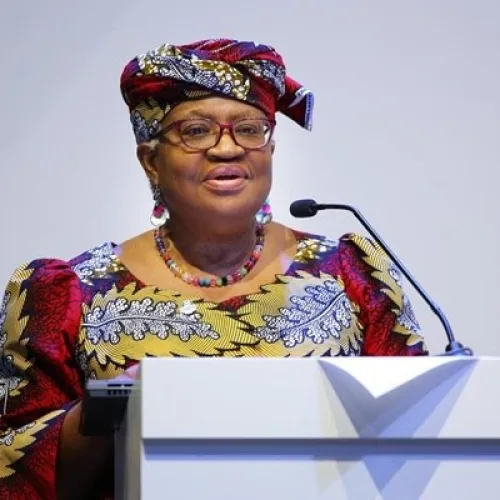
The Director-General of the World Trade Organisation (WTO), Dr Ngozi Okonjo-Iweala, has urged the Federal Government to prioritise job creation and expand economic opportunities for Nigeria’s growing youthful population.
She also commended the Central Bank of Nigeria (CBN) for implementing reforms that are reshaping the economy, while stressing the need for sustained macroeconomic reforms, prudent fiscal management, and responsible debt contracting and management.
Okonjo-Iweala made the remarks during a fireside dialogue titled “Building Africa’s Resilience in a Changing Global Economic Order,” where she shared the stage with the Governor of the CBN, Mr Olayemi Cardoso.
She stressed that the benefits of ongoing reforms must translate into tangible improvements in the lives of ordinary Nigerians.
“Nigerians have to feel the dividends of reform in the real economy. Instead of negative feedback loops of uncertainty, fragmentation and slower growth, we have an opportunity to build positive feedback loops through reformed rules, greater certainty, and improved economic prospects for people and businesses,” she said.
The WTO chief noted that globalisation is evolving from an era of cooperative interdependence to one of competitive interdependence.
According to her, the global order established after World War II to promote stability, predictability, peace and prosperity is facing its most significant disruptions in over 80 years.
“So much that shaped the world we know is now being called into question. States compete vigorously, but within a global economic system they cannot afford to abandon. They seek to outpace rivals without sacrificing the benefits of economic integration. The hope that global economic integration would produce geopolitical harmony may have failed, at least for now,” she said.
Okonjo-Iweala added that the emerging era of competitive interdependence reinforces the need for stronger, rules-based global systems.
She observed that the balance of global economic power has shifted dramatically over the past three decades.
“In 1995, advanced economies accounted for about 60 per cent of global economic output in purchasing power parity terms, while developing countries accounted for only 40 per cent. Today, those shares have effectively reversed, driven by faster growth in developing economies,” she said.
The WTO Director-General also expressed concern over widening economic inequality, citing a report presented to the G20 by an independent committee of experts on global inequality.
According to the report, more than two-thirds of the world’s population live in countries where the richest one per cent have increased their share of national income since 2000, while nearly three-quarters live in countries where the wealthiest one per cent have also expanded their share of total wealth.
She further noted that technological advances—from computers and the internet to artificial intelligence (AI)—have transformed global production, communication and trade but have also displaced workers through automation.
“Fears of AI-induced job losses are intensifying, and history reminds us that major technological shifts are often accompanied by economic anxiety and social unrest,” she said.
On climate change, Okonjo-Iweala said African countries are bearing a disproportionate burden.
Citing the World Meteorological Organisation, she said African economies lose between two and five per cent of GDP annually due to climate change, with many countries spending up to nine per cent of their national budgets responding to extreme weather events.
Speaking at the event, CBN Governor Olayemi Cardoso said the apex bank was pleased to co-host the forum, describing it as a demonstration of a shared commitment to building a more resilient and prosperous Africa.
He said the forum’s theme, “Building Africa’s Resilience in a Changing Global Economic Order,” is particularly relevant as global trade, finance and international relations continue to evolve.
“The global system that has long shaped relations among nations is changing before our eyes. Trade is becoming more uneven, capital is becoming more selective and impatient, and the long-standing rules-based international system is being stretched and tested,” Cardoso said.
He argued that Africa must transform these global shifts into opportunities for growth and shared prosperity.
According to him, with intra-African trade accounting for only about 16 per cent of the continent’s total trade, African countries must strengthen regional value chains, produce more of what they consume and expand trade among themselves.
“The African Continental Free Trade Area provides the platform and opportunity to turn this global shift into an African advantage,” he said.
Cardoso, however, emphasised that African countries must go beyond trade agreements by removing practical barriers to commerce through improved transport infrastructure, harmonised customs procedures and faster, more affordable cross-border payment systems.
He also noted that the era of abundant global capital is over, as investors now prioritise economies with credible institutions, transparency, consistency and sound governance.
“For Africa, this means our development ambitions cannot rely solely on foreign capital. We must mobilise domestic resources, including pension and insurance funds, domestic savings and diaspora investments, and channel them into productive sectors of the economy,” he said.
Highlighting the CBN’s reform agenda, Cardoso said the bank had unified the exchange rate, restored price discovery, ended monetary financing of fiscal deficits and rebuilt the foreign exchange market on the principles of transparency and market confidence.
He added that the apex bank tightened monetary policy where necessary and maintained clear communication with stakeholders despite difficult decisions.
“Today, the results of those sacrifices are evident. Inflation has moderated from previous highs despite energy shocks, external reserves have strengthened, and the financial system is safer and better capitalised to support sustainable economic growth,” he said.
Please follow and like us:
Comments
Start the conversation about this story.