





Foreign high-security printers dominated Nigeria’s banknote supply in 2025, accounting for 65 percent of approved production, as the Nigerian Security Printing and Minting Plc (NSPM) missed 38 percent of its allocation, delivering only 62 percent during the year, according to the Central Bank of Nigeria’s 2025 annual report and statement.
The report noted that the CBN approved the production of 5.71 billion pieces of banknotes across various denominations in 2025, representing a 20.5 percent increase from the 4.74 billion pieces approved in 2024.
Of the 5.71 billion pieces approved, NSPM was allocated 2.0 billion pieces, representing 35 percent of the total, while foreign high-security printers were allocated the remaining 65 percent.
The allocation highlights the significant role foreign printers continued to play in meeting Nigeria’s currency supply needs, with the domestic printer accounting for just over one-third of the banknotes approved for production during the year.
By the end of December 2025, NSPM had delivered 1.24 billion pieces, representing 62 percent of its 2 billion-piece allocation. This left 760.76 million pieces, or 38 percent of its allocation, outstanding at the end of the year.
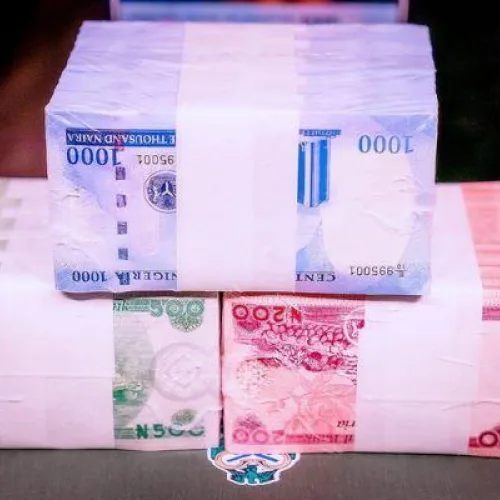
In comparison, foreign printers completed the delivery of 2,206 million pieces across the N1,000, N500 and N200 denominations during the period.
The CBN also said the delivery of an additional 1,500 million pieces awarded to foreign printers in November 2025 was still in progress as of the end of the year.
The increased banknote production came as currency in circulation continued to rise, reaching N5.73 trillion in 2025, compared with N5.44 trillion in 2024.
The CBN attributed the increase in currency in circulation to the increased pace of economic activity and rising demand for cash.
The figures therefore show that while Nigeria’s demand for physical currency remained strong, the supply of banknotes continued to involve substantial participation by foreign printers, with additional capacity required during the year to support currency requirements.
Beyond production, the CBN continued to strengthen its currency management operations. The Bank said its forensic currency laboratory remained active in investigating suspected counterfeit banknotes and assessing mutilated currency.
It also continued to dispose of banknote waste in an environmentally sustainable manner, engaging recyclers to evacuate banknote waste for conversion into consumer products, including manure, egg crates and charcoal briquettes.
The CBN also conducted nationwide public sensitisation programmes on the proper handling and preservation of naira banknotes through roadshows and market outreaches.
It further carried out a nationwide banknote performance evaluation across the six geopolitical zones to assess the fitness, durability and security features of lower-denomination polymer notes. The findings are expected to guide decisions on the issuance and circulation of the notes.
To improve accountability among deposit money banks, the CBN conducted periodic mystery shopping exercises to assess compliance with currency management guidelines. Banks found to have breached the guidelines were sanctioned.
The Bank also inaugurated a Technical Committee comprising the CBN, Association of Licensed Cash Managers of Nigeria, Committee of Heads of Bank Operations and the Office of the National Security Adviser to improve the efficiency of cash processing and cash-in-transit operations nationwide.
As part of efforts to modernise currency processing, the CBN operated 22 Banknote Processing System 1000 machines across 11 branches at the end of 2025, while 24 BPS M7 machines were installed in 12 processing branches during the year.
The Bank also progressed with the deployment of online reporting tools at branches equipped with BPS M7 machines, with a pilot implementation commencing in December 2025. The system is designed to provide real-time reporting and strengthen monitoring, oversight and efficiency in currency processing operations.
The CBN said management also approved the disposal of demonetised coins to decongest its currency vaults in line with international best practices.
Hope Moses-Ashike is an Associate Editor, Banking and Finance, with more than a decade of experience reporting on Nigeria’s financial system and broader economy. She closely tracks market movements, monetary policy decisions, company disclosures, regulatory actions, economic indicators, and global developments, and interprets what they mean for businesses, investors, policymakers, and households. Her reporting helps readers understand complex issues such as inflation trends, foreign exchange market dynamics, interest rate decisions, bank performance, and investment risks. She also covers major international events and periodically travels to Washington, D.C., to report on the World Bank/IMF Spring and Annual Meetings. Her dedication to financial journalism has earned her multiple recognitions and invitations to high-level professional development programmes. She is an alumna of the International Visitors Leadership Programme (IVLP) in the United States and holds an Advanced Financial Journalism Certificate from the Press Association Training in London, UK. Her other notable achievements include completing the Lagos Business School CMC Programme, the Bloomberg Media Africa Initiative Programme, and a Master Class in Journalism at Rhodes University in South Africa.

Comments
Start the conversation about this story.