





Of all the solar system’s planets, Mercury is an oddball. Despite being closest to the Sun, it’s not the hottest planet. It quickly zips around the Sun every 88 days in the shape of a squashed oval but takes an excruciating 59 days to finish one spin on its axis. But wait, there’s more: it only holds onto a radiation belt less than half the time.
Specifically, Mercury’s radiation belt exists about 50% of the time when the planet is farthest away from the Sun, whereas it’s there for about 20% of the time at closer distances. In a study published yesterday in Nature Astronomy, researchers confirmed that, contrary to longtime assumptions, Mercury also has a radiation belt much like those of most planets encapsulated by magnetic fields. So Mercury is officially even weirder than we thought, but the findings also will inform future missions headed in that direction.
“When we think about the future exploration of space and what instruments we send to Mercury, we’ll want to be aware of this radiation belt and take the right sort of precautions and design around it,” Ryan Dewey, the study’s co-first author and an engineer at the University of Michigan, said in a statement.
A buzzy capsule
A planet’s magnetosphere shields it against powerful solar radiation. On Earth, the magnetosphere protects our planet from extreme solar weather by trapping the high-energy particles within its magnetic field. This results in two permanent radiation belts, called the Van Allen Belts, which “surround the Earth like enormous donuts,” according to a NASA explainer.
Other planets have similar protections, although the specifics vary according to the physics of each planet. For example, Mars has a “weak and patchy” magnetosphere, whereas Jupiter’s thick magnetic field means it “barely” feels powerful events like coronal mass ejections, as NASA’s Scientific Visualization Studio explained in 2019. For decades, scientists debated whether Mercury actually trapped particles into a stable belt, even though it also has a magnetic field.
Not an exception
That said, scientists believed this made sense, as Mercury’s weak magnetic field—about 1% the strength of Earth’s—was constantly under attack from the Sun’s tumultuous weather and magnetic extremes, according to the statement. As a result, there wouldn’t be “a whole lot of room for the energetic electrons that make up the radiation to survive before being ejected out into space or hitting the planet,” Dewey explained.
However, Dewey and colleagues wondered if there was any possibility that we’d missed something from old data. For the latest study, the team revisited observations collected between 2011 and 2015 by NASA’s MESSENGER spacecraft. Using more recent, advanced analysis techniques, the researchers found that Mercury indeed had a “ring-like radiation belt,” albeit with lifetimes typically under 8 to 12 hours and very occasionally for up to several Earth days.
Mercury is trying
The reason for this impermanence, according to the paper, is “loss rather than a lack of supply.” In other words, Mercury, like other planets, is perfectly capable of catching and trapping high-energy electrons. As previously assumed, however, its sheer proximity to the Sun does play an important role. Still, the point is that, like other planets, Mercury has a radiation belt. But, like other planets, its innate features and environment affect how that radiation belt manifests.
The findings should be especially relevant for upcoming missions like BepiColombo, a joint mission by Europe and Japan slated to reach Mercury by November this year. For spaceflight operatives, radiation belts can be pesky obstacles for managing spacecraft (and astronauts, if they’re crewed). In the paper, the team wrote that BepiColombo might have already crossed Mercury’s radiation belts, but its mission should further clue us into our weird neighbor—and maybe others like it.
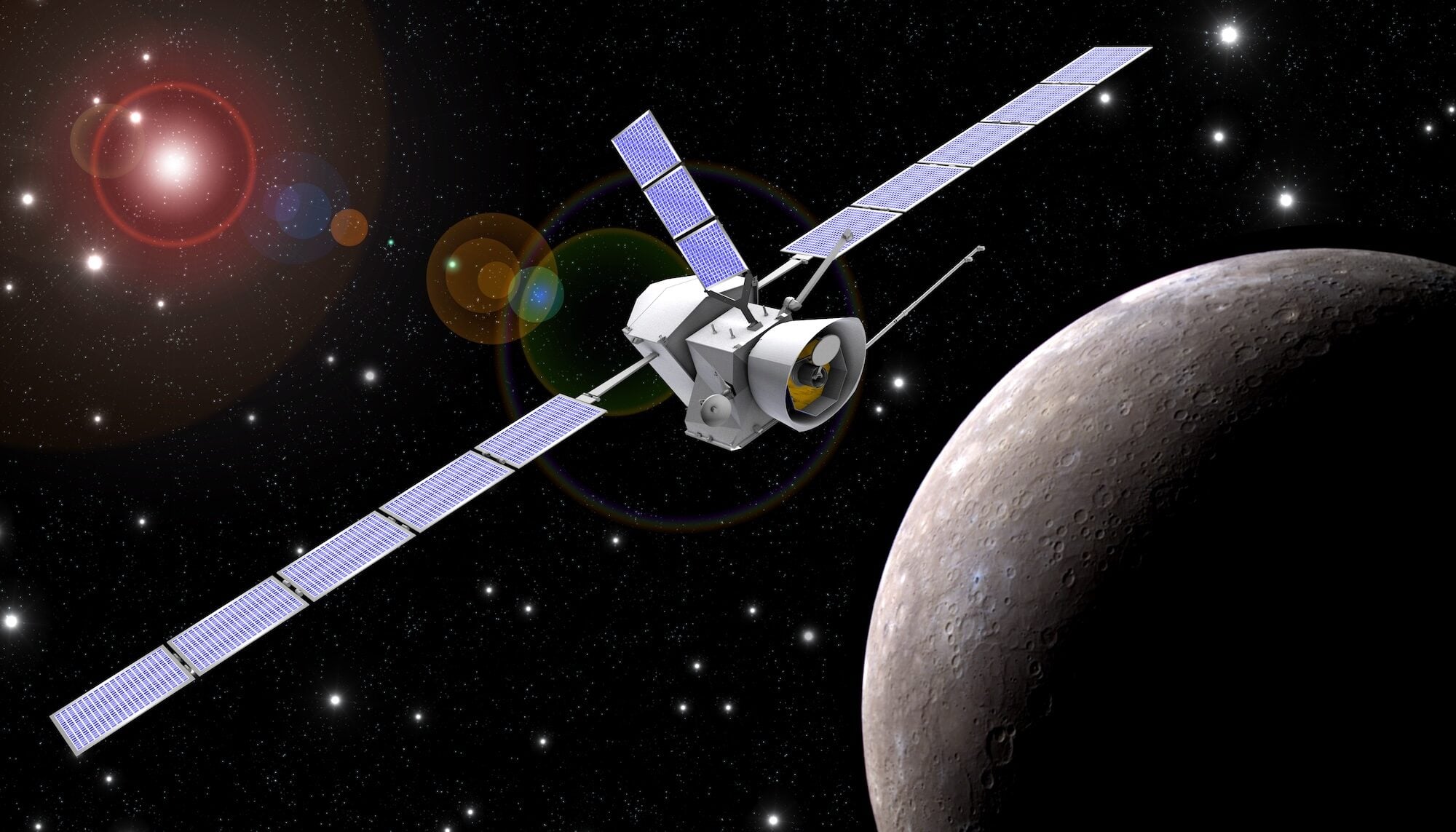 An artist’s impression of the BepiColombo spacecraft at Mercury. Credit: European Space Agency
 “Mercury provides a natural laboratory to infer what the radiation could look like at other planets that orbit close to their stars, as well as distant planets during extreme space weather,” Weijie Sun, the study’s co-author and an astrophysicist at the University of California, Berkeley, said in the statement.
Comments
Start the conversation about this story.