





…Sector needs bold investment to deliver $1tn economy ambition – Expert
Nigeria’s vast marine resources remain significantly underutilised despite growing recognition of the blue economy as a key driver of economic diversification, with industry stakeholders warning that inadequate funding, policy fragmentation and slow implementation of reforms are preventing the country from unlocking an estimated $296 billion in economic value.
Stretching across an 850-kilometre Atlantic coastline, more than 10,000 kilometres of navigable inland waterways and some of West Africa’s busiest seaports, Nigeria possesses one of the continent’s largest blue economy assets.
Beyond ports and shipping, the sector presents opportunities in fisheries and aquaculture, coastal and marine tourism, offshore renewable energy, shipbuilding and repairs, marine biotechnology, seabed mineral exploration, inland water transport, maritime logistics, ocean research and the emerging blue carbon market.
If fully harnessed, these industries could generate millions of jobs, increase non-oil exports, strengthen food security, attract billions of dollars in private investment and support the country’s ambition of building a $1 trillion economy.
However, despite recent improvements in port operations, maritime security and institutional reforms following the creation of the Federal Ministry of Marine and Blue Economy, experts say investment in the sector remains far below what is required to transform Nigeria into a leading maritime economy and regional logistics hub.
It is against this backdrop that Dele Kelvin Oye, Chairman of the Alliance for Economic Research and Ethics Ltd/GTE, warned that Nigeria risks losing a once-in-a-generation opportunity to unlock its estimated $296 billion blue economy potential unless government significantly increases funding, strengthens governance and accelerates reforms across the maritime sector.
Oye, in a report entitled: “Nigeria’s Blue Economy: The Trillion-Naira Ocean We Refuse to Swim In”, argued that although the Federal Government’s decision to establish the Federal Ministry of Marine and Blue Economy in 2023 marked the most significant institutional reform in the sector in decades, the country’s marine assets continue to deliver only a fraction of their economic potential.
According to him, the challenge is not the absence of natural resources but the lack of coordinated policies, sustained investment and effective execution.
“Nearly three years after President Bola Tinubu created the Federal Ministry of Marine and Blue Economy, Nigeria stands at a critical inflection point. The ministry has recorded measurable early gains in port efficiency, maritime security, and institutional restructuring. Yet the sector remains structurally underfunded, institutionally fragmented, and economically underperforming relative to its vast potential.
“With an estimated $296 billion in untapped blue economy value, an 850-kilometre coastline, 10,000 kilometres of navigable inland waterways, and the busiest seaports in West Africa, Nigeria possesses the natural endowment to become Africa’s preeminent maritime power.
“What it lacks is the policy coherence, capital mobilisation, and execution discipline that transformed maritime backwaters in Singapore, Norway, and Indonesia into global economic engines. This is not a matter of geography; it is a matter of choice,” he said.
He noted that the ministry has recorded measurable gains in its first three years, particularly in port efficiency, maritime security and institutional restructuring.
Citing first-quarter 2026 operational data from the Nigerian Ports Authority (NPA), Oye said Gross Registered Tonnage (GRT) of ocean-going vessels rose by 19.5 per cent to 46.75 million, despite a slight decline in vessel calls, indicating that larger and more efficient vessels are increasingly calling at Nigerian ports.
He added that cargo throughput, excluding crude oil terminals, reached 32.38 million metric tonnes, while vehicle handling increased by 67% to 58,870 units.
Container trans-shipment traffic also surged by 83.1%, signalling Nigeria’s growing importance as a regional maritime hub under the African Continental Free Trade Area (AfCFTA).
According to him, the improved performance demonstrates that reforms in the sector are beginning to yield results and position Nigeria for greater regional competitiveness.
On maritime security, Oye said the Deep Blue Project has fundamentally changed Nigeria’s profile in the Gulf of Guinea, once regarded as one of the world’s most dangerous shipping routes.
He noted that Nigeria has now recorded more than four consecutive years without piracy incidents, improving investor confidence, lowering insurance premiums for vessels and enhancing the country’s reputation as a safer maritime destination.
The expert also described the recent launch of the digital disbursement portal for the Cabotage Vessel Financing Fund (CVFF), which has accumulated more than $700 million, as a significant milestone towards strengthening indigenous shipping capacity after years of delays.
Despite these achievements, Oye maintained that inadequate financing remains the sector’s biggest obstacle.
He observed that while the marine and blue economy oversees activities responsible for more than 90 per cent of Nigeria’s international trade by volume, the ministry’s N10.5 billion proposed budget for 2026 falls far short of what is required to modernise ports, expand inland waterways, strengthen fisheries, improve maritime safety and attract large-scale private investment.
He cited estimates by the National Institute for Policy and Strategic Studies (NIPSS), which suggest that Nigeria requires about N72 trillion annually across ports, inland waterways, fisheries, renewable energy and related infrastructure to unlock the full value of the blue economy.
“The current allocation represents only a tiny fraction of what is required. It reflects structural underinvestment in a sector that should be one of Nigeria’s biggest economic growth drivers,” he said.
Oye also identified overlapping responsibilities among agencies such as the Nigerian Maritime Administration and Safety Agency (NIMASA), the Nigerian Ports Authority (NPA), the National Inland Waterways Authority (NIWA) and other maritime institutions as a major deterrent to investment.
According to him, duplicated regulations, multiple licensing requirements and fragmented oversight have created uncertainty for investors while slowing project execution across the maritime value chain.
He further argued that Nigeria’s fisheries sector illustrates the enormous economic losses arising from underinvestment.
With annual fish demand estimated at over 3.6 million metric tonnes against domestic production of about 1.4 million metric tonnes, the country spends more than $1 billion every year importing fish.
He said expanding aquaculture, establishing fish processing plants and investing in cold-chain logistics could significantly reduce imports, improve food security and create millions of jobs across coastal and riverine communities.
Oye also urged the government to look beyond traditional maritime activities and develop emerging blue economy industries such as offshore renewable energy, marine biotechnology, coastal tourism, shipbuilding, marine equipment manufacturing, ocean research, blue carbon projects and seabed resource development.
According to him, these sectors are attracting substantial investment globally and could become important sources of export earnings, innovation and climate finance if Nigeria develops the appropriate regulatory and investment framework.
To reposition the industry, he recommended establishing a National Blue Economy Coordination Council to harmonise the mandates of maritime agencies, increasing annual budgetary allocations to the ministry to at least N500 billion, issuing Nigeria’s first sovereign Blue Bond to finance marine infrastructure and accelerating the rehabilitation of seaports and dredging of inland waterways.
He also called for the adoption of a National Marine Spatial Plan to provide clear rules for allocating ocean resources among shipping, fishing, tourism, energy development and environmental conservation, thereby improving investment certainty and reducing conflicts among users of Nigeria’s maritime domain.
“The Federal Ministry of Marine and Blue Economy has laid a commendable foundation. The Q1 2026 performance data proves that reform can yield results. But Nigeria is running out of time.
“The AfCFTA is intensifying regional competition, and the global blue economy, valued at $4.5 trillion, is being captured by nations that move faster and invest more.
The blue economy is not merely a sector; it is a transformation. It is the bridge between Nigeria’s oil-dependent past and its diversified future. It is the pathway to the $1 trillion economy that the Renewed Hope Agenda envisions.
“Three years after the ministry’s creation, the question is no longer whether Nigeria can harness its marine potential. The question is whether it will, before the tide turns irrevocably toward other shores,’ he added
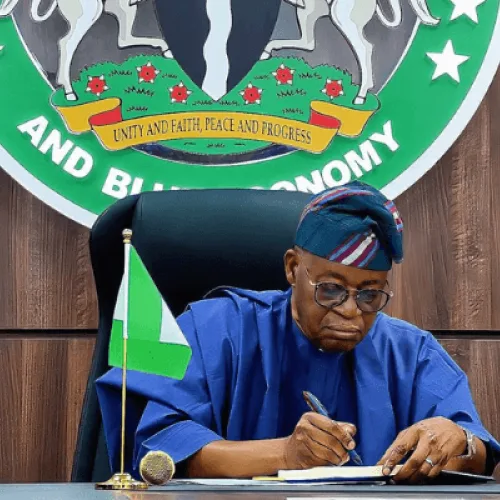
The expert’s recommendations come as the Minister of Marine and Blue Economy, Adegboyega Oyetola, told lawmakers during the defence of the ministry’s 2026 budget proposal that inadequate funding had become a major constraint to implementing reforms capable of transforming the sector.
Oyetola described the proposed N10.5 billion allocation as “grossly insufficient,” noting that it would merely sustain basic operations rather than support the scale of investment needed to improve port infrastructure, inland waterways, fisheries, aquaculture and maritime administration.
He also disclosed that the ministry’s revised 2025 capital budget of N3.53 billion received an actual cash release of only N202.47 million, representing about 1.7% of the approved amount, underscoring the financing challenges confronting the ministry’s reform agenda.

Comments
Start the conversation about this story.