





Twenty-five years after the launch of Google Images transformed how people searched the internet, artificial intelligence is ushering in another shift that could reshape retail across Africa, turning smartphone cameras into shopping tools and forcing businesses to rethink how customers discover their products.
Olumide Balogun, Google’s director for East and West Africa, said African businesses risk losing customers if their products cannot be found through AI-powered visual search, as consumers increasingly use images, cameras and voice instead of typing keywords into search engines.
Read also: Meta unveils Muse Image as Zuckerberg escalates AI race against OpenAI, Google
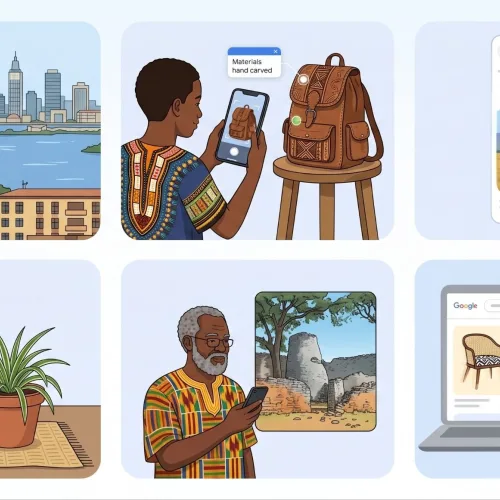
The change marks a significant evolution in online commerce. While Google Images was born in 2001 after millions searched unsuccessfully for Jennifer Lopez’s iconic green Versace dress from the 2000 Grammy Awards, today’s AI-powered search allows consumers to simply point a smartphone camera at an item, circle an object on a screen or ask questions in their local language to instantly identify and purchase products.
“For African business leaders, this is not an abstract technology story. Around one in four visual searches globally is commercial, with people trying to identify, compare or buy something they have just seen,” Balogun said.
The trend is gathering momentum across Africa, where smartphone adoption, digital commerce and artificial intelligence are expanding rapidly. Google now supports AI-powered search in 13 African languages, including Yorùbá, Hausa and Kiswahili, making the technology accessible to more than 100 million people across Sub-Saharan Africa.
The company believes this combination of AI, local language support and visual search could fundamentally change how consumers interact with brands.
Imagine a guest at a wedding in Lagos spotting a pair of sneakers made with traditional African fabric. Instead of searching for words that describe the design, she simply points her phone at the shoes or circles them on her screen. Within seconds, AI identifies the brand, compares similar products and provides a direct link to buy them.
“If your product is not in that result, someone else’s is,” Balogun said.
The shift comes as Nigeria emerges as one of Africa’s fastest-growing AI markets. According to Google, YouTube watch time in Nigeria has increased by more than 55 percent year-on-year, reflecting growing demand for video-first content that increasingly drives shopping decisions.
Google also said eight in ten Nigerians are optimistic about artificial intelligence, while the same proportion already use AI tools to explore business opportunities, almost double the global average.
For marketers, this means the traditional strategy of targeting typed search keywords is becoming less effective as consumers increasingly search with images, videos and voice.
To help businesses adapt, Google has outlined a 90-day roadmap centred on three priorities: making products discoverable through visual search, using AI-powered marketing tools to reach customers across multiple channels, and scaling creative content with generative AI.
The first step, Balogun said, is ensuring every product is professionally photographed, digitised and uploaded into structured product feeds that search engines can recognise. Without that digital foundation, products may remain invisible to AI-powered shopping experiences.
“The success measure is simple. By day 30, every product you sell should be recognisable to a camera,” he said.
The second phase focuses on changing how companies spend their advertising budgets. Rather than relying solely on keyword-based campaigns, businesses should build demand through image- and video-led content while allowing AI systems to optimise advertising across the entire customer journey.
According to Google, AI can now analyse signals in real time, directing marketing budgets towards consumers most likely to make purchases instead of simply targeting those who type specific search terms.
The final phase addresses one of the biggest constraints facing African businesses—creating enough high-quality marketing content.
Balogun said advances in generative AI now allow companies to produce hundreds of variations of images and videos from a handful of original campaign assets, significantly reducing production costs that once favoured large multinational brands.
He pointed to demonstrations at this year’s Cannes Lions advertising festival, where Google DeepMind recreated football legend Pelé’s famous but unrecorded 1959 goal using archival photographs and generative AI, illustrating how the technology has evolved from a data analysis tool into a creative partner.
For African businesses, however, the practical application lies in producing marketing campaigns at scale, identifying suitable creators and tailoring content for different audiences without significantly increasing costs.
Read also: Tinubu orders probe of Meta, Google, X over alleged exploitation of Nigerian media content
Balogun said the development could level the playing field for Africa’s small and medium-sized enterprises, which account for the majority of businesses across the continent.
“This continent’s economies run on small and medium enterprises, and for the first time the tools of sophisticated marketing are not gated by scale. A designer in Accra, a founder in Nairobi and an artisan in Ibadan can now run substantially the same playbook as a multinational. The businesses that will define the next 25 years here will not necessarily be the largest. They will be the ones that acted early,” he said.
As AI increasingly enables consumers to search with cameras, voices and local languages rather than keyboards, Google believes the next chapter of digital commerce in Africa will be determined not by who has the biggest advertising budget, but by which businesses can be seen and understood by AI.
Get Newsletter Updates
Enjoying our column?
Subscribe to our specialised **Tech Pulse** feed to receive fresh reports and analyses directly in your inbox.
Royal Ibeh is a senior journalist with years of experience reporting on Nigeria’s technology and health sectors. She currently covers the Technology and Health beats for BusinessDay newspaper, where she writes in-depth stories on digital innovation, telecom infrastructure, healthcare systems, and public health policies.

Comments
Start the conversation about this story.