





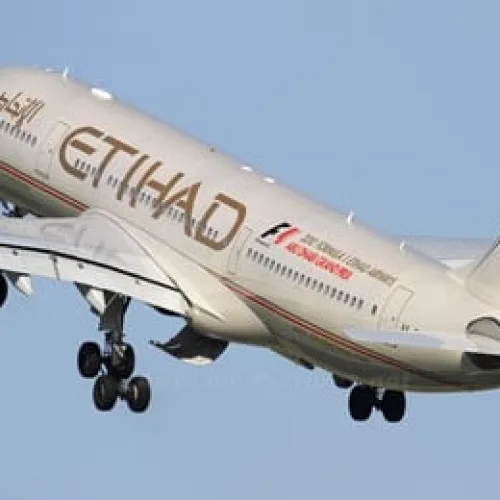
RECENTLY, the Minister of Aviation and Aerospace Development, Festus Keyamo, hosted a delegation from Etihad Airways in the United Arab Emirates (UAE). Central to their discussions was the resumption of Etihad’s scheduled services between Abu Dhabi and Nigeria.
From all indications, the airline is expected to return to the Nigerian market in the first quarter of 2027.
This development comes alongside Etihad’s newly signed codeshare agreement with Nigeria’s leading carrier, Air Peace. The partnership will connect the networks of both airlines, opening access to more than 20 destinations across Nigeria, West Africa and Central Africa for Etihad passengers, while giving Air Peace customers seamless connections to Abu Dhabi and Etihad’s extensive global network.
Etihad last suspended its Abu Dhabi-Lagos service in November 2022 following diplomatic tensions between Nigeria and the UAE. The suspension was driven by several issues, including restrictions on UAE visas for Nigerian travellers, the inability of foreign airlines to repatriate ticket revenues trapped in Nigeria because of foreign exchange shortages, and other bilateral concerns.
The airline’s planned return represents far more than the restoration of another international route. It is a strong vote of confidence in Nigeria’s aviation market and a reminder that, despite the industry’s longstanding challenges, the country remains one of Africa’s most attractive aviation destinations.
Nigeria continues to be the largest aviation market in West and Central Africa, supported by its large population, expanding business community and sustained demand for international travel.
It is therefore unsurprising that major global airlines continue to view the country as a strategic market.
Etihad’s decision also comes at a time when Nigeria’s aviation industry is gradually regaining international confidence. For years, foreign airlines grappled with trapped funds, foreign exchange constraints and operational uncertainties. Although these issues dented investor confidence, recent government efforts to clear outstanding airline revenues and improve the operating environment have begun to restore trust.
The return of the Abu Dhabi-based carrier should therefore be seen as an endorsement of these improvements. It signals that Nigeria is once again becoming a commercially viable destination for global airlines.
For travellers, the benefits are immediate. More international carriers on key routes mean increased competition, additional frequencies and greater travel choices. Competition generally exerts downward pressure on fares while encouraging airlines to improve service delivery in order to win market share.
READ ALSO: Etihad Airways appoints Nigerian to manage activities in Nigeria
Passengers will also benefit from Etihad’s extensive worldwide network. Through its Abu Dhabi hub, Nigerian travellers will enjoy seamless connections to destinations across the Middle East, Asia, Australia, Europe and North America. This enhanced connectivity will particularly benefit business travellers, students, tourists and Nigerians in the diaspora.
Beyond passenger movement, stronger air connectivity supports trade, tourism and foreign direct investment. Efficient international air services are essential for attracting investors, facilitating exports and integrating Nigeria more effectively into the global economy.
At the same time, Etihad’s return should serve as a timely reminder to Nigerian airlines that international competition is becoming increasingly intense. Indigenous carriers must continue investing in fleet modernisation, operational efficiency, customer service and strategic partnerships if they are to remain competitive on both regional and long-haul routes.
Government, on its part, must sustain reforms that encourage investment while maintaining a level playing field for all operators. Regulatory consistency, improved airport infrastructure, competitive airport charges and transparent policies remain critical if Nigeria is to evolve into a true aviation hub rather than simply a destination market.
The Nigerian Civil Aviation Authority (NCAA), the Federal Airports Authority of Nigeria (FAAN) and other aviation agencies equally have important responsibilities in maintaining world-class safety standards, improving passenger experience and ensuring efficient airport operations. These are among the key considerations international airlines evaluate before committing long-term investments.
Etihad’s return further reinforces Nigeria’s growing importance within Africa’s aviation landscape. As more international airlines expand their operations into the country, policymakers should seize the opportunity to strengthen the local aviation ecosystem through supportive policies, modern airport infrastructure and greater assistance for indigenous airlines.
The task now is to sustain that confidence. If government maintains the momentum of ongoing reforms and industry stakeholders work together to eliminate persistent operational bottlenecks, Etihad’s return may well be remembered not merely as the comeback of a major international airline, but as another defining milestone in the continued resurgence of Nigerian aviation.
Comments
Start the conversation about this story.