






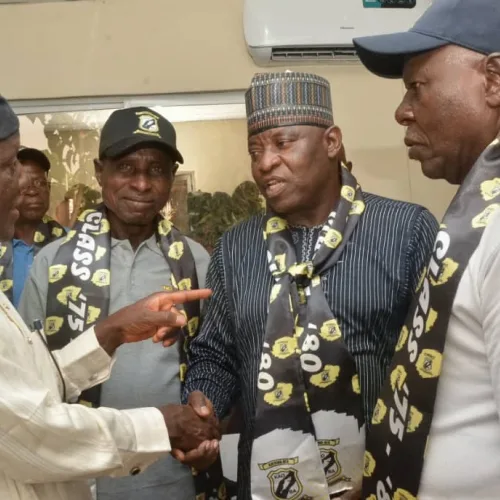
Blueprint.ng correspondent joined in the celebration of the reunion of the Katsina-Ala Old Boys Association (KAOBA) 1975–1980, where the old boys set for themselves a developmental agenda befitting of their alma mater
When old friends meet, old dreams come alive. The hugs were long, the laughter loud, and the memories even louder.
For many members of the Katsina-Ala Old Boys Association (KAOBA) 1975–1980 set, the annual reunion which took place in Abuja was more than another gathering of classmates. It was a journey back to an era when school uniforms, morning assemblies and classroom friendships laid the foundation for lives that would later produce professors, military officers, politicians, farmers, civil servants and retirees.
The hall was thick with the kind of noise that only decades-old friendship can make — laughter breaking suddenly into song, handshakes stretching into embraces, grey-haired men calling out names they had not spoken in over forty years. Some had not seen each other since 1980. On Saturday at the popular Rita Lori Hotel, in Abuja, they saw each other again.
More than four decades after leaving Government Secondary School, Katsina-Ala, Benue State, the old boys reunited not only to relive cherished memories but also to reaffirm their commitment to one another and to the institution that shaped them. Beyond nostalgia, the reunion became a platform for discussing welfare, retirement security and practical steps towards restoring the once-prestigious school.
A brotherhood that has endured for life

National President of KAOBA, Anthony Adah, described the annual reunion as proof that the association remains a lifelong family.
“It is encouraging because this meeting is organized by a class set. They remember themselves, support those who have lost family members and assist where necessary. Katsina-Ala Old Boys is for life. We cannot go back to another secondary school to get another old boys’ platform,” he said.
Adah said the association was preparing for a major fundraising appeal in Abuja this October to revive critical infrastructure within the school.
“We are planning to upgrade the school in several ways, including a major appeal launch in Abuja this October. Many public schools are no longer receiving adequate government attention. The school trained us to be disciplined, and it is time for us to give back.”
According to him, belonging to an alumni association goes beyond social gatherings, offering members emotional support, professional networking and opportunities to help one another in times of need.
“There is an advantage in associating with members of your class. We contribute during weddings, support ourselves in difficult moments and even help create opportunities for one another. We must continue to be our brother’s keeper.”
Forty-six years later, gratitude outweighs time

For Professor Tor Iorapuu, the reunion was first a celebration of life.
Having entered the school in 1975 as teenagers and returning more than 40 years later as senior citizens, he said the gathering was a reminder of God’s faithfulness.
“It is a feeling of excitement and thanksgiving. After more than 40 years, from adolescence we have become senior citizens. Seeing this number of us alive today is something worth thanking God for.”
Iorapuu also challenged alumni who have remained distant from the association to reconnect with their alma mater.
“In every community there are people who stay away, but if someone like General TY Danjuma, who has achieved so much, can still identify with his alma mater, then what about the rest of us? We need to learn from that spirit and continue supporting the school.”
His remarks reflected a common sentiment among participants—that preserving the school’s legacy requires the commitment of every former student, regardless of status or location.
Rebuilding a school that once inspired excellence
The Chairman of the 1975–1980 set, Paul Danladi Attsar, traced the evolution of the group from scattered classmates to one of KAOBA’s most organised sets.
Beginning with about 140 students across four streams in 1975, the association has successfully reconnected more than 50 classmates worldwide through digital platforms.
“We opened a WhatsApp group and started tracing people from everywhere. Today we have over 50 members, and every reunion brings people we haven’t seen since 1980.”
Attsar said the unity of the set had translated into tangible projects for the school.
“When we visited the school in 2020, we found the administrative block in a terrible state. Members contributed whatever they could and raised N4.17 million. We renovated the administrative block within three months, becoming the first set to complete such a project.”
The successful intervention, he noted, encouraged younger alumni to embark on similar renovation projects.
Looking ahead, Attsar expressed confidence that the set’s impact would continue to grow.
“Our commitment remains strong. Every year attendance improves, contributions increase and our determination to preserve the school’s legacy becomes even stronger.”
Looking beyond retirement towards lasting legacies
While school rehabilitation dominated discussions, former military officer Capt. Micka Luka urged members to think beyond immediate interventions by building sustainable financial structures for the future.
He argued that retirement planning and welfare should become major priorities for the association.
“I’ve saved for retirement, but we must build a robust welfare and retirement-investment plan—not just for us, but for the school and even the nation.”
Luka proposed creating an investment and trust fund capable of supporting members, their families and future generations.
“If each of us invests the equivalent of $100, we can create something that will continue caring for families long after we are gone. We should leave a legacy that outlives us.”
He revealed that he had already begun making investments in the school’s name, hoping they would eventually generate resources for future development projects.
“My goal is that the school should eventually have investment income of its own. Once we care for ourselves, it becomes easier to care for the school and society.”
More than memories
The group of men – once innocent boys – took time to pay a condolences visit to the family of one of their own late Salihu Sule.
As conversations drifted from classroom jokes to national development, one message became unmistakably clear: the KAOBA 1975–1980 reunion was no ordinary reunion.
It was a gathering where memories inspired action, friendships translated into philanthropy and nostalgia evolved into responsibility.
With plans to raise fresh funds for infrastructure, strengthen member welfare and create long-term investment vehicles, the old boys are proving that education’s greatest legacy is not simply what happens inside the classroom, but what former students choose to build long after the school bell has stopped ringing.
For the KAOBA 1975–1980 set, the reunion was not about looking back in regret. It was about ensuring that future generations inherit a stronger school, a stronger brotherhood and a lasting culture of giving back.
Comments
Start the conversation about this story.