





Experts say weak state-level action, poor preparedness and inadequate funding could derail Nigeria’s climate targets as floods, heatwaves and disease outbreaks worsen.
Climate change has emerged as one of the gravest threats to Nigeria’s public health, national security and economic future, with the Nigerian Academy of Science (NAS) warning that unless urgent action is taken at state and community levels, the country risks reversing decades of development gains and missing its net-zero emissions target.
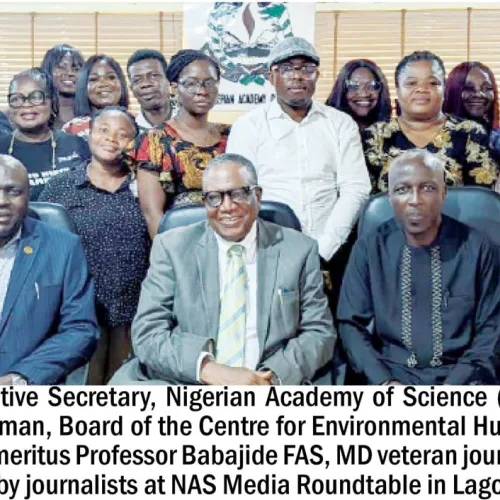
The warning came at the Academy’s media roundtable on “Climate Change, Health and the Nigerian Reality” held in Lagos, where scientists and science communication experts urged governments, businesses, communities and the media to treat climate change as an immediate national emergency rather than a distant environmental concern.
Opening the event, the Public Affairs Secretary of the Academy, Professor Chinedum Babalola, said climate change was no longer an abstract scientific concept but a daily reality already affecting the health and livelihoods of millions of Nigerians.
She noted that flooding has continued to trigger cholera outbreaks, heatwaves are worsening cardiovascular diseases, changing rainfall patterns are threatening food production and nutrition, while deteriorating air quality is increasing respiratory illnesses.
Quoting the World Health Organisation, Babalola described climate change as “the single biggest health threat of the 21st century,» stressing that science must move beyond laboratories to shape public policy and everyday decision-making.
“Science must not remain in journals and laboratories. It must speak to policy, to business, and to the Nigerian people,” she said, describing the media as the bridge between scientific evidence and public action.
Presenting the lead paper, Chairman, Board of the Centre for Environmental Human Resources Development, Emeritus Professor Babajide FAS, warned that rising temperatures, desertification, flooding, coastal erosion and erratic weather patterns are already undermining food security, public health and economic productivity across Nigeria.
He described climate change as an “existential challenge” capable of worsening insecurity through resource scarcity, displacement and migration, saying women, youths, farmers and fishing communities remain the hardest hit.
According to the Professor of Chemistry, former Deputy Vice-Chancellor (Academics & Research), University of Lagos, drought, shrinking grazing lands and declining agricultural productivity have intensified farmer-herder conflicts, while climate stress has become a «risk multiplier” contributing to violent extremism, organised crime and migration across the Sahel region.
Although Nigeria has adopted ambitious climate policies, including its Nationally Determined Contributions (NDCs), the Great Green Wall initiative and erosion control programmes, Alo said implementation remains largely concentrated at the federal level.
He expressed concern that many states still lack climate policies, dedicated funding, institutional capacity and public awareness programmes despite bearing the greatest impacts of climate change.
READ ALSO: Organisers release first teaser video for BBNaija season 11
“The impacts of climate change are mostly borne by states, yet subnational climate governance remains weak,” he said, warning that Nigeria’s target of achieving net-zero emissions by 2060 would be difficult to attain without stronger participation from state and local governments.
The professor also highlighted the mounting health consequences of climate change, saying vulnerable populations, including the elderly, persons living with disabilities and displaced persons, now face greater exposure to disease outbreaks, extreme weather events and mental health disorders.
He called the situation “a crisis within a crisis”, noting that climate-induced displacement has fuelled trauma, depression and other psychological challenges.
Alo urged governments to abandon purely top-down interventions in favour of community-led adaptation by empowering local institutions, promoting indigenous knowledge, involving women and young people in climate decision-making and investing in climate education, renewable energy, sustainable agriculture, ecosystem restoration and improved water management.
He disclosed that Nigeria’s updated climate commitments submitted to the United Nations include reducing greenhouse gas emissions by 29 per cent by 2030 and 32.2 per cent by 2035 while pursuing net-zero emissions by 2060.
The strategy, he said, envisages ending routine gas flaring by 2030, planting 25 million trees annually, expanding renewable energy, promoting electric vehicles and constructing 2,000 climate-resilient primary healthcare facilities by 2030.
However, he estimated that implementing the programme would require about $337 billion between 2026 and 2035, underscoring the need for stronger domestic commitment and sustained international financial support.
Also speaking, science communication expert, Wale Fatade, challenged journalists to redefine climate reporting by treating climate change as a public health and human development issue rather than simply an environmental story.
He said rising temperatures, floods and changing weather patterns are expanding the spread of malaria, dengue fever and other infectious diseases, while contaminated floodwaters continue to increase outbreaks of cholera and dysentery.
Fatade added that prolonged droughts are worsening food insecurity and malnutrition, while increasing heat and air pollution are aggravating cardiovascular and respiratory illnesses.
Beyond physical health, he warned that climate disasters are triggering post-traumatic stress disorder, depression, anxiety and growing ‘eco-anxiety’, particularly among young people.
He criticised what he described as ‘parachute reporting’, where journalists focus only on disasters after they occur without investigating their underlying causes or tracking long-term recovery efforts.
“The media serves as the bridge between complex scientific research and the everyday experiences of citizens,» he said, urging journalists to simplify scientific evidence, use data responsibly, humanise climate stories and sustain coverage beyond headline disasters.
Fatade called for closer collaboration between scientists and journalists through training, research partnerships and science communication networks to improve public understanding and influence policy.
The Academy said the discussions align with the United Nations Sustainable Development Goals on health, climate action, clean water and sustainable cities, while reinforcing the growing importance of environmental, social and governance principles in both public and private institutions.
As Nigeria grapples with increasingly severe floods, prolonged heatwaves and growing food insecurity, the scientists maintained that decisive action at grassroots level, backed by stronger governance, sustained investment and evidence-based policymaking, would determine whether the country can build a climate-resilient future.
Comments
Start the conversation about this story.