






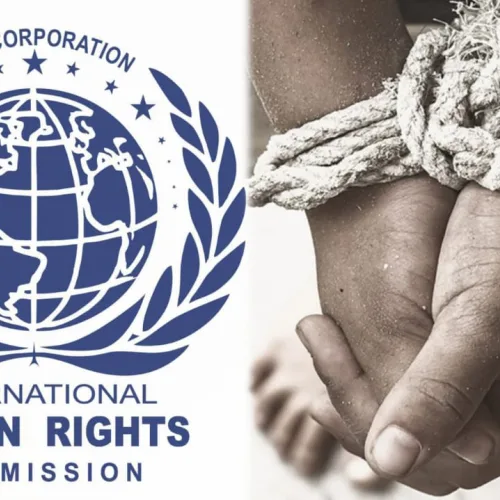
As the world marks the 2026 World Day Against Trafficking in Persons, the International Human Rights Commission (IHRC Corporation), also operating under the name INTERPOL Centre USA (ICA), has placed Nigeria’s children at the centre of a bold new policy initiative aimed at transforming the country’s response to child trafficking from rescue to prevention.
In a joint statement issued by the IHRC Secretary-General, Prof. h.c. Rafal Marcin Wasik, and the Head of Diplomatic Mission, IHRC Corporation Mission in the Federal Republic of Nigeria, H.E. Ambassador Duru Hezekiah, to commemorate this year’s World Day Against Trafficking in Persons, the Commission stressed that Nigeria must move beyond responding to trafficking after exploitation has occurred and instead invest in stronger prevention systems, institutional resilience, and community ownership capable of stopping exploitation before it begins.
The initiative is being championed by the Headquarters of the International Human Rights Commission – IHRC Corporation, Washington, D.C., United States, through its Mission in the Federal Republic of Nigeria, in strategic partnership with the National Agency for the Prohibition of Trafficking in Persons (NAPTIP).
It is anchored on the forthcoming Nigeria Child Protection Compact (CPC) Readiness Assessment and Strategic Framework (2027–2032), a comprehensive policy framework designed to strengthen Nigeria’s preparedness for a more coordinated and sustainable response to child trafficking.
The development comes shortly after the renewal of the strategic partnership between IHRC Corporation and NAPTIP, a collaboration that has further reinforced joint efforts in policy development, institutional engagement, human rights advocacy, capacity strengthening, and the promotion of sustainable strategies for preventing trafficking in persons.
The Commission explained that the CPC Readiness Assessment is not intended to replace Nigeria’s existing anti-trafficking policies. Rather, it seeks to complement national priorities by identifying strategic opportunities to reinforce prevention, strengthen inter-agency coordination, expand community participation, and support institutional preparedness for a more integrated child protection system.
It further noted that the Framework aligns with Nigeria’s commitment to addressing trafficking in persons through collaborative partnerships, evidence-based policymaking, internationally recognised child protection principles, and sustainable community engagement. A key innovation of the Framework is the proposed National Community-Based Child Protection and Anti-Trafficking Prevention Platform (NCCPATPP), designed to strengthen grassroots prevention, early warning, and coordinated community action against child trafficking.
As activities commemorating the World Day Against Trafficking in Persons continue, the Commission called on governments, development partners, security agencies, civil society organisations, faith-based institutions, the private sector, traditional leaders, educational institutions, and citizens to recognise that the fight against trafficking begins long before exploitation occurs.
For the IHRC Corporation, the message is clear: the future of child protection lies beyond rescue. It lies in preventing exploitation before it starts, empowering communities to recognise risks early, strengthening institutions to respond effectively, and building a Nigeria where every child can grow in safety, dignity, and hope.
The Nigeria Child Protection Compact (CPC) Readiness Assessment and Strategic Framework (2027–2032) is expected to be published in the coming weeks as part of the Commission’s ongoing efforts to advance child protection, strengthen strategic partnerships, and support sustainable anti-trafficking efforts in Nigeria.
Comments
Start the conversation about this story.