





The son of Nigerian football legend, Teslim “Thunder” Balogun, Kayode Balogun, has called for his late father’s legacy to be preserved, warning that the government must not allow the icon’s memory to fade, as the family marked 54 years since his death.
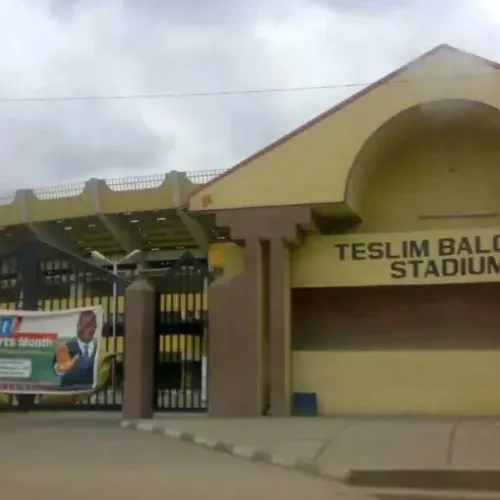
Kayode said the greatest honour paid to his father by the Lagos State government was the naming of the multi-purpose stadium in Surulere after him, though he lamented that little activity now takes place at the venue.
“Government must not allow my father’s legacy to die. There should be sporting activities there to keep the place booming,” he said.
Balogun, one of Nigeria’s greatest footballers, died in his sleep at Ibadan, Oyo State, at the age of 45, in circumstances his family says remain a mystery. Kayode recalled the morning of his father’s death in vivid detail.
“When he got back home from work the evening before his demise, he was in his usual self, jubilant and cheerful. After a light shower, he took his dinner. We all went to bed, no complaints. Early in the morning, we were woken up by a scream from Dad’s bedroom,” he said.
“It was mummy. When we rushed to the bedroom to find out what happened, we saw mum just screaming and pointing at our daddy, lying still on the bed. A few neighbours came in after hearing mum’s scream. She called a doctor who came in moments later and confirmed that our father was dead. Later, they took the body to the morgue. To date, we still don’t know what killed him.”
Balogun married Alhaja Mulikat Balogun in 1955. Before their marriage, Mulikat was a table tennis player and was introduced to Balogun by sports enthusiast, the late Chief Molade Okoya-Thomas.
She joined him in London in 1956 while he played for Queens Park Rangers and later became the pillar of the family after his death, raising their eight children.
Renowned for a fearsome shot that earned him the nickname “Thunder”, Balogun represented the Nigerian national team for 12 years and was a member of the famous UK Tourists side.
He won the Governor’s Challenge Cup a record five times from seven finals, playing for Nigerian clubs including Marine Athletics, Pan Bank, Jos XI, UAC and Railway, as well as English sides Peterborough United and Queens Park Rangers.
He went on to become the first African to qualify as a professional football coach. According to Kayode, it was former Premier of Western Nigeria, Chief Obafemi Awolowo, who persuaded Balogun to return home from England to help develop the game in the region.
“While in England, the former Premier of Western Nigeria, Chief Obafemi Awolowo, persuaded my father to return and help develop the game in the region. He heeded the call, came back and took Western Nigeria to their first Challenge Cup triumph,” Kayode said.
Balogun later led the Nigerian national team at the 1968 Summer Olympics in Mexico, where, after defeats to Japan and Spain, they held Brazil to a 3-3 draw.
As a coach, Balogun was known for discovering and developing talent, grooming the likes of the late Chief Adegboye Onigbinde and coach Jossy Lad. Another of his children, Engineer Olamide Balogun, remembered him as a devoted family man.
“He was a man who loved his children and ensured he was close to them. He visited us at school and helped in whatever way he could to make us happy and comfortable,” he said.
Comments
Start the conversation about this story.