





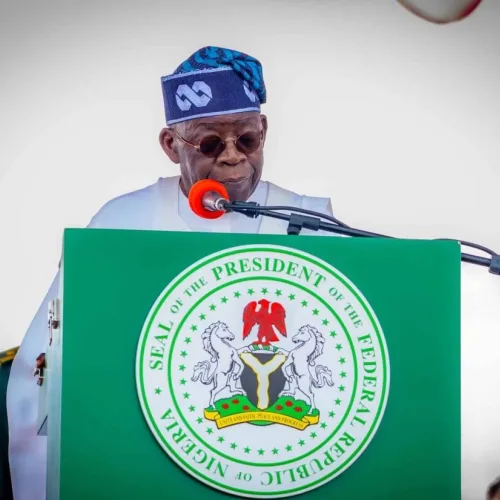
President Bola Ahmed Tinubu has advised state governors to prioritise the construction of roads over flyovers in locations with little traffic, saying improved federal allocations should be invested in projects that enhance the quality of life and strengthen security and access to underserved communities.
The President said states now receive between four and five times their previous allocations from the Federation Account, giving them greater capacity to execute meaningful infrastructure projects.
Tinubu spoke on Thursday while receiving a delegation of traditional rulers from Oyo State led by the Olubadan of Ibadanland, Oba Rashidi Ladoja. The monarch and his delegation visited the President to congratulate him on the rescue of schoolchildren and teachers abducted in Oriire Local Government Area after spending 56 days in captivity.
Addressing Ladoja and other members of the delegation who had previously served as governors, Tinubu said, “The cost of operation is high. But the money that I’m pushing to the states, if you had it during your own time, or during my time, it would have been different.
“They are taking four to five times their money. Nobody is borrowing money to pay salaries now. Pensioners are receiving their pay.
“They should do more instead of building flying over where there is no numeric traffic; build roads and artery networks to really enhance the quality of life and the accessibility of the security agencies to penetrate those areas.”
The President also disclosed that terrorists behind the abduction of the Oriire pupils and teachers demanded the release of detained members of their group in addition to ransom, but the Federal Government rejected the request.
He said the incident prompted his administration’s decision to increase the Nigerian Army’s operational divisions from eight to 12, explaining that the expansion would improve response time and strengthen the military’s ability to tackle terrorism and banditry across the country.
Tinubu maintained that his administration would not negotiate with terrorists or pay ransom for the release of victims.
ALSO READ: How I struck late UNIJOS graduate three times with wooden plank — Suspect
Speaking publicly on the incident for the first time since the victims were rescued on July 10, he said, “We refuse to negotiate for ransom. These criminals wanted us to release from detention members of their criminal gangs that were already arrested, that was one of their conditions, outside of the money they were looking for.
“And we said no deal. We are not going to negotiate with criminals.
“They committed murder, and we were ready to finish with their families, members of their own communities. They grew up somewhere.”
The President praised the armed forces for their role in the rescue mission, saying, “I agree that we should commend the men and women of the armed forces for their excellent performance.
“On behalf of them, I accept your message, and I will forward the same thing and the same message on.”
Tinubu said the successful operation was made possible by the military’s understanding of the terrain, adding that every security challenge provided lessons that shaped future strategies and operations.
“As we emphasise the question of security, each event teaches us new methods, opens our eyes, challenges us to examine and re-examine our architecture, our strategy, our map and operations.
“And you will have seen we’ve given a geographical and numerical answer to the challenges.
“We refused to pay ransom. We have the geography of the forest. We know what it is, and in answer to it, you’ve seen that from eight divisions, we are now moving to 12 divisions, to shorten the response time, to give that response time the teeth that is needed for us to defeat terrorism and banditry,” he said.
The President further said the Federal Government was moving ahead with plans to establish state police, noting that safeguards would be put in place to prevent abuse while traditional rulers would also play a role in the new policing structure.
“It is very necessary, and we are doing so. We have equally embarked upon what was missing; several decades of fears and uncertainty about what to do about security at the local level will be corrected.
“There will be state police, and that state police will have guardrails from abuses.
“We will protect it from abuses, and you traditional rulers too will have a role to play more.”
Comments
Start the conversation about this story.