





It’s been 10 years since Apple removed the headphone jack from the iPhone. Yes, you can get excellent wireless earbuds nowadays, but maybe you prefer plugging in or don't want to charge your headphones. The joy of the 3.5-mm headphone connector is its universal compatibility. You can use any pair of corded headphones—no need to worry about connectivity blips, batteries dying, dongles, or misplaced earbuds.
There are times when Bluetooth is preferable, but having the option is nice. Unfortunately, every year, another major manufacturer decides to cut the headphone jack from the feature list. In 2025, that was Samsung, which no longer offers the venerable port on its Galaxy A-series phones. But don't lose hope! You still have some options, like Motorola's Moto G Stylus 2026. These are the best phones with the headphone jack.
Read our Best Android Phones, Best Samsung Phones, Best Motorola Phones, Best Pixel Phones, Best iPhones, and Best Cheap Phones guides for more.
Updated July 2026: We've added the Moto G Stylus 2026.
What Happened to the Headphone Jack?
It all began when Apple removed the port on the iPhone 7 in 2016—yes, technically Oppo did it first, but Apple's decision sparked an industry trend. Apple famously cited space-saving reasons to make the phone slimmer and fit a bigger battery, but it was also to nudge along the burgeoning wireless headphone market. (Guess who sits at the top right now?) Since then, other companies followed swiftly until the port was found only on budget and midrange phones.
Now, cheap phones are beginning to lose the port, likely because you can buy decent wireless earbuds for as little as $30 these days. The 3.5-mm port will likely disappear entirely from all smartphones within the next few years.
Does Plugging In Improve Audio Quality?
Yes, plugging in a pair of wired headphones means the audio is not compressed, so it can transmit more detail, offering a higher-fidelity audio experience. There's also little or no latency, meaning there's no delay between the music coming from your phone and the audio playing through the headphones. Wired connections also offer zero connectivity issues, and you won't have to worry about battery life. Some wired earbuds also have physical buttons for music playback controls, which always beats out the finicky touch controls on most earbuds.
On the other hand, today's Bluetooth codecs are significantly better than those from even five years ago. Most people will not hear a major difference in audio quality between wired and wireless headphones.
You Can Use a USB-C Dongle
Not having a 3.5-mm port doesn't mean you can't use wired headphones with a smartphone. You can buy a USB-C headphone dongle that plugs into your smartphone's USB-C port and adds a 3.5-mm port.
Apple USB-C to 3.5-mm Adapter for $9. This adapter from Apple will work with any smartphone with a USB-C port—that means Android phones and the iPhone 15 and newer. I recommend buying a few because they’re easy to lose. If you have an iPhone with a Lightning port (iPhone 14 or earlier), you'll need to use a third-party dongle, as Apple has officially discontinued its adapter.
Google USB-C Earbuds for $31: Alternatively, you can use USB-C earbuds. They're standard wired earbuds, but instead of a 3.5-mm connector at the end, there is a USB-C connector that plugs into your phone's charging port. I've used these Google earbuds for a few years—they sound decent and are cheap. You can probably find plenty of other USB-C headphones, but make sure you check reviews to see what's worth your money.
What Happened to Asus Phones?
Asus was one of the few companies churning out flagship smartphones with the headphone jack. Sadly, the company confirmed earlier this year that it is exiting the mobile business altogether—say goodbye to the Zenfone and ROG Phone series. It'll continue supporting the phones as promised, but there are no new device launches for 2026. The company claims it's a “temporary” pause, so there's always a chance it could return to the market.
Best Overall
Photograph: Julian Chokkattu
Photograph: Julian Chokkattu
Photograph: Julian Chokkattu
Motorola
Moto G Stylus 2026
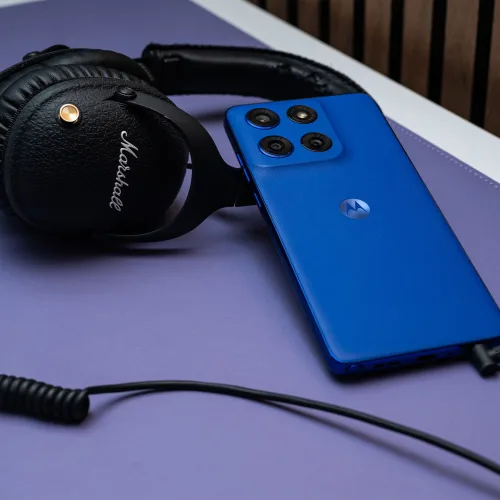
If a headphone jack is a must-have on your next phone, Motorola's Moto G Stylus 5G 2026 is hands-down your best option. Not only does it have the jack, but it also stores a stylus inside, an embarrassment for any other company that cited space-saving reasons to nix the port. The problem is that Motorola didn't add much new in the 2026 iteration, yet it upped the price—it even has the same processor as the 2025 model but less storage to start. That's par for the course with most electronics these days.
Performance is completely fine, thankfully, and you get a 120-Hz, 6.7-inch OLED screen. It's slim, despite the 5,200-mAh battery, which can last two full days with light to average use. The 50-megapixel main camera is reliable day or night as long as you keep still when tapping the shutter button and your subject isn't moving; otherwise, you'll get a lot of blurry images.
Even if it now starts with 128 GB of storage, there's a microSD card slot to expand space, something you won't find on most smartphones these days. It also sports wireless charging and an IP68/69 rating so it will survive an accidental drop in the pool. Motorola's offering two Android OS upgrades and 3 years of security updates, which is not great considering the price of this phone—the Google Pixel 10a, for example, will receive seven years of blanket updates.
At $500, it's not great value like its predecessors, but if you can find it on sale, this is still one of the only phones on the market with good performance, a headphone jack, a microSD card slot, and an embedded stylus, if you care about that perk.
Runner-Up
Photograph: Julian Chokkattu
Photograph: Julian Chokkattu
Photograph: Julian Chokkattu
Motorola
Moto G Power 2026
Motorola may have cut wireless charging from the 2026 iteration of the Moto G Power, but thanks to some under-the-hood optimization, it performs better than its predecessor. That's a fine trade-off, though it's odd considering the two phones are powered by the same MediaTek Dimensity 6300 chip with 8 GB of RAM. Yes, you'll still notice some slowness here and there—it's a step down from the Moto G Stylus, after all—but it's not a stuttery experience. The other notable hardware upgrades are an improved selfie camera and a slightly larger 5,200-mAh battery capacity.
Battery life is the next best thing about this phone, easily lasting two days with average use. The 6.8-inch LCD screen is bright and sharp enough, and the phone is IP68/69-rated to survive dips in the pool and inclement weather. Don't expect much from the camera system. If you have steady hands, you can capture passable photos from the 50-MP primary shooter, though it struggles in low light and high-contrast scenes. Introduce any kind of handshake, and you'll get a blurry photo.
If you can deal with those flaws—including the limited software policy of two Android OS upgrades and three years of security updates—the Moto G Power 2026 still checks off a lot of boxes for its $400 price. (Yes, it originally was $300, but Motorola jacked the price by $100.) It has NFC for contactless payments, a microSD card slot to expand on the 128 GB of storage, and, naturally, the coveted headphone jack.
Comments
Start the conversation about this story.