






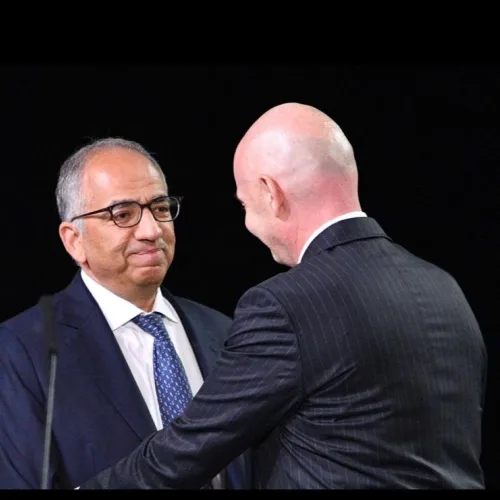
The crisis surrounding FIFA President Gianni Infantino’s controversial proposal to sell a minority stake in the commercial rights of the FIFA World Cup deepened on Friday after his Senior Adviser, Carlos Cordeiro, resigned in protest over the plan.
Cordeiro on Friday announced his immediate resignation, saying he could not support a proposal that would allow private investors to acquire an ownership stake in football’s biggest tournament through FIFA’s proposed commercial subsidiary, FIFA Forward Enterprise (FFE). Blueprint reports
His departure marks the most significant internal opposition yet to the proposal and piles further pressure on Infantino, who has faced mounting resistance from football’s continental governing bodies and several national associations.
The former United States Soccer Federation president described the proposal as harmful to FIFA’s 211 member associations and warned that it could undermine the long-term future of world football.
Cordeiro rejects proposal
Explaining his decision, Cordeiro stressed that he had no involvement in developing the proposal and could not remain in office while FIFA pursued what he described as a damaging course.
He argued that FIFA is already financially strong and has no need to sell part of its most valuable commercial asset.
According to him, the governing body generated about 15 billion dollars in revenue between 2022 and 2026, has substantial financial reserves and carries no debt, making the proposed transaction unnecessary.
Cordeiro maintained that football’s greatest competition should be preserved for future generations rather than treated as a commercial asset for outside investors.
His resignation follows only days after FIFA formally unveiled plans to create FIFA Forward Enterprise, a new commercial entity through which the organisation intends to sell up to a 20 per cent stake to private investors while promising increased development funding for member associations.
Continental bodies intensify opposition
The resignation comes amid growing resistance from football’s continental confederations.
UEFA has already declared that all its 55 member associations unanimously oppose the proposal, insisting that the FIFA World Cup is not for sale and warning that private ownership would fundamentally alter the governance of international football.
The European governing body argued that introducing external investors would place commercial returns above the interests of players, supporters, clubs and national associations.
UEFA also criticised FIFA for allegedly developing the proposal without meaningful consultation, describing the process as lacking transparency and proper governance.
Opposition has since spread beyond Europe.
Reports indicate that the Confederation of North, Central America and Caribbean Association Football (CONCACAF) and the Asian Football Confederation (AFC) have also voiced serious concerns over the proposal, increasing pressure on FIFA to reconsider its plans.
Proposal sparks global football debate
At the centre of the controversy is FIFA’s proposal to establish FIFA Forward Enterprise, a commercial company expected to manage the business rights attached to the World Cup and other FIFA competitions.
The organisation intends to attract billions of dollars in private investment through the sale of a minority stake, arguing that the initiative would generate additional funding for football development worldwide.
Under the proposal, member associations that support the initiative would receive significantly increased development funding, while those rejecting it would receive considerably less, a move critics have described as coercive.
Supporters believe the investment could unlock new commercial opportunities and expand FIFA’s development programmes.
Critics, however, fear that allowing private equity firms to acquire ownership interests could permanently shift football’s priorities towards profit rather than sporting integrity.
Many also argue that investor influence could eventually affect decisions relating to competition formats, scheduling and commercial strategy.
Pressure mounts on Infantino
Cordeiro’s resignation represents a major political setback for Infantino at a time when opposition to the proposal appears to be gathering momentum.
Having served as one of the FIFA president’s closest advisers since 2021, Cordeiro was regarded as an influential figure in shaping the organisation’s commercial strategy.
His decision to step down publicly and criticise the proposal has intensified scrutiny of FIFA’s leadership and governance.
Analysts believe the growing coalition of opposing member associations could significantly complicate FIFA’s efforts to secure approval for the proposal before the planned September deadline.
The widening resistance has also fuelled speculation that the dispute could become one of the most consequential governance battles in FIFA’s modern history.
Future of proposal uncertain
Despite the backlash, FIFA has indicated that the consultation process with its member associations will continue before any final decision is taken.
Whether the proposal ultimately survives may depend on the outcome of discussions among FIFA’s 211 member associations, many of whom must now weigh the promise of increased development funding against concerns over the future ownership and governance of the sport’s most prestigious competition.
For now, Cordeiro’s resignation has added fresh uncertainty to an already divisive debate, leaving FIFA facing one of its biggest governance challenges in recent years as the battle over the future commercial ownership of the World Cup intensifies.
Comments
Start the conversation about this story.