





By Ijendu Iheaka, News Agency of Nigeria (NAN)
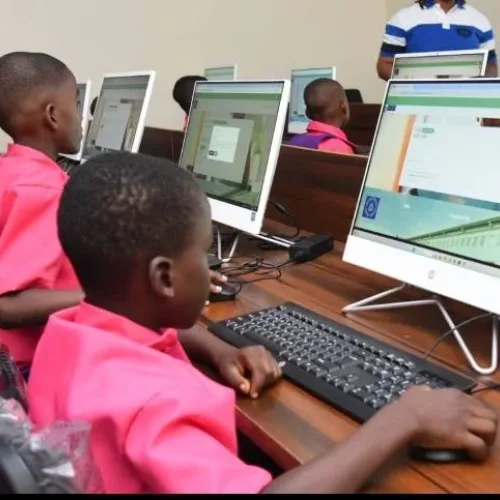
A digital display board stands at one end of a classroom as pupils listen attentively while their teacher, Ms Chidimma Ojo, explains the different parts of a computer.
The images shown on the large screen are also displayed on the computers placed on the pupils’ desks, making technology a regular part of their learning.
A few metres away, a young pupil lies on a hospital bed at the school’s sickbay as two nurses attend to him.
One of the nurses uses an iPad to connect with a medical consultant, who provides guidance on the child’s treatment.
The scenes reflect the learning environment at the Umuomayiukwu Nsulu Smart School in Isiala Ngwa North Local Government Area of Abia, one of the technology-enabled schools established by the state government to transform basic education.
The facility represents a shift from the conventional classroom model, where learning largely depends on textbooks and traditional teaching methods, to an environment where digital tools, innovation and practical skills are integrated into education.
The transformation comes at a time Nigeria’s education sector continues to face challenges of access, infrastructure gaps, poor learning outcomes and the need to prepare young people for a rapidly changing global economy.
In spite of several government and development interventions, millions of Nigerian children remain outside the formal education system.
The UN Children’s Fund (UNICEF) estimates that about 10.5 million children of primary school age are out of school in Nigeria, placing the country among nations with the highest number of out-of-school children globally.
Similarly, data from the National Bureau of Statistics (NBS) and UNICEF indicate that about 18.3 million children aged between six and 17 years are not attending school.
Beyond enrolment, education stakeholders have emphasised the importance of improving learning outcomes and equipping children with digital literacy, creativity, critical thinking and problem-solving skills required in the 21st century.
Against this background, the Abia Government said the Smart School initiative was designed to address emerging educational needs by combining modern infrastructure with innovative teaching approaches.
The Umuomayiukwu Nsulu Smart School, which was originally established in 1953 through the efforts of community leaders and the Anglican Church, once served as a centre for educating children in the area and neighbouring communities.
The school played a major role in expanding access to basic education at a time when many children had to travel long distances to attend school.
However, over the years, inadequate maintenance and changing educational realities contributed to its decline, leaving the facility in poor condition and with fewer pupils.
The school has now been transformed into a modern learning centre under Abia’s Smart School programme, aimed at preparing children with skills relevant to the demands of the digital age.
The Umuomayiukwu Nsulu Smart School is the second completed facility under the initiative, following the inauguration of the first at Ogbor, Ubakala in Umuahia South Local Government Area in July 2026.
The state government said it began the construction of 20 Smart Schools across the 17 local government areas in 2024 as part of efforts to strengthen basic education and equip learners with future-oriented skills.
The Smart School concept, which originated in Malaysia in 1999, has gained global attention as a model that integrates technology with innovative teaching methods.
For Abia, the initiative represents a move away from a system focused mainly on examination performance towards one that encourages creativity, collaboration, innovation and practical problem-solving.
At the inauguration of the Smart School, the Commissioner for Basic and Secondary Education, Mr Goodluck Ubochi, said the project demonstrated the government’s commitment to improving education quality across the state.
He said transforming education required sustained investment, effective planning and a long-term commitment beyond individual projects.
“Today’s ceremony demonstrates that the transformation of education in Abia is not a one-time achievement but a progressive, deliberate and sustained journey.
“It reflects our commitment to building a future where every child, irrespective of location and background, can learn in an environment that nurtures creativity, critical thinking, innovation and digital excellence,” Ubochi said.
Similarly, the Executive Director of the Abia State Universal Basic Education Board (ASUBEB), Mrs Lydia Onuoha, said the Smart School model was developed to prepare pupils for participation in a technology-driven economy.
 Umuomayiukwu Nsulu Smart School in Isiala Ngwa North Local Government Area of Abia,
According to her, the initiative aligns with the state’s education reform agenda by combining infrastructure development with modern learning approaches.
“The Abia Smart School model represents a paradigm shift in educational delivery, combining technology with innovative pedagogical approaches to create future-ready learning environments.
“The aim is to transform traditional schools into centres of excellence that harness artificial intelligence, virtual reality and adaptive learning technologies while ensuring sustainability through renewable energy integration,” she said.
Onuoha explained that the Smart School journey began with the Blue Giraffe Team, which developed and delivered a model facility at Okaliagwu Village in Ohafia Local Government Area in 2024.
She said the pioneer facility featured solar panels, battery storage systems, interactive smart boards and internet connectivity to create a digital learning environment.
She added that the Umuomayiukwu Nsulu Smart School, with a capacity for 300 pupils, currently accommodates 261 learners supported by 23 trained teachers.
The facility includes 10 classrooms, an early childhood care and development centre, an inclusive classroom, a library, an information and communication technology (ICT) centre with internet access, a sickbay and a dedicated space for girls.
Beyond physical infrastructure, Onuoha said the schools would incorporate artificial intelligence-enabled personalised learning, immersive Science, Technology, Engineering and Mathematics (STEM) experiences through virtual and augmented reality, as well as continuous teacher development.
She said the government had also developed an operational framework to ensure proper maintenance of facilities and equipment.
Meanwhile, Pastor Caleb Ajagba, Chief of Staff to Gov. Alex Otti, described the project as an investment in the future of Abia children.
Ajagba, whose political ward hosts the school, urged residents to protect the facility and support government efforts aimed at improving education.
He said sustaining the project would ensure that future generations continued to benefit from the investment.
Speaking at the event, Gov. Alex Otti said the purpose of education should go beyond producing graduates with certificates to developing individuals capable of creating solutions and contributing meaningfully to society.
He said the Smart Schools were designed to encourage experiential learning and help pupils acquire skills relevant to a technology-driven world.
“The smart schools represent our commitment to long-term development because, in this new age, prosperity is increasingly tied to the value of the mind’s output, the capacity to create value and transform ideas into solutions,” Otti said.
The governor announced that about 6,000 pupils across rural and urban communities in Abia would benefit as more Smart Schools become operational.
He urged pupils to take advantage of the opportunities provided by the facilities, remain committed to learning and develop the confidence to pursue their aspirations.
It may be recalled that at the inauguration of the Ogbor Central Smart School, Ubakala, the Minister of Education, Dr Tunji Alausa, commended Gov. Alex Otti for his investment in education and human capital development.
Alausa said sustainable development was not measured only by physical infrastructure such as roads and bridges but also by deliberate investments in education and the intellectual capacity of citizens.
He said the Smart Schools would provide Abia children with learning opportunities comparable to those available to children in advanced economies.
“When you have a governor who is committed and who thought and said, ‘I am going to build a smart school’, not just one, not two, not three, not four, 10 or 20, that is a governor who cares for the people.
“Today, your kids and Abia children will sit in this school. They will get the best educational material that a child in America or in London would get, and also have it right here in this community.
“They will learn how to use AI. Five years from now, 10 years from now, Abia will lead the world,” Alausa said.
However, education observers noted that technology alone would not resolve all the challenges confronting Nigeria’s education sector.
They stressed that the sustainability of the Smart School initiative would depend on consistent funding, regular maintenance of facilities, continuous teacher training, reliable electricity supply and ensuring access for children in surrounding communities.
They also emphasised the need to balance digital learning with foundational skills such as reading, writing and critical thinking, which remain essential for lifelong learning.
For Abia, which has historically placed emphasis on education and human capital development, observers said the success of the initiative would depend on how effectively technology is integrated into teaching and whether pupils can apply the knowledge acquired beyond the classroom.
As the state works towards completing its planned Smart Schools, analysts believe the initiative could contribute to preparing young learners for the demands of the global knowledge economy if supported by strong policies, effective implementation and sustained investment. (NANFeatures)
Comments
Start the conversation about this story.