





The Power Glove’s one-minute-plus cameo in 1989’s The Wizard wasn’t the first time wearable tech made a splash in pop culture, but it’s the one that got me and countless others hooked on wearables nearly two decades before we ever bought our first Fitbits.
If you haven’t heard of The Wizard, it’s essentially a 90-minute-long Nintendo commercial in the form of a kids’ movie. The Odyssey-like tale follows a traumatized young boy, Jimmy Woods, who has a preternatural talent for playing Nintendo games and is rescued from an “institution” by his half-brother Corey, played by Fred Savage. They strike out for California, picking up Haley Brooks (Jenny Lewis) along the way. They catch wind of a video game tournament in California with a $50,000 grand prize, which everyone agrees Jimmy could absolutely win, if only they could find their way through all of the Nintendo product placement littering the film to get there.
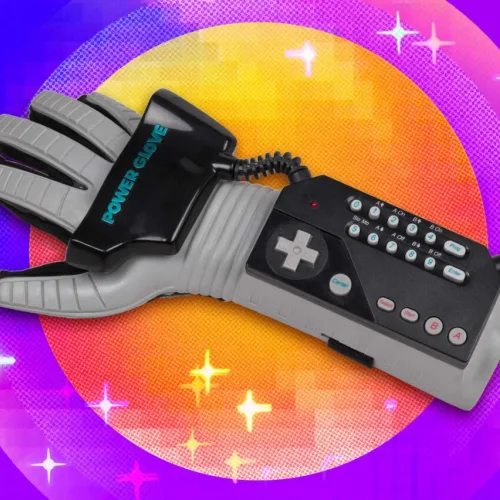
As an eight-year-old, I ate this sh*t up. The Wizard was the first film I can remember that spoke to my favorite interest, video games, and I was enthralled by it. Not only did it give us our first look at the highly-anticipated Super Mario Bros. 3 before the game released in North America, it also showed us what I can only describe as “the future”: the Power Glove, a Nintendo controller you wore on your arm that let you play NES games using gesture controls.
The Power Glove wrecks the brains of a generation
To the adolescent mind, the Power Glove was the ultimate flex. It had all the prerequisites for being cool: it was expensive, it was exclusive, and the only character seen using the Power Glove is the film’s bad-boy child villain Lucas, so you know it wasn’t for dorks. We all wanted it and tried to aura farm it by lying to our classmates that our cousins, who lived somewhere that was definitely not within walking distance, had one.
Now, I’ve never even seen a Power Glove in person, much less used one, and this is probably for the best. The Power Glove was a terrible product that was officially supported by just two games and would only work with unsupported games through complex input programming.
Nintendo, which only licensed the Power Glove and was not involved in its development, rushed it out the door to get it on the shelves for Christmas 1989. It managed to sell close to 2 million units at about $100 apiece (about $250 today), largely off the back of an aggressive marketing campaign that included The Wizard, and so it was actually a commercial success.
But the rushed release meant there wasn’t enough time for game studios to develop and ship new titles to support its launch, and there was no way to go back and add in official Power Glove support for games that had already been released. The two games that did support the Power Glove sold terribly, and, seeing the writing on the wall, Nintendo pulled the Power Glove off the shelves after only a year.
The whole thing is one of those fleeting cultural moments that was always destined to take on mythical status, and for many of us, it did more than just provide reliable nostalgia bait as adults; it influenced how we look at wearables today.
Wearables have always been future-coded
The fact that the Power Glove was hot garbage doesn’t matter. What mattered to us back then was that it represented a technical capability just beyond our grasp and looked cool in the process, something that had a profound effect on our young brains. This experience wasn’t unique to us, though.
In 1946, the comic detective Dick Tracy started sporting a radio strapped like a watch to his wrist, and by the 1960s, the watch had evolved into a two-way radio, something that didn’t just predict the smartwatch decades ahead of time; it helped lay the cultural foundation for the future wearable’s development (Apple CEO Tim Cook loved Dick Tracy comics as a kid).
Likewise, the recent attempts at making AI-powered pins are clearly riding on the appeal of Star Trek-style communicator badges, even if their actual implementations were abominable. Meanwhile, having a pair of glasses act like a digital heads-up display or translator for the wearer has long been a science fiction trope, so seeing smart glasses make a comeback after Google Glass’s failure shouldn’t be a surprise.
There is something about wearing a piece of technology that grabs hold of our imaginations in a way that other innovations do not. Futuristic tech in people’s hands simply doesn’t have the same feel to it. The titular Predator from the iconic 1987 film could just have easily carried a futuristic plasma rifle in its hands as it stalked Arnold Schwarzenegger through a jungle, but that would have made it an alien mirror to the gun-toting heroes, which is boring. Put that plasma rifle on its shoulder, though, and it’s like it gained a third arm that gave it an unfair advantage against its human prey. Now you’ve got a movie.
The wearability of technology implies something more advanced, something more capable and “smarter” than handheld tools, even very advanced or futuristic ones. I’m sure there are complicated psychological reasons for why that is, but I really think it just comes down to us being a bit lazy.
Wearables point to a future where things are easier
There’s very little difference between the Predator and Lucas Barton in The Wizard in this regard: they both get ahead of the rest of us (at least initially) by virtue of the tech they wear. Their wearables make their job easier, while the rest of us have to fumble through life with our hands to get things done, and that sounds too much like work for our liking.
I’ve played video games for as long as I can remember and have always loved them, but seeing the Power Glove in The Wizard made me believe that there was a hidden layer between the video game and myself that only the Power Glove could reach across. While I tried to work buttons and the D-pad to steer a car, the Power Glove could let me actually drive the car by turning an imaginary steering wheel, exactly like I would if it were the real thing.
I was a kid at the time, so I wasn’t exactly seeing it through the lens of labor. The fact that it was the coolest thing ever was just self-evident to me and all my friends, but the Power Glove’s appeal was that it promised to do away with the work needed to achieve immersion in a video game, namely translate my intentions into specific button presses. Instead, I could just make my way through any game with natural, intuitive gestures, like punching, finger-gunning, or any other interaction that a game called for as I would in real life, no extra steps needed.
I obviously didn’t see how daunting a task this would be to actually program into not just one game but all games, being a kid and all, and I also never had the illusion of the Power Glove’s awesomeness spoiled for me by actually owning one, so there was nothing to speak against it. Instead, what I was left with was the vision of a world where things would be easier than they were at the time and more immersive, and that vision is ultimately what wearable tech in pop culture has always appealed to, for better or worse. It also happens to be what tech companies rely on to generate interest in new products as technologies improve.
Wearable technology is catching up to our cultural imagination
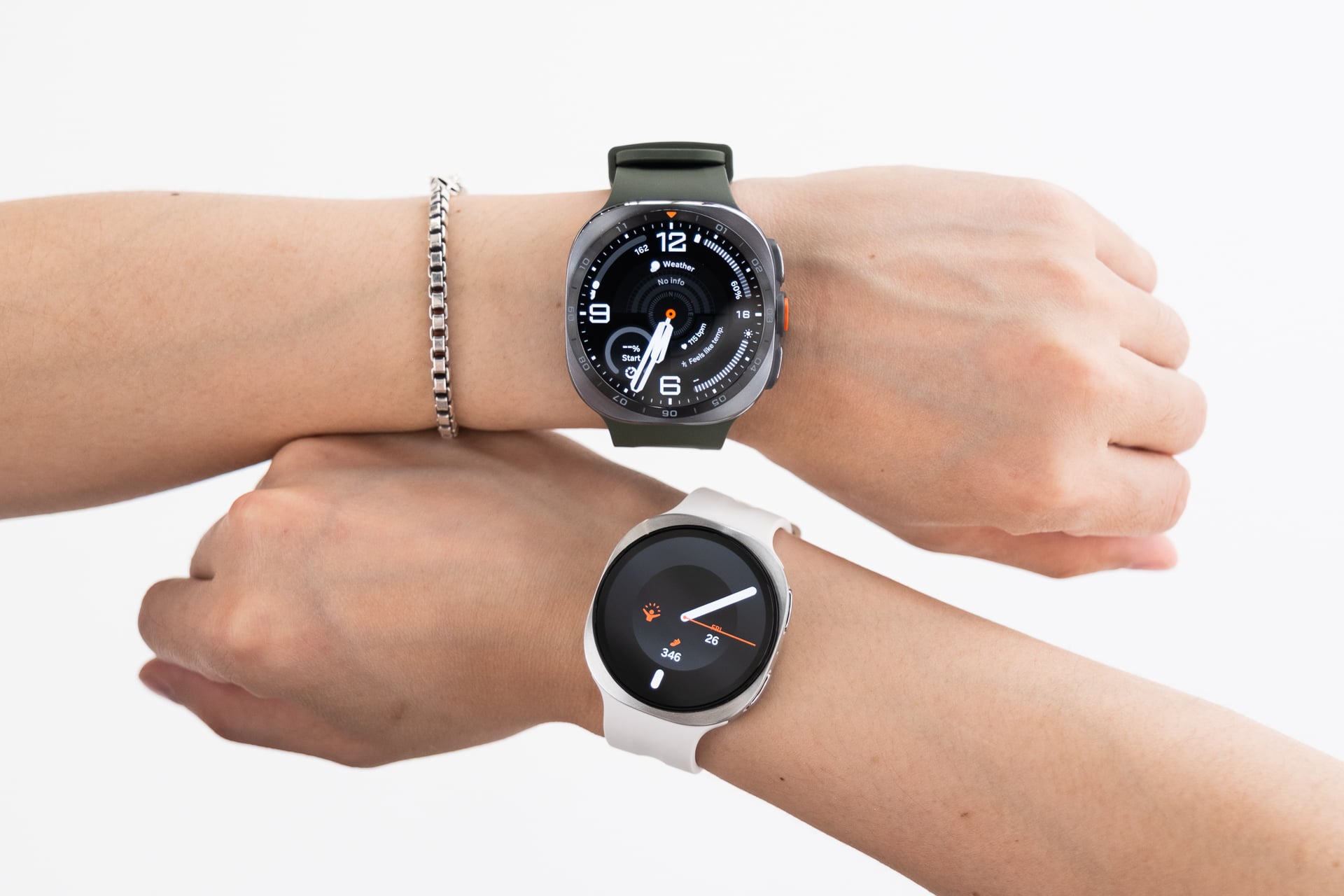 Smartwatches, like the Samsung Galaxy Watch Ultra 2 and Watch 9, owe a big debt to futurists and artists who dreamed them up in the first place. © Adriano Contreras / Gizmodo
 I grew up in a time before wearable electronics more advanced than a digital watch were possible. We could imagine strapping on a device that could do all kinds of cool stuff; we just couldn’t build any of it with the technology of the time. This made wearables science fiction, and our imaginations were fueled by the work of artists like William Gibson, John Carpenter, and even films like The Wizard.
What’s different now, though, is that all of the technologies required to make wearables work have caught up to the fiction of the past. The shrinking microprocessor, rechargeable batteries, wireless connectivity, and all the rest mean that you can put a computer with a camera, microphone, and speakers into a set of glasses and wear the whole thing around town. Mood rings used to be a scam, but as smart ring technology gets better, who’s to say what might be coming down the road, given what they can already do? The list goes on.
New technology isn’t enough to make a lucrative market on its own, though. There needs to be a base of consumers ready to spend on the new technology to get things going, and wearables owe a massive debt to the work of forward-thinking artists who helped prime the market with years, if not decades, of free advertising for products companies are only just now able to build.
So, was The Wizard part of a capitalist push to keep me consuming ever-new products and profits rolling in? Of course it was, but it worked, and not just on me. It worked on all of us. And while I might have moved on from the Power Glove (and gesture control for games more generally, sometimes things are best left in the childhood idyll), trying on a new wearable still feels like stepping a bit closer to that imagined horizon I glimpsed in the theater as a kid, and I suspect it always will.
Gizmodo’s The Next Interface is a series that explores the exciting—and perplexing—world of wearables in all of its evolving form factors. From fitness bands and smartwatches that track your heart rate to wireless earbuds and headbands that read your brainwaves to smart glasses that shove the internet closer than ever to your eyeballs, we’ll analyze them all with optimism and a healthy dose of skepticism.
Comments
Start the conversation about this story.