





By Elizabeth Nta
For most fans, the FIFA World Cup is about goals, national pride and the moment a captain lifts the trophy. But beyond the spectacle on the pitch lies one of the most powerful commercial systems in global sport a multi-billion-dollar machine built around access, attention and global demand.
On July 19, Spain defeated Argentina 1–0 after extra time to win the 2026 FIFA World Cup, concluding the biggest edition in the tournament’s history. The expanded competition featured 48 teams, 104 matches and was staged across 16 host cities in Canada, Mexico and the United States.
Yet the result was only one part of a much larger story.
Behind every match is an ecosystem where FIFA monetizes nearly every touchpoint of the tournament. It does not simply sell football it sells access to football. Broadcasters pay billions for the right to air matches, brands invest heavily to align with the World Cup’s global reach, and fans pay premium prices for tickets, hospitality and experiences.
According to FIFA’s revised 2023–2026 cycle budget, published via FIFA.com and first detailed in FIFA’s Annual Report presented at its 2025 Congress, the organization projected $8.911 billion in revenue for 2026 alone. Broadcasting rights were budgeted to generate $3.925 billion, marketing rights $1.786 billion, while ticketing and hospitality were projected to contribute 34 per cent of the year’s revenue.
These figures reflect more than just strong demand; they illustrate the underlying mechanics of the World Cup’s financial power. Broadcasters pay billions for the rights to air matches because the tournament consistently delivers one of the largest global audiences in sports, reaching billions of viewers across continents.
For television networks, it represents a rare advertising platform at an unmatched scale. Brands, in turn, invest heavily in sponsorship and marketing rights to align with that global visibility, using the tournament to reach diverse international markets within a single campaign cycle.
At the same time, fans drive the commercial engine through ticket purchases, premium hospitality packages, and exclusive experiences, turning access to the World Cup into a high-value commodity.
This commercial scale becomes even clearer when viewed across the full cycle. Speaking to representatives of FIFA’s member associations in New York on July 18, 2026, the day before the final, FIFA President Gianni Infantino said he believed FIFA “can top the $15 billion mark” in revenue for the full 2023–2026 commercial cycle. A FIFA spokesperson later confirmed the figure covers the entire four-year cycle, not the World Cup alone. The figure remains FIFA’s latest stated expectation pending final audited results, underscoring how the world cup operates not just as a tournament, but as a sustained global business model.
The expanded tournament also meant more money for the teams.
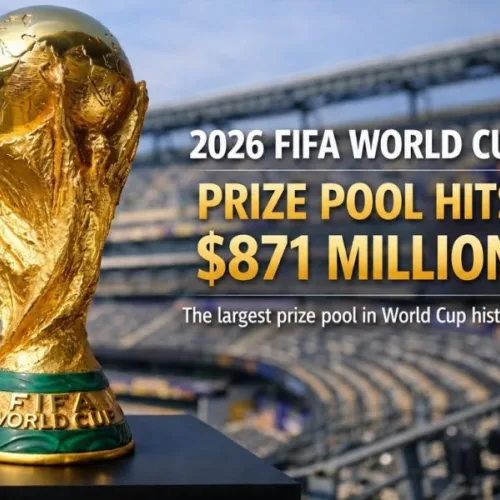
FIFA increased the total financial distribution for the 2026 World Cup to $871 million, according to a FIFA Council media release published on FIFA’s official site. Every participating team received $10 million in qualification money and $2.5 million in preparation funding, guaranteeing each team at least $12.5 million before performance-based prize money.
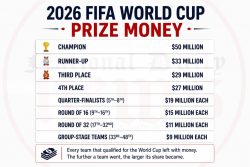
FIFA announced the increase at its 36th Council meeting in Vancouver on April 28, 2026, raising the total distribution from $727 million the figure the Council had originally approved in December 2025 to $871 million.
For fans, access to the stadium became its own market.
FIFA operated an official resale marketplace for eligible tickets. Under its own published ticketing terms, sellers paid a 15 per cent resale fee, while buyers also paid a 15 per cent fee.
Source: FIFA World Cup 2026 Ticketing FAQ, tickets.fifa.com.
Demand reached extraordinary levels during the 2026 final, where some resale listings reportedly approached $2.3 million per ticket a reflection of how scarcity and global attention drive value far beyond face price.
Even before resale, the 2026 final was dramatically more expensive than the previous World Cup final. The most expensive official (Category 1) seats for the 2022 Qatar final averaged around $1,600, according to Statista figures cited by Sports Illustrated, while the cheapest general-admission seats for the 2026 final started at more than $2,000, reinforcing the world cup’s positioning as both a sporting event and a premium global product
Sources: Statista, via Sports Illustrated; Gulf News.
Beyond revenue streams, the tournament also operates as a massive logistical and commercial operation. From team base camps to travel, accommodation and infrastructure across three host countries, the scale of coordination reflects an event designed not only for competition, but for global economic impact.
And at the centre of it all remains the most recognizable symbol of football the World Cup trophy.
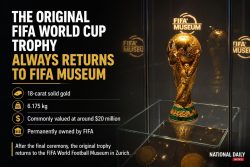
While Spain lifted the original trophy in celebration, it does not retain it permanently. The 18-carat gold trophy, valued at around $20 million and weighs 6.175 kilograms, remains FIFA property and is returned to its museum in Zurich after the tournament. Winners receive a gold-plated replica instead.
The Policy is rooted in an earlier chapter of football history. The original Jules Rimet Trophy, awarded permanently to Brazil after their third win in 1970, but the trophy was later stolen and never recovered. FIFA subsequently decided that the replacement trophy, introduced in 1974, would never permanently leave its ownership.
The Jules Rimet Trophy had already produced one of football’s strangest stories.
In 1966, it was stolen during a public exhibition in London ahead of that year’s World Cup. A week later, a dog named Pickles found it wrapped in newspaper beneath a hedge a story documented in FIFA’s official history of the trophy and preserved in BBC historical archives.
Incidents like these helped shape FIFA’s decision to retain permanent ownership of the current trophy, reinforcing how tightly the organization controls its most valuable symbols.
Even this reflects the broader system: the World Cup is carefully structured, protected and managed not just as a sporting tradition, but as a global asset.
For fans, the tournament is defined by moments on the pitch.
For FIFA, it is defined by a complex commercial network built on broadcasting rights, sponsorships, ticketing, hospitality and global branding.
Forty-eight teams. 104 matches. Three host countries. Billions of dollars in motion.
The goals are what the world celebrates.
But behind every goal is a business built to make the world watch.
Comments
Start the conversation about this story.