





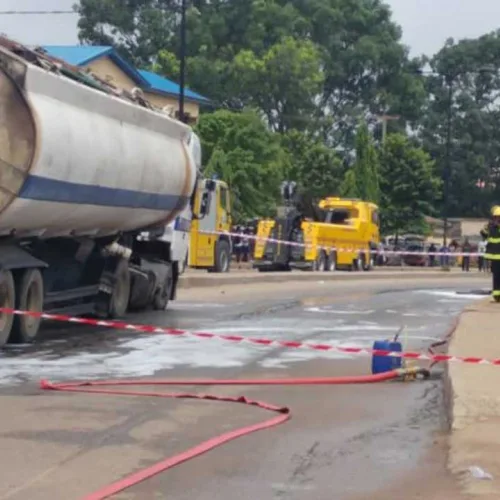
In a striking display of desperate survival over personal safety, dozens of residents in Delta State rushed onto a public road with plastic buckets, basins, and jerrycans to scoop fuel from a damaged Rainoil tanker, braving the immediate risk of a catastrophic explosion.
Driven by soaring petrol prices following the removal of fuel subsidies and mounting economic hardship, men, women, and youths repeatedly dipped containers into the pooling liquid and rising vapour cloud. The high-risk gathering unfolded over several hours before emergency responders could secure the crash site, underscoring how financial pressure continues to push citizens toward life-threatening gambles despite Nigeria’s tragic history of fatal tanker blasts.
Video footage circulating on social media captured the chaotic scene along the busy thoroughfare. Fuel streamed onto the asphalt and soaked into the surrounding soil, creating a volatile atmosphere. Despite the imminent risk of ignition from passing traffic, shoe friction, or static electricity, crowd members continued to harvest the liquid.
Eyewitnesses reported that news of the spill spread rapidly through neighbouring communities, drawing large crowds within minutes of the tanker coming to a halt. Emergency services faced significant delays reaching the location, leaving the scene uncontained during critical initial hours while bystanders gathered the hazardous cargo.
The dangerous behaviour highlights the severe economic strain gripping many Nigerian households. Following subsidy removals and rising inflation, the cost of refined petroleum has skyrocketed, turning spilt fuel into a high-value commodity for struggling families seeking to power domestic generators or resell the petrol on the informal market to afford basic necessities.
Nigeria has a tragic history of spillage disasters. Over the past two decades, similar incidents in states such as Rivers, Benue, and Jigawa have resulted in massive explosions that incinerated hundreds of people in seconds. Safety experts reiterate that a single spark from a passing exhaust pipe or a mobile device can instantly transform a spill site into an inescapable fireball.
In response to the incident, public safety officials issued urgent warnings, reminding citizens that petrol vapours can ignite over long distances and that no financial relief from recovered fuel can compensate for the risk of severe injury or death.
Athekame Kenneth is a politics, economy, and finance reporter whose work is anchored in sharp investigative storytelling. He brings analytical depth to every piece, drawing on a strong academic foundation that includes a degree in Economics, an MBA in International Trade, and a minor in Petroleum Economics from Lagos State University, Ojo. His reporting blends rigorous research with a keen eye for hidden truths, delivering stories that illuminate power, policy, and the forces shaping everyday lives.

Comments
Start the conversation about this story.