






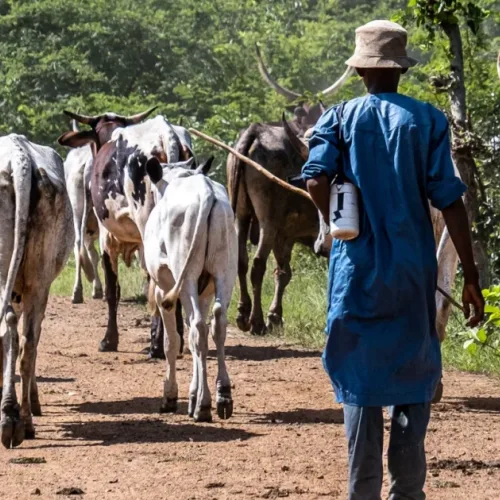
Image of a nomadic herdsman with his cattle used as illustration. Photo: “Fulani herdsman in Togo, West Africa” by Brendertogo via saisreview
At least 27 conflict and livestock movement alerts were recorded across seven frontline local government areas of Katsina and Zamfara states in June 2026 alone.
Community informants also warned that every case of late herd movement was likely to escalate into full-blown clashes between farmers and herders.
The figures are contained in the Transhumance Tracking Tool Dashboard 25, an early warning report by the International Organisation for Migration’s Displacement Tracking Matrix, obtained by Saturday PUNCH as the latest data on the recurring farmer-herder crisis in the North-West.
The IOM said it deployed the TTT to track transhumance movements and support peaceful coexistence between herders and farmers in the two states.
The tool draws on real-time reports from key informants from Community Peace Committees and local government-based teams, who flag either a conflict “event” or a livestock “movement” that could trigger a clash.
According to the dashboard, the 27 alerts logged in June included 21 event alerts and six movement alerts monitored in Batsari, Dan Musa, Jibia, Faskari and Safana LGAs of Katsina, and Bungudu and Gusau LGAs of Zamfara.
Events accounted for 78 per cent of all alerts, while sudden livestock movements accounted for 22 per cent.
By location, Gusau Local Government recorded the highest share of alerts at 26 per cent, followed by Bungudu with 22 per cent, while Batsari and Dan Musa each accounted for 11 per cent. Gada/Karakai Ward in Bungudu Local Government Area stood out as the single worst-hit location, recording six event alerts alone, the highest of any ward covered by the tool.
On livestock movements, the report disclosed that all six reported movement alerts in June involved animals arriving late, with a combined total of 957 cattle moving across states in Nigeria and into neighbouring regions of the Niger Republic.
It said every key informant who filed a movement report indicated that it was likely to result in agro-pastoral conflict, while 17 per cent also flagged the risk of inter-community tensions.
On how likely the risk was to materialise, 67 per cent said it was “likely,” while 33 per cent described it as “very likely.”
Of the 21 events logged, 71 per cent were agro-pastoral conflicts, 24 per cent were intra-community tensions, and five per cent were other incidents such as cattle rustling.
The report identified the biggest triggers of farmer-herder conflicts as farm or crop destruction and the early or late passage of herds, each responsible for 40 per cent of cases, followed by farmland encroachment and damage to surrounding fields, both accounting for 27 per cent, and herders bypassing officially designated transhumance routes, at 20 per cent.
It said local farmers and breeders were the groups most frequently affected, featuring in 71 per cent of the events, followed by pastoral groups in transhumance at 43 per cent, state or national authorities at 10 per cent, and non-state armed groups at five per cent.
On the human and economic toll, the dashboard showed that 10 per cent of the reported events resulted in casualties or injuries, while 29 per cent led to the loss or destruction of crops.
The report said despite a series of interventions, resolution remained elusive in nearly half of the cases.
According to the IOM, community leaders were the most active responders, participating in 73 per cent of conflict management efforts, followed by local or national authorities at 55 per cent, religious leaders at 36 per cent, and humanitarian and pastoral organisations at lower proportions.
Yet only 52 per cent of the reported events had been fully resolved by the time the report was compiled, leaving 48 per cent of the conflicts unresolved.
The IOM said local actors responded largely through awareness campaigns, peace dialogue, and by passing information to community leaders and peace committees, interventions that in several cases produced amicable settlements and rerouted herders through bypass cattle tracks. For late movements, herders were “sensitised and guided to use different or bypass livestock routes” to avoid damage to villages along their routes.
The TTT is funded by the European Union and implemented alongside the Centre for Democracy and Development and Mercy Corps, in partnership with the Federal Government.
The IOM noted that the TTT is one of several early warning systems it has rolled out in the country’s conflict-prone areas, where competition between herders and farmers over shrinking grazing land and water sources has remained rife.
Comments
Start the conversation about this story.