





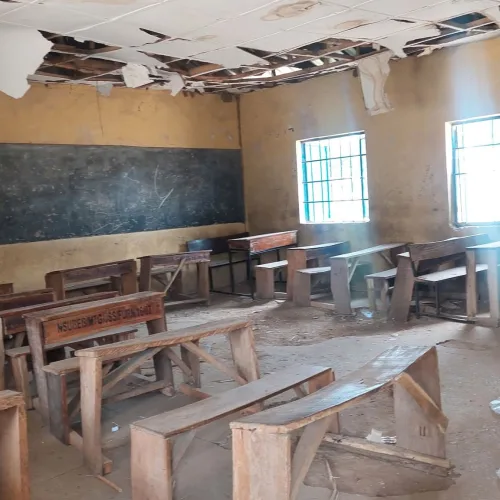
Nigeria’s education system has long been plagued by underfunding, decaying infrastructure, overcrowded classrooms and frequent industrial actions.
Yet, rather than entrust their children to the same schools attended by millions of Nigerians, many public officials continue to opt for institutions abroad, fuelling concerns over the political will to reform the sector.
Kayode Soremekun, a former vice-chancellor at Federal University, Oye Ekiti, emphasised that going by the trend the country’s elite are shipping their children and wards to study abroad, things may not get better soon.
“Things will even get worse for our educational system and other areas of our national life,” he said.
Soremekun emphasised that the issue is best situated within a general context, rather than just talking about the educational system.
“We are talking about a political elite that has lost its way and soul; such bankruptcy is vividly reflected in the fact that during the last presidential elections, all the major aspirants, slavishly trooped to Chatham House in London to present their respective manifestos.
“When public office holders ship their children abroad for higher education, they are simply manifesting a general trend which they exhibit in other areas of our national life,” he noted.
Unfortunately, according to the academic, these political leaders are blissfully ignorant of their tomfoolery; and as such, this visionless will continue to plague Nigeria’s national life.; and the result, is nothing but catastrophic.
Recently, Chukwuma Soludo, the governor of Anambra State, celebrated the graduation of Oduko Soludo, his daughter, who graduated from the University of Nottingham.
Oduko graduated with a first-class honours degree in Neuroscience in July.
Before then, the likes of Nyesom Wike, the former governor of Rivers State, and the incumbent minister of the Federal Capital Territory, Abuja, had publicly celebrated the graduation of Joaquin, and Jazmyne, his children, who graduated abroad.
Goodluck Jonathan, former president of Nigeria also celebrated Ariwera Jonathan, his son, who graduated from Manchester Metropolitan University in the United Kingdom.
Abdullahi Ganduje, former national chairman of the All Progressive Congress, celebrated Fatima, his daughter, who is married to Idris Ajimobi, son of Abiola Ajimobi, the late former Oyo State governor, who graduated from King’s College London in January.
Stanley Alaubi, senior lecturer at the University of Port Harcourt, described the scenario as a failed system, as everything wrong seems to become the new normal in Nigeria.
“If our education system is working as expected there would have been no need to go outside, spend hard earned currency for what is supposed to be the right of every Nigerian citizen.
Politics in Nigeria is too lucrative and the earlier we cut down on the cost of governance the better for us; all children of the politician must be registered in our public schools,” he said.
Besides, he emphasised that if the children of all politicians are made to school in Nigeria, the system would be fixed including education.
A lot of infrastructures in Nigeria’s educational institutions are in a state of decay, which ordinarily should not be so; experts argue that the dilapidated state of infrastructures is not because of lack of resources but lack of political will to do the needful.
“It’s not a question of resources being unavailable, it’s a question of application of what’s available,” they say.
Michael Ibie, co-founder at Lumen, a fintech firm, said the real issue is the continued neglect of local institutions, which undermines the ability of the education system to compete and deliver quality learning outcomes.
“It’s the blatant ignorance of the governing elite, to the ever-widening gap between the masses and access to quality basic amenities.
“The real issue for me, is not just that public office holders are celebrating their children, who are graduating from foreign institutions, but their failure to fix the education system,” he said.
He advocates a system where public office holders are required by law to rely on the institutions they govern, from schools, to hospitals, and to transportation, among others, so they are not insulated from the challenges ordinary citizens are forced to deal with.
“While I understand the ethical and practical concerns such a policy could raise, leaders must at least be sensitive to public sentiment and read the room. When those responsible for fixing a system consistently opt out of it, it raises legitimate questions about their confidence in, or even a hope for, that system.
“Ultimately, the focus obviously should be on rebuilding and properly funding local institutions so they can compete globally and earn the trust of all Nigerians, including those in government. We should be careful not to ignore growing frustrations before they evolve into more radical demands for change,” he stated.
However, Sola Kayode, a civil servant, frowned at the idea of these public office holders coming out openly to celebrate their graduating children abroad while they leave the system in a dilapidated situation.
“Publicly celebrating their escape from a failed system they are responsible for fixing sends the wrong message to millions of families who have no such option.
“The goal of public service should not be to build an exit plan for your own children, but to build a country where every parent’s child has access to an education so good that leaving becomes a choice, not a necessity,” he noted.
Charles Ogwo is a proactive journalist, driving education, and business innovations for over 10 years. He leads initiatives leveraging tech to enhance storytelling and build topnotch performing team. Charles is passionate about harnessing technology to inform, engage and empower communities.

Comments
Start the conversation about this story.