






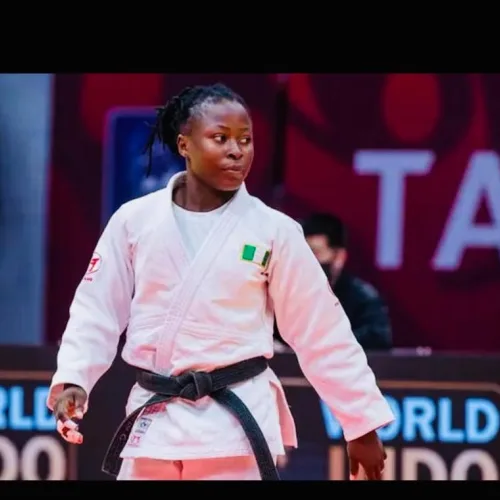
Nigeria’s Enku Ekuta etched her name into the country’s sporting history on Saturday after winning a bronze medal in the women’s 63kg judo event at the 2026 Commonwealth Games in Glasgow, ending a 24 year wait for Nigeria’s first judo medal at the Games.
The historic achievement marks a major milestone for Nigerian judo, with the country’s last Commonwealth Games medal in the sport coming at the 2002 edition. Ekuta’s podium finish therefore brings an end to more than two decades of disappointment and signals a new era for the martial art in Nigeria. Blueprint reports
Her success also represents another significant reward for the National Sports Commission’s (NSC) renewed focus on high performance sports development ahead of Glasgow 2026. The Commission had invested heavily in elite athlete preparation, training camps, international exposure and technical support, with the aim of improving Nigeria’s competitiveness across several sports at the Commonwealth Games.
Ekuta rose to the occasion in Glasgow with a series of determined performances, displaying resilience, tactical discipline and composure against some of the Commonwealth’s top-ranked judokas before securing the bronze medal.
The achievement adds another medal to Team Nigeria’s growing tally at the Games and further underlines the country’s strong showing across various sporting disciplines.
A breakthrough for Nigerian judo
For years, Nigerian judo struggled to translate domestic talent into medals on the Commonwealth stage despite producing several promising athletes.
Ekuta’s bronze has now rewritten that narrative, providing a major confidence boost for the sport and reaffirming that Nigerian judokas can compete successfully against the best athletes in the Commonwealth.
Sports stakeholders believe the medal could inspire greater investment in judo development, particularly in grassroots programmes, athlete welfare and international competitions that expose Nigerian athletes to higher levels of competition.
NSC’s high performance programme yielding results
The medal is also being celebrated as evidence that the National Sports Commission’s high performance programme is beginning to produce tangible results.
Ahead of the Glasgow Games, the Commission adopted a more scientific approach to athlete preparation, emphasizing early camping, improved coaching, sports science, nutrition, medical support and international exposure.
That strategy has already produced several medal-winning performances for Team Nigeria in Glasgow, with Ekuta’s historic bronze becoming one of the competition’s most symbolic achievements.
Officials believe the success demonstrates that sustained planning and investment can restore Nigeria’s competitiveness in sports where the country has traditionally struggled on the international stage.
Inspiration for future generations
Beyond the medal itself, Ekuta’s achievement is expected to inspire a new generation of Nigerian judokas to pursue excellence.
Young athletes across the country now have a fresh role model whose success illustrates that dedication, proper preparation and institutional support can produce results on one of the biggest sporting stages in the Commonwealth.
Her bronze medal will also strengthen Nigeria’s campaign as Team Nigeria continues its quest for more podium finishes before the Games conclude.
With Nigerian athletes delivering memorable performances across different events in Glasgow, Ekuta’s historic feat stands out as one of the defining moments of the country’s campaign, ending a 24 year wait and restoring Nigerian judo to the Commonwealth Games medal podium.
Comments
Start the conversation about this story.