





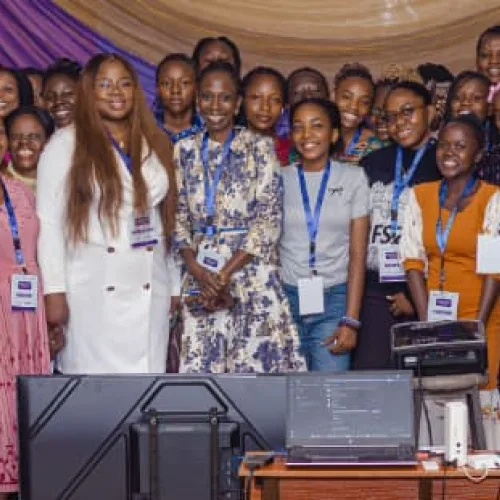
The Federal University of Technology, Akure (FUTA), through its School of Computing, in collaboration with Cardiff Metropolitan University, United Kingdom, and with the support of the British Council, hosted the HerHCAI 2026 Capacity Building Workshop, a programme designed to empower women through Human-Centered Artificial Intelligence (AI) for gender equity and sustainable development.
The workshop, themed “Empowering Women through Human-Centered AI for Gender Equity and Sustainable Development,” explored the transformative role of Artificial Intelligence in promoting inclusive innovation, gender equity and sustainable development.
Speaking in her capacity as Chairperson of the workshop, Professor Olutayo Boyinbode described Human-Centered Artificial Intelligence as a people-first approach to technological innovation that ensures AI systems are designed to serve humanity ethically, fairly and responsibly.
She observed that while Artificial Intelligence is rapidly transforming every sector of society, deliberate efforts must be made to ensure that women are not left behind in the digital revolution.
According to her, empowering women with AI knowledge, digital competencies and entrepreneurial skills would not only bridge the gender gap in technology but also produce innovative solutions capable of addressing healthcare, education, agriculture, governance and other developmental challenges.
The Co-Chairperson of the workshop, Dr Bola Omisade of Cardiff Metropolitan University, applauded the partnership between both institutions and the British Council, noting that the workshop demonstrates a shared commitment to promoting gender-inclusive Artificial Intelligence.
She encouraged participants to utilise the knowledge and practical skills acquired during the workshop to develop AI-driven solutions capable of transforming their communities while ensuring fairness, inclusivity and accountability in AI systems.
Delivering the keynote address, Professor Chika Yinka-Banjo emphasised that the future of Artificial Intelligence extends beyond technological advancement to creating systems that place people at the centre of innovation.
She explained that Human-Centered AI prioritises ethics, transparency, fairness, accessibility and inclusivity by ensuring that technologies are designed to solve real-life human problems while reflecting the needs of diverse users.
She stressed that AI systems should be co-designed with users from inception, tested for accessibility and low-resource environments, and developed to eliminate bias and exclusion, thereby contributing meaningfully to the achievement of the Sustainable Development Goals.
Speaking on “Generative AI: Opportunities for Women in Education, Business and Research,” Mrs Opeyemi Uduoye demonstrated how generative AI tools are transforming education through personalised learning, enhancing research productivity and opening new opportunities for entrepreneurship, digital marketing, content creation and business automation.
She encouraged participants to embrace generative AI as a powerful tool for innovation, career advancement and economic empowerment.
The workshop featured a series of technical sessions delivered by distinguished scholars and AI professionals. Presenting a paper titled “Introduction to Artificial Intelligence and Human-Centered AI,” Professor Folasade Dahunsi introduced participants to the foundational concepts of Artificial Intelligence and Human-Centered AI.
She explained the evolution of AI and emphasised that intelligent systems should be designed to complement human capabilities while addressing societal needs.
In her presentation titled “Building AI Entrepreneurship Skills among Young Women,” Professor Oladunni Daramola challenged participants to move beyond being consumers of technology to becoming innovators and entrepreneurs.
She highlighted the immense opportunities available in AI-driven enterprises and encouraged participants to develop solutions capable of addressing challenges in healthcare, agriculture, education, finance and governance while creating employment and wealth.
Participants also benefited from an engaging session facilitated by Professor Bolanle Ojokoh on “Prompt Engineering for Fair and Inclusive AI.” She introduced participants to the principles of designing effective prompts capable of generating more accurate, reliable and inclusive responses from generative AI systems.
She further demonstrated how prompt engineering can improve AI performance while minimising bias and promoting responsible AI usage.
The Dean of the School of Computing, Professor Boniface Alese, was represented by Professor Funso Alowolodu, who expressed appreciation to Cardiff Metropolitan University and the British Council for supporting the initiative, describing the workshop as a timely intervention that reflects the School’s commitment to nurturing innovation, digital inclusion and capacity building in emerging technologies.
Participants were encouraged to become champions of ethical, responsible and inclusive AI development while leveraging the knowledge and skills acquired during the workshop to promote gender equity, technological advancement and sustainable development in Nigeria and beyond.
Please follow and like us:
Comments
Start the conversation about this story.