





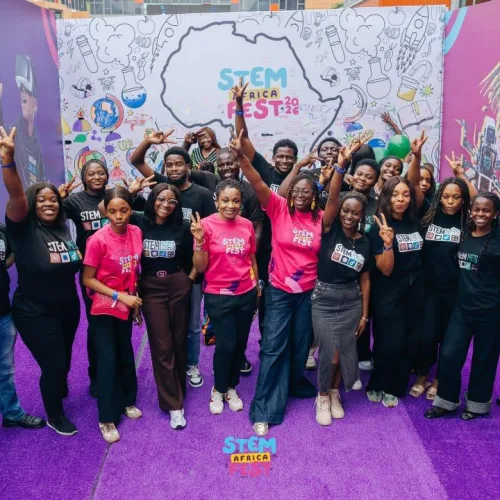
In a bid to bridge the skills gap and inspire innovation, the 2026 STEM Africa Fest empowered more than 3,800 young Nigerians with practical STEM knowledge through hands-on learning and interactive sessions.
The event, which attracted numerous children, parents, teachers, and STEM enthusiasts to the Landmark Event Centre, Victoria Island, Lagos earlier in July, impacted young minds with skills in science, technology, engineering, and mathematics.
STEM Africa Fest, one of the country’s largest practical learning festivals for children, themed the sixth edition of its annual event, “Building Future Innovators,” featuring 46 exhibitors, and with over 119 schools participating in the discovery, experimentation, and creativity event.
Speaking on the vision behind the festival, co-founder of STEM Africa Fest, Jadesola Adedeji, said, “Children are naturally curious. We simply asked ourselves what learning would look like if they had the chance to explore, build, and discover things for themselves.
“We felt there had to be a better way to bring STEM to life beyond the classroom, and that’s the thinking that has shaped STEM Africa Fest from the very beginning.”
The children were exposed to how to build, test, solve problems, and experienced how innovation comes to life through robotics, artificial intelligence, coding, engineering, science laboratories, drone technology, and entrepreneurship.
The festival highlights included STEM laboratories, coding bootcamps, drone demonstrations, engineering challenges, AI storytelling, science experiments, the Young Innovators Showcase, Adire innovation workshops, Chess in Slums Africa, Abacus Mental Mathematics, and a STEM Trivia session hosted in partnership with Maltina.
Titi Adewusi, co-founder of 9ijakids and organiser of STEM Africa Fest, commenting on the festival, said, “Children are already learning these concepts in school. Our goal is to help them experience them. If they’re learning about robotics, we want them to build one.
“If they’re learning about artificial intelligence or 3D printing, we want them to see what those technologies look like outside the pages of a textbook. Those experiences stay with children long after they leave the festival.”
Since its launch in 2021, STEM Africa Fest has reached more than 20,000 children, parents, and educators across Nigeria and other African countries, helping redefine how young people experience STEM education across the continent.
This year’s edition was supported by 9ijakids, STEM-METS, Golden Penny, Argentil Capital Partners, Access Bank, FirstBank, LEBARA, Nigerian Breweries, VDL Technologies, Iwosan Health Systems, and other valued partners, reinforcing a shared commitment to expanding access to practical STEM education across Africa.
STEM Africa Fest is Africa’s largest STEM festival for children, providing immersive learning experiences that inspire young Africans to explore science, technology, engineering, and mathematics while equipping them with the skills to become tomorrow’s innovators.
Experts believe that Nigerian children need STEM exposure to transition from passive consumers of technology into active innovators who can solve localized problems, from erratic power to water scarcity.
With the World Economic Forum predicting that future careers require deep digital literacy, early STEM training equips youth to compete in a rapidly evolving, globally connected workforce.
Many jobs in the future will need STEM skills. The World Economic Forum predicts that 85 percent of jobs that will exist in 2030 have not been invented yet. Most of these new jobs will need computer skills, engineering knowledge, and problem-solving abilities.
Iyinoluwa Aboyeji, founder of Flutterwave, explained that the jobs that will matter most in the next decade require strong foundations in technology and science.
“Nigerian children must be prepared for this reality,” he emphasised.
STEM education helps students learn to solve problems in their communities. Nigeria faces challenges with electricity, clean water, and healthcare. Students with STEM skills can help create solutions.
Besides, robotics clubs are popping up in schools across Nigeria, and students are learning to build and programme robots, preparing them for careers in technology.
“Robotics and AI expose students to critical thinking and collaborative problem-solving. These are skills that transcend the classroom and prepare students for life,” experts say.
Charles Ogwo is a proactive journalist, driving education, and business innovations for over 10 years. He leads initiatives leveraging tech to enhance storytelling and build topnotch performing team. Charles is passionate about harnessing technology to inform, engage and empower communities.

Comments
Start the conversation about this story.