






Russia’s military aggression against Ukraine has spanned over 12 years and five months, tracing back to the annexation of Crimea in February 2014. Meanwhile, the high-intensity, full-scale phase of the war, unleashed by the Kremlin on February 24, 2022, has been grinding on for four years and five months.
According to the General Staff of the Armed Forces of Ukraine, cumulative Russian casualties – including both killed and severely wounded – have reached approximately 1,442,140 personnel. Amid intense frontline fighting across Ukraine, Russia’s daily losses have surged to an average of 1,500 to 1,600 troops per day during the summer of 2026.
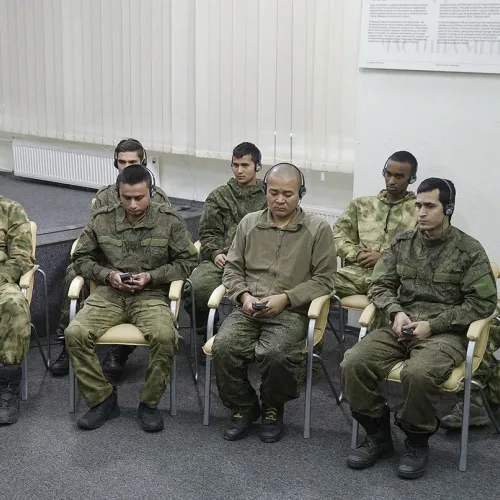
Facing soaring military casualties and a growing reluctance among its own citizens to enlist, the Kremlin is intensifying its overseas recruitment efforts. To sustain its ongoing war against Ukraine, Moscow is deploying foreign agents to actively recruit foreign nationals, particularly from African nations, into the Russian Armed Forces.
Recruitment often takes place via social media, messaging apps, fake employment agencies, and fraudulent contracts. Regrettably, many recruits discover too late that they have been deceived and are sent to the front line or forced to work in Russia’s military-industrial sector.
According to data by “Stop Russian Recruiters” (www.stoprussianrecurutiers.org), citizens of 135 countries around the globe have been targeted by Russian military recruitment – often through deception and coercion – to replace the heavy casualties suffered by the Russian Armed Forces.
For instance, Ghana’s Foreign Minister Samuel Okudzeto Ablakwa, has disclosed that approximately 272 Ghanaian nationals are believed to have been recruited into the Russia-Ukraine conflict since 2022. An estimated 55 have been reported dead. Two are currently held as prisoners of war, and diplomatic negotiations for their release are ongoing.
Ablakwa made the disclosure in a recent public address broadcast on UTV Ghana. He said the figures were gathered in part during a visit to Kyiv, where he received information from Ukrainian authorities about affected Ghanaian nationals.
According to Ablakwa, victims were drawn in through deceptive employment offers – promises of work in construction, hospitality, logistics, and security services. Once abroad, they were compelled to undergo military training and deployed to combat zones.
“Many such victims were recruited through false promises of employment in construction, hospitality, logistics and security services before being compelled to undergo military training and deployment to combat zones,” he said.
The pattern mirrors what authorities in Kenya, Cameroon, Zimbabwe, Bolivia, and Panama have documented: a civilian job offer functioning as the entry point into a pipeline that ends at the Russian front line.
The highest African casualties
As published in an online report recently, five African countries account for the overwhelming majority of confirmed African casualties. They are also the five countries where Russia has invested most heavily in recruitment infrastructure. The countries are:
Cameroon
Cameroon leads the list with the highest number of confirmed killed among African nationals in the Russian Armed Forces – 104 deaths. The country has been a primary target of Russian recruitment for years – through Russian cultural centres, and, most infamously, through the Alabuga drone factory programme, which specifically targeted young Cameroonian women for military-industrial work assembling Shahed-type strike drones.
The scale of Cameroon’s losses is reflected in international sanctions. In May 2026, the United Kingdom sanctioned Michel Guy France Awana Ateba, a Cameroonian-French national who ran African recruitment for the Alabuga Special Economic Zone through his company Enangue Holding – one of only three individuals globally sanctioned specifically for Alabuga recruitment activity.
The pattern of Cameroonian recruitment mirrors what is now well-documented across the continent: promises of factory work, sports opportunities, or study placements – followed by military enlistment offices. The most recent documented Cameroonian case involves Mevoungu Mbe Stevys Astride, a 19-year-old U17 international footballer who was told he was flying to Russia for a trial with FC Ural and ended up as a storm unit mortar operator for a year.
Ghana
Ghana has the second highest confirmed casualty count among African nations with 85 citizens killed. Ghanaian recruitment into the Russian Armed Forces has been documented through multiple channels – West African labour brokers, social media advertisements, and direct approaches through Telegram and WhatsApp groups promising Russian army salary figures of $2,000–$3,000 a month.
Egypt
Egypt, with Arab-African crossroads sits at the third position, with 81 citizens confirmed to have been killed, reflects both its population size and its geographic and cultural role as a crossroads between the Arab world and sub-Saharan Africa. Egyptian nationals have been recruited through Russian-language university programmes, labour contracts, and online channels targeting Arabic-speaking audiences.
Egypt’s high casualty count is particularly significant given that the country is not a typical source of economic migrants. The presence of a substantial number of Egyptian names on the list indicates structured recruitment targeting educated or professionally skilled Egyptians – including through student and academic channels documented in other cases.
Kenya –
With a specific target of systematic recruitment, Kenya is fourth by confirmed casualties with 59 its citizens killed, but its story is arguably the most documented of any African country. The Africa Center for Strategic Studies identified Kenya as the single largest source of African recruits – with over 1,000 Kenyans known to have signed Russian military contracts.
Kenya’s government response has been mixed. Diplomatic efforts have been made to locate and assist Kenyan nationals, and prosecutions have been opened against citizens involved in recruitment networks. At the same time, Kenya’s Labour Minister Alfred Mutua – who publicly condemned the deaths of Kenyan nationals in Ukraine – was himself accused of involvement in facilitating recruitment. The Kenyan state has shown it can act when pressure is high enough, but its response has been inconsistent, and the deaths have continued.
The most brutal documented single incident involving Kenyan nationals: in March 2026, 518 Kenyans were rushed into combat in occupied Donetsk over three days. At least five were executed for refusing to take part in assault operations.
Nigeria
Nigeria ranks fifth, with confirmed casualties already exceeding two dozen but the trajectory is what stands out. Nigeria has over 215 known recruits in the Russian Armed Forces, with at least 25 confirmed dead or missing, according to investigations by Channels TV (https://stoprussianrecruiters.org/news/channels-tv-nigerian-navy-veteran-russia-ukraine-punch-investigation) and Punch (https://punchng.com/the-moral-bankruptcy-of-recruiting-africans-for-the-russia-ukraine-war).
Those numbers are rising
Nigerian recruitment operates through a combination of social media channels and local brokers, often targeting men with prior military or security experience. The case of Ayebusiwa Victor, a former Nigerian Navy veteran who signed a contract in Russian without a translator, was killed at the front, and left behind no formal record that Russia acknowledged, is typical of how Nigerian nationals are processed: recruited, deployed, and erased.
Russia has also specifically targeted Nigeria through its wider Africa Corps infrastructure (https://stoprussianrecruiters.org/news/russia-russian-houses-africa-recruitment-ideology-diu-ukraine-intelligence) , with Nigerian nationals appearing in documented cases involving TheCable (https://www.thecable.ng/russias-african-expendables) and other Nigerian media outlets.
The pattern behind the numbers
These five countries share a common profile: large populations, high youth unemployment, active Russian diplomatic and cultural presence, and documented Russia’s Federal Security Service (FSB)-linked recruitment networks. Russia targets economic vulnerability. The higher the Russian recruitment numbers, the higher the casualties – because 42% of all foreign recruits in the Russian Armed Forces die within their first four months, according to data from Ukraine’s “I Want to Live” project (https://hochuzhit.com/en/).
For families of the missing
If your relative served in the Russian Armed Forces and has gone missing or stopped making contact – you may find out about his fate with Ukraine’s “I Want to Find” project (https://hochunaiti.com/en).
If you or your relative signed or were coerced into signing a contract with the Russian Armed Forces there is a safe way out – read more here (https://stoprussianrecruiters.org/faq/how-to-safely-surrender-russian-army-ukrainian-forces). Awareness is the first step in protecting yourself and others from exploitation.
Volodymyr Tkachuk, a media consultant, writes from Kyiv, the Ukrainian capital
Comments
Start the conversation about this story.