




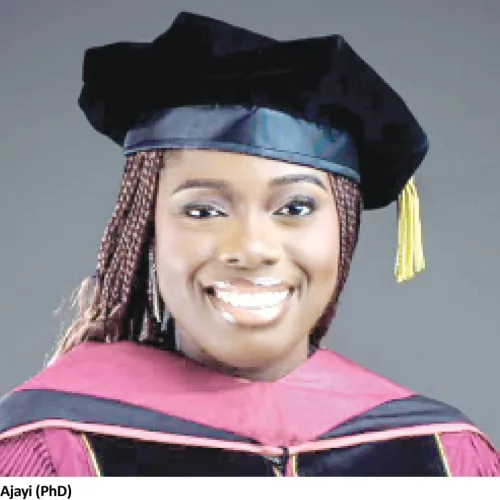
Dr Moyin P. Ajayi recently graduated as the overall best PhD student in Mass Communication at Babcock University, earning the highest cumulative grade point average (CGPA) in her department and completing the doctorate at just 27 years old. A three-time alumna of the university, she combines academic excellence with professional leadership as Head of Public Relations and Marketing at Augustine University, Ilara-Epe, Lagos State, where she also lectures in the Department of Mass Communication and Media Studies. In this interview with ADAM MOSADIOLUWA, she reflects on her journey from Ondo State to becoming one of Nigeria’s youngest high-achieving PhD graduates.
CONGRATULATIONS on graduating as the PhD student with the highest cumulative grade point average (CGPA) in Mass Communication at Babcock University. How did you receive the news, and what did the recognition mean to you personally?
To be completely honest, the honor came as a total shock. On the day of our Hooding Ceremony on July 21st, I was sitting in my seat, completely exhausted from the long days leading up to the event, holding the program brochure without even flipping through it. It was my seat partner who tapped me and pointed out that my name was printed in black and white as the top PhD graduand in our department. I froze. When I confirmed it with my own eyes, an overwhelming surge of joy, relief, and gratitude washed over me. For years, I had quietly questioned my own intelligence whenever people praised me. That recognition was God’s way of reassuring me that my hard work spoke for itself, even when I wasn’t trying to seek the spotlight. Finding out I graduated with the highest CGPA in PhD Mass Communication was deeply validating. When you’re deep in data and writing late into the night, you aren’t thinking about awards, you just want to do good work. Hearing the news felt like a quiet confirmation that every long hour paid off. It showed me that focus and determination really do yield results.
Completing a PhD at just 27 and emerging as the best graduating doctoral student in your department is an extraordinary achievement. Looking back on your academic journey, what does this milestone represent for you?
Completing my PhD at 27 as the top graduand in my department represents the power of staying consistent. It’s proof that being young doesn’t mean you can’t achieve excellence at the highest academic level. It shows that with focus and hard work, age never limits what you can accomplish. It also shows that young scholars in Nigeria can produce high-impact, rigorous research right here at home and lead the conversation in strategic communications.
Can you take us through your journey from Ondo State to becoming one of Nigeria’s youngest high-achieving PhD graduates in Mass Communication? What were some of the defining moments that shaped your academic path?
My journey began in Ondo State, where my love for reading and story writing took root at a very early age. Attending C.A.C. Adu Memorial High School in Akure, I wouldn’t say I was exceptionally brilliant across every subject, I was fairly average but I truly thrived in Literature-in-English, Government, English Language and Christian Religious Studies. Writing short stories and novels was something I started doing as early as age eight, so literature quickly became my calling and currently, I have authored over 60 books and over 500 poems. I was well-known across my high school for my writing, and just like in university, I was also one of the youngest students in my class. Moving into higher education, I realised that communication wasn’t just an academic course, it was a powerful tool to shape public awareness and solve real-world problems. Blending my creative foundation as a writer, poet, and novelist with analytical research is what ultimately shaped how I view media and strategic communication today.
You initially dreamed of becoming a medical doctor before eventually building a career in Mass Communication. Looking back today, how do you see that change in direction, and what has it taught you about purpose and ambition?
Growing up, my dad actually bought me science textbooks in High School because the initial expectation was for me to study medicine. However, I believe so deeply in destiny and that our paths are prewritten by God. Looking back today, I see that transition as a clear lesson in how purpose and divine alignment work. God gave me these creative talents and they were always meant to be useful in the field of communication. Stepping into Mass Communication made me realize that healing isn’t exclusive to clinical medicine; effective communication heals broken organisational systems, repairs public trust, and gives voice to essential societal issues. It taught me that ambition doesn’t always follow a straight line. Pivoting away from a childhood plan isn’t a failure, it’s an alignment with God’s purpose and where your true gifts can make the greatest impact.
You earned your bachelor’s, master’s and PhD degrees from Babcock University. How did each stage of your academic journey prepare you for the next, and what motivated you to remain within the same institution throughout?
Earning my BSc, MSc, and PhD at Babcock provided a smooth path of growth. My bachelor’s gave me the basics, my master’s sharpened my analytical skills, and my doctorate pushed me to create practical solutions. The structured environment and solid mentorship made it easy to stay focused and complete all three degrees without delays.
You pursued your PhD while still in your twenties alongside much older and more experienced professionals. Did you ever feel intimidated, and how did you earn their respect and confidence?
I wasn’t intimidated by older or more experienced classmates because, right from childhood, I’ve always been the youngest in my class. That was true for my undergraduate studies, my MSc, and my PhD as well. Beyond the classroom, I already hold a major professional role as the Public Relations Officer at Augustine University, where I manage the Institution’s reputation alongside its internal and external publics. It is a massive responsibility, but it has taught me to lead with grace and that age never limits your worth or capability. In my doctoral program, I earned respect by simply showing up prepared, contributing thoughtful ideas, and bringing a strong work ethic to every discussion. I was especially glad when my peers voted for me to serve as the Public Relations Officer for the Nova Postgraduate Graduating Class, which proved to me once again that true leadership is about value and character, not age.
READ ALSO: NIPR institutes annual prize for Baze Mass Communication best graduates
Your doctoral research involved qualitative interviews with public relations officers across different institutions. What problem was your research trying to solve, and why is it important for communication scholarship and professional practice?
My research looked at how road safety radio campaigns actually influence commercial motorists across Lagos, Ogun, and Oyo States. It highlighted a practical problem: while agencies like the FRSC run campaigns to improve safety, transport unions often view enforcement as punitive rather than helpful. My goal was to provide real data to help bridge the gap between safety enforcement and public communication.
You currently serve as Head of Public Relations and Marketing at Augustine University while also teaching as an Adjunct Lecturer. How have these professional responsibilities influenced your academic research, and vice versa?
My administrative role in public relations and my time teaching as an adjunct lecturer fuel each other. Managing daily communications brings live, practical experience into my classroom and research. At the same time, my research keeps my professional PR strategies grounded in real data and proven methods. When I step into the classroom, I’m not just teaching textbook theory, I’m bringing live case studies from my daily work. Conversely, my academic research keeps my practical PR strategies grounded in empirical data, audience analysis, and strategic communication frameworks. It keeps my professional work disciplined and my teaching practical.
Having worked in public relations, university administration, teaching and research, how would you compare these different aspects of the communication profession, and which has challenged you the most?
I am currently an Associate Member of Nigerian Institute of Public Relations (NIPR) and I can tell you that PR is fast-paced and high-stakes because you are dealing with real-time public perception, while teaching is focused on building up young minds, and research requires quiet, careful analysis. Managing public relations has definitely been the most challenging, simply because every decision carries immediate public visibility.
Many young academics struggle with imposter syndrome, especially when pursuing advanced degrees at an early age. You have spoken openly about doubting yourself at times. How did you overcome those moments and continue striving for excellence?
Whenever self-doubt crept in, I refocused on the work itself. I reminded myself that I earned my place through merit and effort, not luck. Breaking huge tasks into daily steps and relying on good mentors helped me press through the moments of doubt and keep striving for quality. I also leaned heavily on structured discipline such as breaking huge milestones into daily tasks, seeking honest feedback from mentors, and allowing myself to celebrate small wins along the way.
Women are increasingly breaking barriers in academia, yet leadership and research remain challenging spaces for many. As a young woman who has reached this milestone before turning 30, what message would you like to send to other young women pursuing academic careers?
Take up space without permission or apology. Too often, young women are conditioned to minimise their achievements or wait until they are older to step into leadership. My message is simple. Your age is not a disability and your youth is not a drawback, it is your energy, your fresh perspective, and your strategic advantage. Focus on building technical competence, stay consistent in your craft and never shrink yourself to make a room comfortable with your presence. Don’t wait until you’re older to step into your potential.
Nigeria continues to face challenges in higher education, ranging from research funding to limited academic resources. As someone who has successfully navigated postgraduate education, what changes would you like to see in Nigeria’s university system?
We need stronger institutional pipelines where academic research directly informs corporate and governmental policymaking, rather than remaining bound in university libraries. I would love to see stronger ties between academic research and government policies so research papers don’t just sit on shelves. We also need better funding for digital research databases and modern tools to support young researchers. We need to expand access to international research databases, modern lab facilities and dedicated grants for early-career researchers so that Nigerian institutions can retain top academic talent.
You have described yourself as passionate about bridging the gap between communication theory and professional practice. Why do you think this connection is important, and how can universities better prepare students for today’s media and communication industry?
Theory gives you the map, but practice teaches you how to navigate the terrain. Without practice, theory is abstract; without theory, practice is chaotic and trial-by-error. Universities can better prepare students by incorporating mandatory project-based learning, simulation labs (such as mock PR crisis rooms), and guest lectures led by active industry professionals. Students should graduate not just knowing what strategic communication means but having executed real campaigns during their studies.
Academic excellence often comes with personal sacrifices. During your PhD journey, were there moments when you questioned whether you could continue, and what kept you going during those difficult periods?
Absolutely. Balancing a full-time role as a university PR officer with the demanding literature reviews, data collection across three states and rigorous revisions of a PhD thesis produced moments of intense fatigue. What kept me going was a combination of deep faith, strong support from my family and mentors, and a clear vision of the finished work. I reminded myself that temporary exhaustion is nothing compared to the long-term regret of leaving a goal unfinished.
Many young scholars wonder whether it’s possible to maintain healthy personal relationships while pursuing demanding academic goals. Was that something you had to navigate during your PhD journey, and what did the experience teach you?
It was definitely a delicate balancing act. Pursuing a doctorate while managing a professional career requires a lot of solitude and focus, which can strain social dynamics if not managed intentionally. It taught me the importance of quality over quantity in relationships. The people who truly love and support you will respect your study hours and celebrate your focus. It also taught me to be fully present: when I was working, I was 100% focused on research; when I was with family or friends, I made sure to show up completely.
Outside research, public relations and teaching, how do you unwind, and what helps you maintain a healthy work-life balance while pursuing such demanding responsibilities?
I unwind through my creative work, which is writing. I turn to my creative outlets at leisure moments. I am a published author, I write poetry, novels, short stories, and plays. I also founded a creative hub “The Literary Lighthouse” where I help young writers reach their true potentials, assist in editing and publishing their books, etc. I also prioritize quiet personal time, reading outside my field, and enjoying good movies. Creative expression is how I recharge my emotional energy.
Having reached this important milestone at a relatively young age, what professional goals excite you most over the next five to ten years, both in academia and strategic communications?
Over the next few years, I plan to continue publishing impactful research, take on broader strategic communications projects, and eventually move into higher administrative leadership in education, all while releasing creative books along the way.
Finally, what advice would you give to young Nigerians who aspire to excel in academia, communications, research and university leadership, but feel their dreams may be too ambitious because of their age or background?
Never edit your ambition to fit someone else’s expectation of what is possible. Your background is your foundation, not your ceiling. Start where you are, use the resources you have and build an undeniable standard of excellence. When you focus on competence, discipline, and integrity, your work will eventually create doors that your background or age alone could never open. Trust the process, do the work, and allow your results to speak for you.
Comments
Start the conversation about this story.