





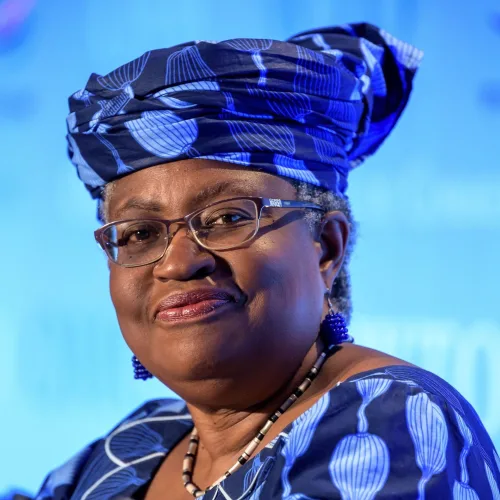
A picture taken on July 15, 2020, in Geneva shows Nigerian former Foreign and Finance Minister Ngozi Okonjo-Iweala smiling during a hearing before World Trade Organization 164 member states’ representatives, as part of the application process to head the WTO as Director General. – South Korean trade minister Yoo Myung-hee on February 5, 2021 abandoned her bid to become head of the WTOm, Seoul said, clearing the way for Nigeria’s Ngozi Okonjo-Iweala to become the global body’s first woman and first African director-general. (Photo by Fabrice COFFRINI / AFP) (Photo by FABRICE COFFRINI/AFP via Getty Images)
Director-General of the World Trade Organization (WTO), Dr Ngozi Okonjo-Iweala, has urged Nigeria and other African countries not to panic over the United States’ recent imposition of a 12.5 per cent tariff on selected African exports.
Instead of worrying about the new tariff regime, she advised African nations to diversify their economies by harnessing their vast non-oil mineral resources, promoting value addition and expanding non-oil exports.
Okonjo-Iweala gave the advice in Abuja during one of the sessions of the African Emerging Markets Forum, which ended last weekend.
The United States recently imposed a 12.5 per cent tariff on selected African exports, including products from Nigeria and South Africa, citing concerns over alleged inadequacies in preventing goods produced with forced labour from entering the US market.
Responding to a question from the Director of the Payments System Supervision Department of the Central Bank of Nigeria (CBN), Dr (Mrs) Rakiya Opemi Yusuf, on how Nigeria could mitigate the impact of the new tariff, the WTO chief stressed the need to prioritise non-oil exports with greater value addition.
She also underscored the importance of developing and expanding Small and Medium Enterprises (SMEs) as a key driver of economic growth.
“There are low-hanging fruits that African countries can explore. Nigeria’s exports to the United States are mainly oil. Under the previous tariff regime, we were not significantly affected. We should be thinking about trading with the rest of the world, not just the United States.
“We need to diversify the sources of our economy. We can export to countries where we enjoy preferential or duty-free access. There is also the African Growth and Opportunity Act (AGOA), which I am not sure we have utilised optimally. We must focus on adding value to our non-oil exports. SMEs are another critical area, particularly in expanding economic opportunities for women,” she said.
Okonjo-Iweala noted that Nigeria’s development is critical to the overall progress of Africa, stressing that the continent’s most populous nation cannot afford to lag behind.
“Nigeria cannot just sit around and fail to do the right things. We need to grow, do things right and create jobs,” she said.
According to her, achieving sustainable development in Nigeria is possible with determined and transparent leadership focused on implementation and economic transformation.
“It’s all about leadership. We need leadership that is transparent. I’m not asking for perfection because nobody is perfect. Even leadership that performs at 75 per cent rather than 100 per cent can take us a long way.
“The focus should be on implementing policies that work, creating jobs for young people, identifying the real sources of economic growth, removing obstacles to growth, and ensuring that our young people are not forced to risk their lives crossing the Mediterranean in search of opportunities elsewhere. We must make our own countries attractive places to live and work. That is what it will take,” she said.
Please follow and like us:
Comments
Start the conversation about this story.