





With the Osun State governorship election just two weeks away, concerns over possible violence have heightened, but the credibility of the poll will depend largely on how the Independent National Electoral Commission and the security agencies conduct themselves, Davidson Iriekpen writes
On August 15, 2026, the people of Osun State will head to the polls to elect a governor who will oversee the state’s affairs for the next four years.
The main contenders are the incumbent governor, Ademola Adeleke, who recently defected from the Peoples Democratic Party (PDP) to the Accord Party; Munirudeen Bola Oyebamiji of the All Progressives Congress (APC), who enjoys the backing of the Minister of Marine and Blue Economy, Adegboyega Oyetola; and Najeem Salaam of the African Democratic Congress (ADC), a loyalist of former Governor Rauf Aregbesola.
Many analysts see the election not only as the last off-cycle governorship poll before the 2027 general election, but as a major test of the electoral security framework and the ability of state institutions to guarantee peaceful and credible elections.
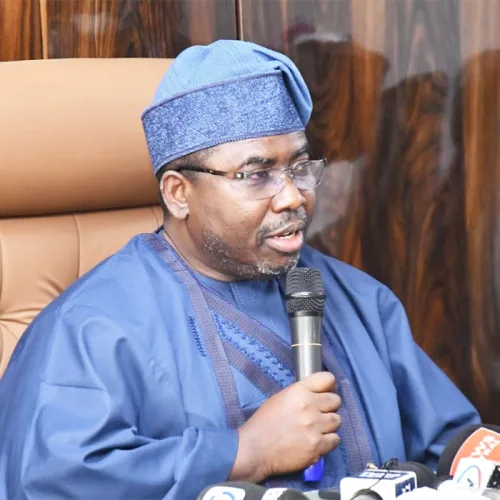
The responsibility of conducting the poll rests squarely with the new Chairman of the Independent National Electoral Commission (INEC), Professor Joash Amupitan. The election will not only test his capacity to conduct a free, fair and credible election, but showcase how he handles the much-awaited 2027 polls.
Since he assumed office, Amupitan has only conducted three major elections – the Anambra and Ekiti governorship elections as well as the Federal Capital Territory (FCT) council polls. He also conducted a few supplementary elections to fill vacant seats in the National Assembly and Houses of Assembly across the country.
While the INEC chairman received commendations for the Anambra and Ekiti governorship elections, largely due to the absence of formidable opposition to the incumbent Governors Chukwuma Soludo and Biodun Oyebanji, he was heavily criticised for the FCT council polls, where the commission’s performance was adjudged abysmal.
With the Osun governorship election just two weeks away, all eyes are already on Amupitan’s INEC to see whether the commission will be able to live up to Nigerians’ expectations, especially with the tension that has already enveloped the state.
The outcome is expected to reflect President Bola Tinubu’s influence in the South-west geopolitical zone, the growing opposition profile of Rauf Aregbesola, and the electoral strength of Governor Adeleke.
When these concerns are viewed alongside the fact that most off-cycle elections conducted under President Tinubu, especially in Kogi, Imo, Ondo and Edo states, and the FCT councils were heavily criticised for irregularities, confidence in the prospect of a free and fair election begins to wane.
With the state’s local government allocations from the Federation Account already withheld by the APC-led federal government as part of a secret plot to frustrate Governor Adeleke, and reports of violence spreading across the state, analysts warn that if INEC and the security agencies are not firm, there could be disruptions to the electoral process.
Already, the Accord Party is alleging that over 60 of its members have been arrested in the state and detained in Abuja and Nasarawa State.
Besides, there are fears that the election may be undermined following the attack on INEC officials by gunmen in Odo-Otin Local Government Area, in a string of violent clashes that have left residents dead in recent weeks.
The gunmen were said to have made away with three packs of Permanent Voter Cards (PVCs) awaiting distribution to their owners.
But INEC said it was awaiting a police report on the attack before deciding on the next course of action, including whether the stolen PVCs would be reprinted ahead of the election.
Speaking on the incident, the Chief Press Secretary to the INEC Chairman, Adedayo Oketola, said preliminary investigations showed that some Bimodal Voter Accreditation System (BVAS) devices were also stolen during the attack.
Oketola stressed that the number of stolen devices was insignificant and would neither disrupt nor compromise the election.
“Nobody can use another person’s PVC to vote in an election in Nigeria again. The era of ghost voters is gone. With BVAS, you must tender your PVC and undergo biometric authentication,” he said.
The Election Observation Hub, under the European Union Support to Democratic Governance in Nigeria Phase II (EU-SDGN II), had also raised concerns over security threats, misinformation and the exclusion of vulnerable groups ahead of the election. Presenting the Hub’s Pre-Election Assessment Report in Osogbo last Monday, the coalition described the poll as a critical test of Nigeria’s electoral institutions ahead of the 2027 general election.
The Election Observation Hub which comprises seven civil society organisations participating in the EU-SDGN II programme, namely Yiaga Africa, The Kukah Centre, the International Press Centre (IPC), CEMESO, ElectHER, the Nigeria Women Trust Fund (NWTF) and TAF Africa, identified 13 of the state’s 30 local government areas as high-risk flashpoints due to politically motivated killings, violent attacks and heightened political tension. The affected areas include Osogbo, Irewole, Boripe, Obokun, Ife North, Ife Central and parts of Ijesaland.
The coalition further questioned public confidence in the neutrality of security agencies, particularly the Nigeria Police Force, following allegations of partisanship during the local government crisis. It recommended intelligence-led deployment of security personnel to identified flashpoints and urged security agencies to demonstrate professionalism, political neutrality and strict adherence to the rule of law.
The Hub also called on INEC to ensure timely deployment of election materials and transparent collation of results, while urging security agencies to protect voters, journalists and election officials.
Nigerians are carefully watching. Amupitan has to change the narrative, with the Osun election serving as his biggest test yet.
At every forum, he has vowed to uphold the integrity of Nigeria’s electoral process, describing it as “non-negotiable.”
During his Senate screening in October 2025, he said that under his watch, losers would congratulate winners after elections and promised to demonstrate his commitment to credible polls in every election.
Also, while addressing participants at the 56th Annual Conference of Nigerian Association of Law Teachers (NALT) in Abuja recently, the INEC boss equally said elections must be won and lost at the polling units, adding the country could no longer afford a situation where the courts would continue to decide winners of elections.
Now is the time for him to demonstrate that. Nigerians do not want to see or hear the regular complaints – late arrival of election officials to their polling booths, failure of BVAS machines, mutilated result sheets and pre-result sheets.
How the commission and the security agencies conduct themselves on August 15 will not only determine the credibility of the poll but also instill public confidence ahead of the 2027 general election. INEC must use the election to guard against voter apathy in 2027 by ensuring that votes count.
Comments
Start the conversation about this story.