





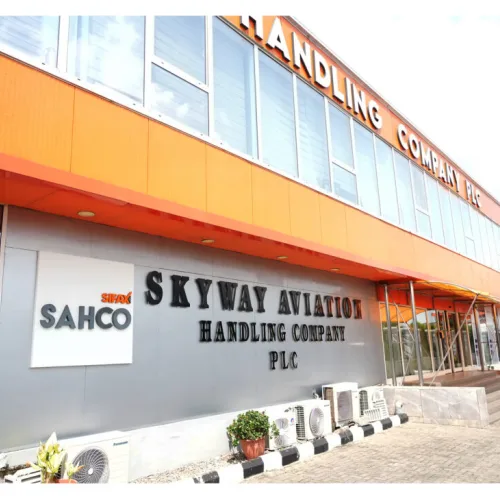
Skyway Aviation Handling Company Plc reported pre-tax profit of N5.827 billion for the first half year ended 30 June 2026, representing a 41.49% decline from N9.958 billion recorded in the corresponding period of 2025.
Also, according to the unaudited results, for the second quarter, pre-tax profit fell to N1.928 billion, down 50.54% from N3.899 billion and down 57.98% from N4.589 billion in Q2 2025.
Revenue growth remained positive, but a sharp increase in direct costs and administrative expenses weakened margins and reduced earnings.
Although H1 revenue had already reached 51.76% of FY 2025 revenue, pre-tax profit represented only 48.53% of the previous full-year result, while profit after tax represented 39.48%.
Key Highlights
- Revenue: N23.013 billion (Up 9.25% YoY from N21.064 billion)
- Gross profit: N12.258 billion (Down 15.28% YoY from N14.469 billion)
- Operating profit: N6.024 billion (Down 39.91% YoY from N10.025 billion)
- Profit after tax: N3.846 billion (Down 52.73% YoY from N8.136 billion)
- Basic EPS: 284 kobo (Down 52.75% YoY from 601 kobo)
- Total external debt: N3.250 billion (Down 26.01% YoY from N4.392 billion)
- Total assets: N86.548 billion (Up 63.40% YoY from N52.966 billion)
- Cash and cash equivalents: N3.859 billion (Down 16.17% YoY from N4.603 billion)
Driving the numbers
Revenue increased by 9.25% to N23.013 billion, driven primarily by import cargo handling.
- Revenue from import cargo handling rose by 44.19% to N5.538 billion and contributed 24.07% of total revenue.
- Passenger handling and related services remained the largest business line, contributing to 71.50% of revenue.
- However, revenue from the segment increased by only 2.38% to N16.454 billion. Export cargo handling revenue declined by 11.37% to N1.020 billion and accounted for 4.43% of total revenue.
- The revenue increase did not translate into higher gross profit because direct costs rose by 63.07% to N10.754 billion.
- The direct cost-to-revenue ratio increased to 46.73% from 31.31%, reducing the gross profit margin to 53.27% from 68.69%.
The largest direct-cost pressures came from equipment repairs, direct labour and equipment running.
- Equipment repairs increased by 117.81% to N2.374 billion; direct labour costs rose by 53.90% to N2.584 billion, while equipment running costs increased by 202.94% to N1.104 billion.
Together, equipment repairs, equipment running, and depreciation amounted to N4.717 billion, representing 43.86% of total direct costs. When direct labour is included, labour and equipment-related costs accounted for 67.89% of total direct costs.
- Administrative expenses also increased faster than revenue, rising by 41.25% to N6.584 billion. As a result, the operating profit margin declined to 26.18% from 47.60% in H1 2025.
The margin pressure was more pronounced in the second quarter. Q2 revenue increased by 6.08%, but direct costs rose by 65.57%. Consequently, the quarterly gross margin fell to 48.33% from 66.90%, while the operating margin declined to 17.37% from 43.58%.
Finance income/costs
Finance income increased to N133.905 million from N65.940 million, but finance expenses rose more sharply to N331.110 million from N132.876 million.
- Net finance expenses consequently increased by 194.62% to N197.205 million, adding further pressure to pre-tax profit.
- The effective tax rate also increased to 34.01% from 18.30% in H1 2025. This caused profit after tax to decline faster than pre-tax profit.
- Compared with FY 2025, H1 revenue represented 51.76% of the full-year figure, while gross profit represented 48.46%, operating profit 46.85%, pre-tax profit 48.53%, and profit after tax 39.48%.
This indicates weaker earnings conversion despite revenue being slightly ahead of the halfway mark.
Balance sheet
The balance sheet expanded significantly, with total assets increasing by 63.40% to N86.548 billion.
Property, plant and equipment rose to N53.776 billion and accounted for 62.13% of total assets.
However, liquidity weakened. Current assets declined by 9.77% to N26.020 billion, while current liabilities increased by 64.14% to N14.809 billion.
- The current ratio fell to 1.76 times from 3.20 times, while working capital declined to N11.212 billion from N19.815 billion
- Cash fell by 21.01% from December 2025 to N3.858 billion, while trade and other receivables remained elevated at N20.105 billion, representing 77.27% of current assets.
This suggests that the excess of current assets over current liabilities became much smaller, leaving less room to absorb delayed customer payments, unexpected operating costs, or other near-term obligations.
- Total borrowings declined by 26.01% to N3.250 billion, leaving the company in a net-cash position of N608.855 million.
- However, the debt structure moved towards shorter maturities, with short-term borrowings doubling year-on-year to N1.404 billion.
Overall, the company remained lightly leveraged and strongly capitalized, but the larger asset base had yet to deliver commensurate returns.
- H1 2026 return on average assets stood at 4.54%, while return on equity was 6.07%.
- Asset turnover was also modest at 0.27 times, meaning the company generated 0.27 in half-year revenue for every 1.00 invested in assets.
This suggests that the substantial increase in property, plant and equipment had not yet translated into stronger asset utilization or profitability, particularly as operating costs rose and margins weakened.
Market reaction
Skyway Aviation’s share price closed May 2026 at 156.95, representing a month-to-date gain of 9.68% and a year-to-date return of 77.44%.
The share price increased further to 171.20 at the end of June, delivering a month-to-date gain of 9.08% and lifting the year-to-date return to 93.56%.
The stock then closed July unchanged at 171.20, leaving the month-to-date return at 0.00% and the year-to-date return at 93.56%.
Comments
Start the conversation about this story.