





Nigeria’s private sector maintained its expansion for the sixth consecutive month in July, supported by stronger customer demand, new product launches, and competitive pricing, although the pace of growth slowed from the previous month.
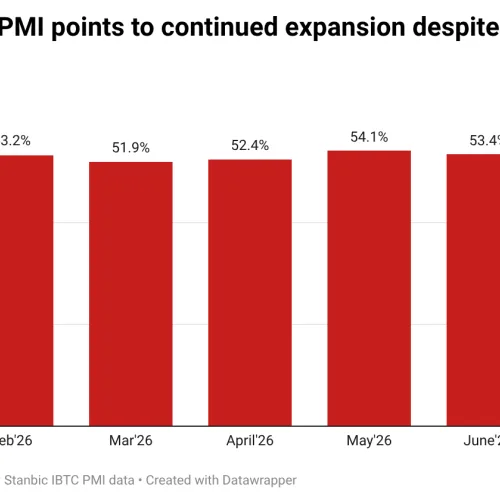
The Stanbic IBTC Bank Nigeria Purchasing Managers’ Index (PMI), compiled by S&P Global, declined to 52.5 in July from 53.4 in June. While the reading marked the slowest expansion in three months, it remained above the 50-point threshold that separates growth from contraction, indicating continued improvement in business conditions.
The survey showed that businesses recorded another sharp rise in new orders, extending the current sequence of demand growth to six months. Respondents attributed the increase to improved customer demand, the introduction of new products, and more competitive pricing strategies.
The sustained increase in new business translated into higher output, although production growth moderated to its weakest pace since January. Agriculture and manufacturing recorded the strongest output gains, while services and wholesale and retail trade posted more modest expansions.
Companies also continued to expand their workforce in response to rising demand, but employment growth eased to a three-month low.
Businesses increased purchases of raw materials and other inputs to meet current orders and prepare for future workloads. Inventories also rose during the month. However, some firms reported logistical challenges that delayed project completion, leading to a slight increase in outstanding work despite efforts to expand capacity.
One of the survey’s more encouraging findings was a further easing in inflationary pressures.
Input cost inflation slowed to its weakest level in five months as purchase prices rose at a softer pace, although firms continued to cite higher fuel and raw material costs. Staff costs also increased at the slowest rate since April.
The moderation in cost pressures filtered through to customers, with companies raising selling prices at the weakest pace since February. Agriculture recorded the fastest increase in selling prices, while services experienced the slowest rate of price inflation.
Muyiwa Oni, Head of Equity Research for West Africa at Stanbic IBTC Bank, said stronger customer demand continued to underpin business activity despite the moderation in the headline PMI.
“Nigerian businesses reported improved customer demand in July, while better pricing and new product launches also helped them to capture new orders arising from the increase in demand,” Oni said.
He noted that firms also increased input purchases to meet existing demand and prepare for future business activity.
According to Oni, the moderation in input costs aligns with Nigeria’s recent inflation trend. Headline inflation eased marginally to 15.91 percent year-on-year in June from 15.93 percent in May, ending three consecutive months of increases.
Although he expects inflation to rise on a month-on-month basis in July, Oni said the annual rate is likely to moderate further to about 15.72 percent, supported largely by favourable base effects.
Stanbic IBTC retained its forecast of 4.1 percent economic growth for Nigeria in 2026, projecting oil sector growth of 3.45 percent and non-oil sector expansion of 4.11 percent.
However, the bank cautioned that several risks could threaten the outlook, including insecurity affecting food production, renewed exchange-rate pressures, adverse weather conditions, higher fertiliser prices and uncertainty in the global economy that could weaken investor sentiment and capital flows.
Looking ahead, businesses remained optimistic about the next 12 months. Nearly half of survey respondents expect output to increase, citing enhanced marketing efforts, business expansion plans, and the opening of new branches. Even so, overall business confidence eased from June’s one-year high.
Chinwe Michael is a financial inclusion advocate and economy journalist who uses compelling storytelling to drive awareness. With a background in Banking and Finance and experience across accounting, media, and education, she applies sharp analysis and attention to detail to every piece. She simplifies complex financial and economy concepts into engaging content for Africa and global audience. Chinwe also doubles as a speaker with global recognition for her expertise.

Comments
Start the conversation about this story.