





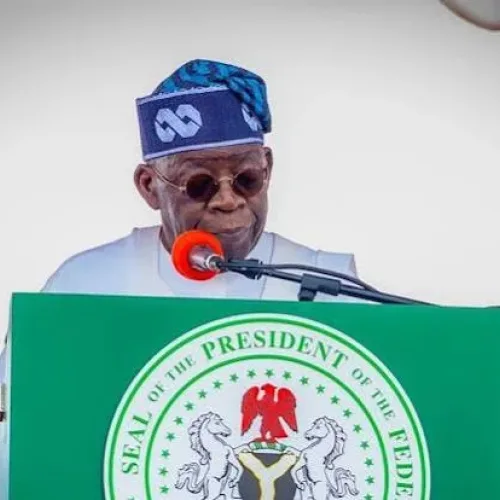
President Bola Tinubu will receive the Executive National Policing Bill on for review on September 3, 2026, the Presidency revealed on Monday.
This was as it unveiled a public information portal, nationalpolicingbill.com, through which Nigerians can submit memoranda and position papers to shape the legislation before it is reviewed by the President and transmitted to the National Assembly.
Chief of Staff to the President and Chairman of the Presidential Working Group on the National Policing Bill, Femi Gbajabiamila, made the disclosures while briefing State House correspondents after convening a meeting of the Working Group at the Aso Rock Presidential Villa, Abuja.
During the briefing, Gbajabiamila disclosed that the approved work programme was a seven-week, milestone-driven exercise running from July 27 to September 14, 2026.
“The resulting Executive Bill package is scheduled for presentation to the President on the 3rd of September.
“Subject to his approval, and I think we have tweaked that so the national consultation will come before the President’s final approval, after which the text and supporting materials will be revised and prepared for formal transmission to the National Assembly,” he said.
He explained that the final package would comprise schedules, an explanatory memorandum, a legal audit and consequential-amendments matrix, a clause-by-clause analysis, a State readiness framework, a fiscal and implementation note, a validation report, a risk register and a controlled digital archive.
According to him, “This is a monumental reform that Nigerians have debated for many years.
“Our central task now is to design a lawful, professional and sustainable federal and state policing system that places greater capability closer to the people while preserving national standards, national security and the rights of every Nigerian.”
The former Speaker of the House of Representatives further distinguished between the constitutional amendment already passed by both chambers of the National Assembly and the operational legislation his Working Group has been tasked with producing.
He explained, “The Senate approved the State Police constitutional proposal on June 24, 2026, and the House of Representatives passed the Executive State Police Bill on 23 July 2026.
“The constitutional amendment is, however, not yet in force. It must obtain the approval required from the State Houses of Assembly as prescribed under the Constitution.
“Until that process is concluded, there is no operational State Police Service anywhere in Nigeria, and the Nigeria Police Force remains the constitutionally recognised police institution.”
On the guiding philosophy of the reform, Gbajabiamila argued that state policing must not become an instrument of political control.
“State Police cannot mean 36 state militias, just as national standards cannot become a disguised method of re-centralising day-to-day State policing.
“No political officeholder should be able to direct the arrest of an opponent, the suppression of lawful political activity or the selective enforcement of the law.
“Federal intervention must remain exceptional, evidence-based, proportionate, time-limited and reviewable.”
Gbajabiamila revealed that the website nationalpolicingbill.com went live on Monday, and will give Nigerians a direct channel to submit memoranda for roughly two weeks, with a possible extension.
“There will be a website which has gone live already, for members of the public to learn about the stages of what we’re doing, and to actually contribute and send their contributions through that platform.
“So the public is included, no matter your station in life. The website is nationalpolicingbill.com, which will metamorphose hopefully in the next couple of days to .gov.ng,” he said.
Responding to a question on the estimated cost of the new policing system, Gbajabiamila declined to offer a figure, saying, “There is no cost that will be too much to secure lives and property.”
He added, “Giving you a cost now will be pulling something out of thin air.
“The cost will be evidence-based, based on thorough research, and on a state-by-state basis, because one state differs from the other in terms of personnel, infrastructure and local needs. It’s a good question, but it’s premature.”
On whether national standards undermine the autonomy state police is meant to provide, he said standards exist purely as a safeguard floor, not a ceiling.
According to him, “National standards are there to ensure safeguards. You can’t just give states carte blanche to do whatever they want, there’s no basic uniformity in that.
“Those standards are just the minimum. States can go beyond if they have the capacity. But no citizen will be shortchanged just because a state cannot meet the minimum.”
Comments
Start the conversation about this story.