





• Set to hold meeting of opposition leaders in two weeks
•Says Nigeria not working, democracy facing exhaustion
A group of 100 prominent Nigerians under the aegis of G100 has formally appealed to leaders of the opposition across the country to close ranks ahead of the 2027 general election, urging them to subordinate personal ambition to national interest and rally behind a common front capable of challenging President Bola Tinubu and the ruling All Progressives Congress (APC).
In an open letter titled: “The Doctrine of a Necessary Democratic Opposition: An Open Letter to the Leaders of the Opposition, Leaders of Thought, Civil Society, and Nigerians of Good Conscience,” the group warned that Nigeria was facing a deep structural crisis, arguing that the country could not sustain a healthy democracy without a strong and united opposition.
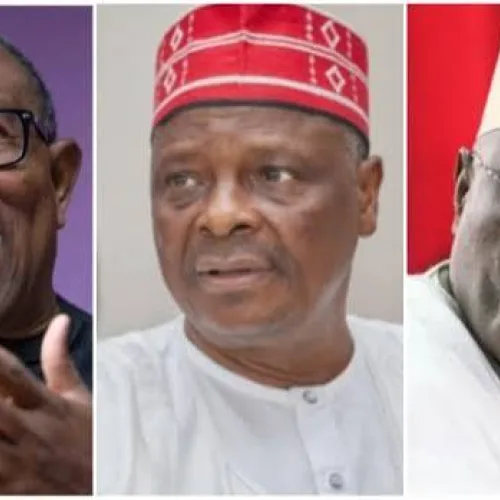
The letter was addressed to key opposition figures, including former Vice President and presidential candidate of the African Democratic Congress (ADC), Atiku Abubakar; presidential candidate of the Nigeria Democratic Congress (NDC), Peter Obi; former Governor of Rivers state and running mate to Atiku, Rotimi Amaechi; former Kano State Governor and running mate to Obi, Rabiu Kwankwaso and former Senate President and Chairman of the ADC, David Mark.
Others included: Oyo State Governor and presidential candidate of the Allied Peoples Movement (APM), Seyi Makinde; Bauchi State Governor, Bala Mohammed; former Osun State Governor and ADC scribe, Rauf Aregbesola; former Bayelsa Governor and NDC national leader, Senator Seriake Dickson, former Cross River Governor and presidential candidate of the Peoples Redemption Party (PRP), Donald Duke and several others.
The group maintained that the time had come for opposition leaders to place the country’s future above individual political aspirations.
The letter was signed by 100 prominent Nigerians, including former National Vice Chairman (North-west) of the APC, Salihu Lukman; former House of Representatives member, Hon. Nnenna Ukeje; former Deputy Governor of Kogi State, Elder Simon Achuba; Dr. Akilu Indabawa; former House of Representatives member, Hon. Annie Ekeh; Prof. Anthony Kila; Dr. Awalu Anwar; Dr. Emeka Ejikonye; Dr. Ibrahim Moddibo; Dr. Ladan Salihu, among others.
The group also announced plans to convene a National Council of Opposition Leaders within the next two weeks, where leading opposition figures would be expected to negotiate the framework for presenting a united front in the 2027 presidential election.
“We therefore call upon every leader of the democratic opposition to assemble, not as rivals contending for personal distinction, but as citizens entrusted with a higher duty to the Federal Republic of Nigeria,” the group stated.
It added that at the proposed meeting, “every candidate’s ambition shall be summoned before the bar of patriotism and every man or woman shall be asked a single question: whether he or she seeks to contest the 2027 elections for himself or herself, or the salvation of Nigeria.”
The G100 explained that the proposed gathering would reaffirm the spirit of the Ibadan Declaration of April 2026 and lay the foundation for the emergence of a single presidential standard bearer for the democratic opposition.
According to the group, “No people can hope to defeat a united failure with a divided alternative.”
In the lengthy letter signed by the 100 Nigerians drawn from different backgrounds, the group painted a grim picture of the country’s current condition, insisting that the nation’s problems extended beyond the economy to the very structure of governance.
“Nigeria is not working. A nation endowed with abundance has become a nation accustomed to scarcity. Honest labour no longer guarantees a decent life. Families work harder yet possess less. The young inherit uncertainty instead of opportunity, while the old witness promises repeatedly exchanged for disappointment,” the group pointed out.
While acknowledging that many Nigerians viewed the country’s predicament as either economic or political, the group argued that the underlying challenge was structural.
“The true crisis is structural. We have fashioned a political order that too often rewards loyalty over merit, patronage over service, and power over accountability. We should not wonder that such a system produces poverty and misery,” it stated.
The group further warned that the country’s democracy was facing a slow but dangerous erosion, stressing that democratic systems often collapsed not through dramatic events but through gradual institutional decline.
“History now presents our own generation with its examination. The danger before us is not the sudden overthrow of democracy, but its gradual exhaustion. Democracies rarely perish in a single day. They decay when opposition becomes disorganised, when citizens become indifferent, and when ambition triumphs over principle,” it said.
According to the signatories, the weakening of opposition politics has allowed the ruling party to consolidate power, while those expected to provide an alternative have become increasingly divided.
“The ruling party grows stronger, not only because of its own organisation, but because it has surrendered internal dissent to the authority of the executive. At the same time, those entrusted with presenting Nigerians an alternative have become divided by ambition rather than united by purpose. While the executive consolidates power, the opposition fragments,” the letter stated.
The G100 argued that democracy could only thrive where governments remained subject to credible electoral competition.
“No democracy can remain free unless those who govern are matched by those who are capable of replacing them,” it stated, adding that “the liberty of a people depends not only upon the existence of government, but upon the certainty that government may be peacefully challenged, corrected and, when necessary, replaced.”
Recalling previous defining moments in Nigeria’s democratic history, the group cited the role of the G34 during the struggle against military rule as well as the Doctrine of Necessity adopted during the constitutional crisis created by the prolonged absence of late President Umaru Yar’Adua, saying both episodes demonstrated the supremacy of national interest over political expediency.
The signatories therefore urged opposition leaders to begin immediate negotiations aimed at building “a common purpose, a common programme, a common strategy and a common resolve to save Nigeria.”
“The hour is too grave for scattered ambition and private calculation. Nigeria cannot be rescued by opposition leaders who march separately toward the same defeat. Personal ambition must submit to national necessity,” the letter added.
The group also challenged civil society organisations, labour unions, religious leaders, intellectuals and ordinary Nigerians to play more active roles in defending democratic values, warning that liberty was often lost incrementally when citizens failed to defend it.
Comments
Start the conversation about this story.