





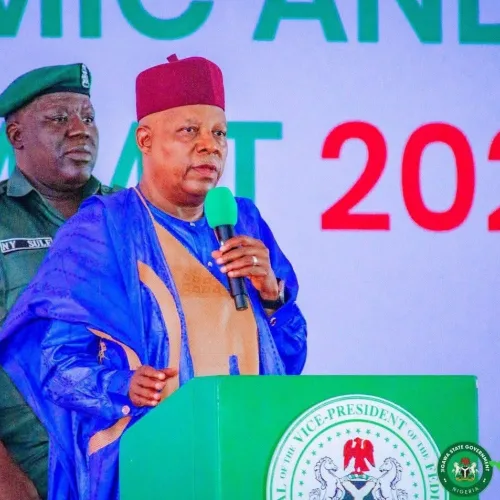
Vice President Kashim Shettima has urged Saudi Arabian investors to seize emerging opportunities in Nigeria, declaring that the country is open for business and positioning itself as Africa’s leading hub in the multi-trillion-dollar global halal economy.
Shettima made the call on Tuesday at the opening of the two-day Nigeria-Saudi Investment and Tourism Exhibition in Abuja, organised by Al-Yaro International Limited in collaboration with the Nigerians in Diaspora Commission (NiDCOM), where stakeholders also advocated stronger trade ties and joint ventures between the two countries.
Represented by his Special Assistant on Export Expansion, Aliyu Bunu Sheriff, the Vice President said President Bola Ahmed Tinubu’s administration has placed export diversification, non-oil export growth and the creation of a globally competitive investment climate at the centre of its economic agenda.
“Nigeria is open. Nigeria is ready. Under the leadership of President Bola Ahmed Tinubu, the administration has made export diversification, non-oil export growth and a globally competitive investment climate central pillars of national policy,” he said.
He noted that the timing of the exhibition was significant as Nigeria and Saudi Arabia seek to deepen cooperation in agriculture, tourism, healthcare, energy, infrastructure, logistics and technology.
According to him, Nigeria should no longer be viewed merely as a consumer market but as Africa’s largest economy and most populous nation, with strategic access to the African Continental Free Trade Area (AfCFTA).
“Too often, the relationship between our two countries has been narrowly defined. Nigeria is not simply a market to be served; it is Africa’s largest economy and most populous nation, sitting at the gateway to the African Continental Free Trade Area’s more than one billion consumers.
ALSO READ: Four killed in fresh attack on Benue community
“Saudi Arabia, in turn, is not simply a source of capital. Under Vision 2030, it is one of the world’s most ambitious and fastest-diversifying economies, with deep expertise in sectors such as tourism, agriculture, energy, infrastructure and healthcare,” he said.
The Vice President said the Federal Government was implementing a comprehensive Halal Economy Strategy to position Nigeria as Africa’s leading destination in the global halal market, valued at more than $7 trillion.
He explained that the strategy covers agriculture, livestock, food processing, pharmaceuticals, cosmetics, logistics and Islamic finance, describing the halal economy as one of the strongest platforms for expanding economic cooperation between Nigeria and Saudi Arabia.
“The opportunity before us is not a one-way investment but a genuine reciprocal partnership.
“Nigeria has, over the past several months, been developing a Nigerian Halal Economy Strategy, chaired by His Excellency himself, to position our country as Africa’s leading hub in the global halal market, which is valued at more than $7 trillion.
“We see the halal economy as one of the most natural and underutilised bridges between Nigeria’s productive base and Saudi Arabia’s capital, expertise and market access across the Gulf and the broader Arab world,” he said.
Highlighting Nigeria’s competitive advantages, Shettima said the country offers investors a large population, abundant agricultural resources, youthful entrepreneurial talent and proximity to Gulf markets.
“We offer proximity—geographically closer to Gulf markets than any of the world’s current halal agricultural exporters.
“Increasingly, we offer structure—a government actively building the standards, certification, financing and infrastructure architecture that gives investors confidence that commitments made today will be honoured tomorrow,” he added.
The Vice President commended NiDCOM and Al-Yaro International Limited for creating a platform that promotes people-to-people diplomacy and commercial partnerships between Nigeria and Saudi Arabia.
He assured investors of the Federal Government’s commitment to work with relevant ministries, departments and agencies to translate discussions from the exhibition into investment agreements and lasting partnerships.
Earlier, the Chairman/Chief Executive Officer of the Nigerians in Diaspora Commission, Hon. Abike Dabiri-Erewa, called for the establishment of joint ventures between Nigerian and Saudi investors, describing the diaspora as a critical driver of investment and national development.
“The Nigerian diaspora brings more than remittances to the country. They bring global expertise, market intelligence, credibility and strategic partnerships that can drive sustainable economic growth,” she said.
Dabiri-Erewa noted that Saudi Arabia hosts one of the largest Nigerian communities in the Middle East, comprising professionals, entrepreneurs, doctors and engineers who are making significant contributions to the Saudi economy.
She regretted that Nigerians abroad are often portrayed negatively despite their achievements.
“We must change the narrative. Nigeria is blessed with outstanding professionals and entrepreneurs whose achievements deserve global recognition. They are ambassadors of our country and should be celebrated,” she said.
She added that the exhibition would deepen business-to-business engagements in energy, infrastructure, hospitality, logistics, technology, healthcare and tourism while promoting structured investments between the two countries.
Speaking with journalists on the sidelines of the event, Dabiri-Erewa said the exhibition demonstrated that Nigeria is ready for investment.
She disclosed that Nigerians living in Saudi Arabia played a key role in attracting Saudi investors to Nigeria while also encouraging Nigerian businesses to explore opportunities in the Saudi market.
According to her, both countries possess enormous economic potential beyond religious tourism, adding that improved perceptions of Nigeria and Saudi Arabia would unlock greater opportunities in manufacturing, commerce and industrial development.
She expressed confidence that discussions initiated during the exhibition would culminate in concrete investments capable of creating jobs, boosting exports and strengthening bilateral economic relations between the two countries.
Comments
Start the conversation about this story.