





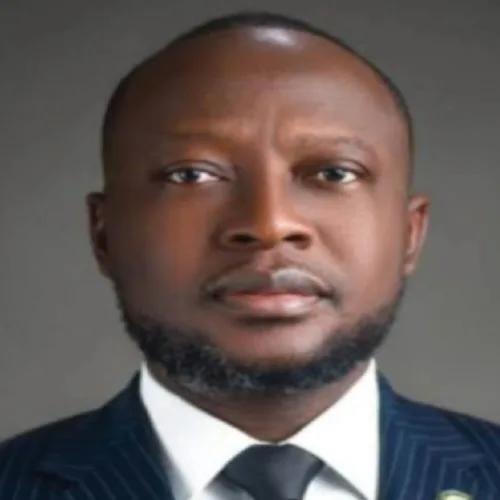
Dr. Muyiwa Gbadegesin is the Managing Director, Lagos Waste Management Authority (LAWMA). In this interview with DAYO AYEYEMI, he speaks on some ongoing projects of the authority to ensure that Lagos is free of dirt.
Olusosun dumpsite is an eyesore, what is the current programme to decommission the site?
There is a total rehabilitation of Road E and two of the platforms on a Corporate Social Responsibility basis by ZoomLion Nigeria Limited; our partner who are constructing Transfer Loading stations and Naterial Recovery Facilities that will be opened in a few months for waste management – disposal and treatment.
There is a bit of confusion. Are you saying Olusosun will be opened for waste dumping despite the planned decommissioning?
We announced that we were winding down activities at Olusosun and that we have a timeline. If you recall, we said 18 months from the time that we break ground on construction of the Transfer Loading Station. So, it hasn’t been closed. You can see in the last few months, we have been seeing trucks coming and going, we have been seeing the queues. What we have done here is to claim a portion so that we can have somewhere to dispose as we wind down the activity. That’s what we’ve achieved so that we can clear some of these wastes on the roads. It’s not a good thing for us to have waste on the road. So, by opening this place, we’ve created more space and eventually we’re going to close the place entirely.
So, what is the message for Lagosians, bearing in mind that the challenges have been access to the dumpsite?
Well, there’s been a lot of challenges. It’s incorrect to say that the challenge is only the dumpsite. A lot of the challenge is also our behaviour and our culture as a people. You have laws that say you should have bins in your house, you should pay PSP operators. The question is, how many of us are paying on time? And if you don’t pay them, how are they supposed to buy diesel? How do they pay their staff? How do they buy batteries and tyres, and all the things that they need to ensure regular collection in your house? That’s one part of the problem. Another part of the problem is just the huge population of Lagos. And that’s why we’re making new investments. We’re talking of Transfer Loading Station, material recovery facility, waste to energy plants, biogas plants.
All these investments by the Lagos State government is to be able to handle the population we have now and the projected population.
Look around you, if you see some trailers bringing in thousands of people every day into Lagos because we have good infrastructure here. We’re not saying that they shouldn’t come, but we have to make provision for them. We are thanking Mr. Governor and a lot of people are thanking him. It’s a continuous thing. You can’t stop. You keep making more and more investment. We’re talking about new trucks coming in. There are so many things that we’re going to put in place over the next few months and years.
With this development, are we going to have Lagos free from dirt?
Let me rephrase that question for you.
Lagos will be free from dirts, when Lagosians decide that Lagos will be free from dirt. It is a collective responsibility if every Lagosian decides. There are some countries you go to where people do not drop waste on the road, they keep it with them until they get to their house or get to somewhere where they can dispose it. If everyone in Lagos decides to be that, there’s not going to be waste on the road again. And we won’t have a problem. But now, some people have decided that they will put their waste on the road, on the median, instead of giving it to the PSP operators or instead of waiting for the PSP operators. We have also said, if you have any delay, reach out to LAWMA direct lines. If you have delay in your collection, call directly, don’t bring your waste to the roadside. That’s when we’ll stop having waste on the roadside.
What’s the cost implication of this project?
It’s a corporate social responsibility. I don’t know the cost. It’s something done by ZoomLion, and if we use this one, well, maybe they’ll be encouraged to do more for us. He cautioned that any attempt by OSGOF to allocate land, impose premiums, revoke titles, or recover land is not merely irregular, but a direct collision with the constitutional order.
ALSO READ: Tinubu’s govt will meet January deadline on FCT projects completion — Wike
The White Paper by Enitan- led Cromwell Center for Research in Housing and Urban Development showed through documents and law that OSGOF’s current trajectory is ultra vires, economically dangerous, and constitutionally corrosive.
“Land Use Act is a federal statute, but it is implemented primarily through state institutions. Governors administer land; state LUACs advise on allocation; state planning authorities regulate development. Federal technical agencies like OSGOF support, but do not supplant these structures.
“When OSGOF creates its own LUAC, issues demand notices, or entertains land-recovery schemes, it creates jurisdictional conflict. State governments are left to wonder whether their constitutional authority is being eroded. Investors are left to wonder which authority to obey. Citizens are left to wonder whose signature truly secures their homes,” the document read.
On it’s economic impact, Enitan explained that actions of OSGOF could inject uncertainty into the title system.
“Banks respond by tightening lending criteria, increasing legal due diligence costs, or refusing to accept certain categories of titles altogether. Developers respond by delaying projects or shifting capital elsewhere. Pension funds respond by re-weighting portfolios away from real estate.
“The result is a slow but steady accumulation of toxic titles: assets that sit on balance sheets but cannot be safely leveraged, traded, or developed. This is dead capital on a national scale,” he said
As remedies, Enitan urged the Federal government to return OSGOF to its lawful mandate of mapping, and not management; dismantle the shadow corporate ecosystem that trades on its name and address; halt any attempt to commercialize sovereign land-recovery powers; restore certainty to land titles; and re-enthrone the rule of law as the only true source of administrative authority.
To restore order, he suggested that Nigeria must obtain a formal legal opinion from the Attorney-General clarifying OSGOF’s mandate.
Comments
Start the conversation about this story.