





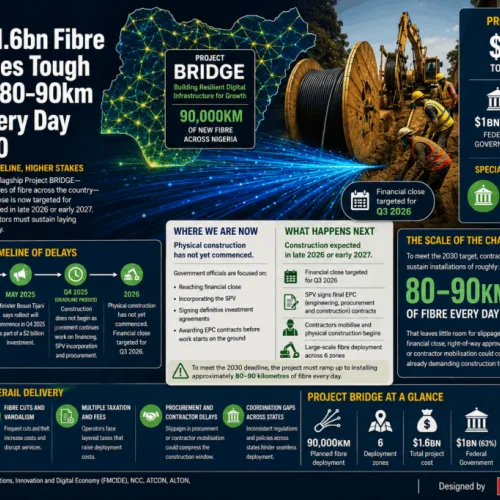
Nigeria will have to sustain one of Africa’s fastest digital infrastructure construction programmes by laying up to 90 kilometres of fibre-optic cable every day for nearly five years, if it is to deliver its flagship Project BRIDGE and meet ambitious broadband targets by 2030.
The scale of the challenge is laid bare in implementation documents for the federal government’s national fibre initiative, which call for about 17,500 kilometres of fibre to be deployed in the first year, followed by 25,000 kilometres annually in 2028 and 2029, before another 22,500 kilometres are completed during the first nine months of 2030.
At peak construction, contractors working simultaneously across six zones would need to install roughly 80 kilometres to 90 kilometres of fibre every day, a pace that industry analysts say will test Nigeria’s engineering capacity, regulatory coordination and ability to protect critical infrastructure.
Read also: Nigeria has fibre across states but lacks fair access market—NCC
The demanding construction schedule marks a shift in the country’s biggest broadband project from financial structuring to execution planning. While the government has spent more than two years securing financing, negotiating right-of-way reforms and designing the project’s commercial structure, the harder task now is converting plans into thousands of kilometres of fibre on the ground.
Project BRIDGE is designed to deploy 90,000 kilometres of new fibre, expanding Nigeria’s national fibre footprint to about 125,000 kilometres through an open-access wholesale network. Rather than competing with existing fibre owned by mobile operators and infrastructure companies, the project aims to connect fragmented networks, improve redundancy and extend broadband deeper into underserved communities.
Bosun Tijani, the minister of Communications, Innovation and Digital Economy, described Project BRIDGE as the foundational digital infrastructure project in Nigeria’s history and a critical pillar in the implementation of President Bola Ahmed Tinubu’s Renewed Hope Agenda.
“This is more than fibre; it is about inclusion. It is about ensuring every Nigerian, whether in a major city or rural community, can participate in and benefit from the digital economy,” he said.
Tijani has also stated that the project will add 90,000km to the existing 35,000km network of fibre optic cable, thereby deepening digital backbone.
The federal government recently confirmed that the project’s financing has been formally appraised at $1.6 billion, lower than the earlier $2 billion estimate that had circulated during the project’s early planning.
The financing package includes $500 million from the World Bank’s International Development Association, $1.1 billion expected from private and commercial investors, $200 million from the African Development Bank, $100 million from the European Bank for Reconstruction and Development and another $100 million from the Arab Bank for Economic Development in Africa (BADEA).
How Nigeria built 101,000km of fibre that bypasses 130m Nigerians
Tijani announced the EBRD approval, saying: “As we conclude the final leg of our Project BRIDGE Investment Tour in Europe this week, following several extremely positive engagements, I am pleased to confirm the formal approval by the Board of the European Bank for Reconstruction and Development to proceed with a $100 million investment in Project BRIDGE.”
On the AfDB’s $200 million approval he stated: “This is yet another signal… that Nigeria’s digital infrastructure agenda commands serious, sustained institutional confidence… Nigeria is not waiting for the world to connect us. We are building our own infrastructure and the world is choosing to invest alongside us.”
Government officials say more than 30 local and international companies have already expressed interest during the market-sounding and prequalification process, with the next phase expected to focus on establishing the Special Purpose Vehicle (SPV), concluding investment agreements and awarding engineering, procurement and construction contracts.
The ownership structure also reflects a departure from traditional government-led infrastructure projects. Private investors are expected to own between 51 percent and 75 percent of the SPV, leaving the federal government with a minority stake of between 25 percent and 49 percent. The arrangement is intended to shield the company from political interference while allowing it to operate on commercial principles.
But raising capital may prove easier than delivering the network.
To achieve its targets, Nigeria plans to split the country into six engineering, procurement and construction zones, allowing multiple contractors to build simultaneously. Beyond laying fibre, the project also requires wholesale interconnection hubs to be activated, more than 400 local government headquarters to be connected, redundant network routes to be created and public institutions linked to high-speed internet.
By 2030, the government expects the programme to increase broadband users from around 92 million to 150 million, reduce wholesale bandwidth prices by 17 percent, increase fixed broadband speeds to 50 Mbps and connect more than 59,000 public institutions, including schools, hospitals and government offices.
The programme also includes digital literacy training for 37,000 Nigerians, with women expected to account for 60 percent of participants.
Those targets underline why Project BRIDGE extends beyond the telecommunications sector.
Affordable and reliable fibre infrastructure has become the foundation for artificial intelligence, cloud computing, fintech, digital public services and modern manufacturing. A larger wholesale fibre backbone could enable operators and internet service providers to expand into commercially underserved areas while lowering the cost of bandwidth across the economy.
Aminu Maida, the executive vice chairman, Nigerian Communications Commission (NCC) noted that by extending the national fibre backbone through the deployment of approximately 90,000 kilometres of additional fibre-optic cable, the project is expected to expand broadband availability, improve network resilience and extend high-capacity connectivity to all 774 Local Government Areas.
“The project will also strengthen Nigeria’s digital backbone, improve network resilience and support faster, more reliable broadband services across the country,” Maida said, stressing that “Fibre infrastructure is now foundational to Nigeria’s digital economy, inclusive growth and global competitiveness.”
Tony Emoekpere, chairman of the Association of Telecommunications Companies of Nigeria (ATCON) President has said the project aimed to create a robust and resilient telecommunications backbone across Nigeria and is not meant to replace existing infrastructure but to complement it, creating a more resilient network.
“Right now, most of the networks that we have are linear in nature. Just imagine, if there is only one road from Lagos to Ibadan; if anything happens to that road, you would not get to Ibadan. This project will create alternative routes,” he said, adding that While still at the early stages, the clarity around this initiative in 2025 restored confidence that Nigeria is serious about building a scalable, open-access fibre foundation for the digital economy and that key routes and regional rings are expected to go live progressively so Internet Service Providers (ISPs) can benefit early.
Yet the project faces significant execution risks.
The World Bank has classified the programme’s overall risk as substantial, pointing to governance concerns, procurement challenges, institutional capacity constraints and broader macroeconomic pressures, including inflation and foreign exchange volatility.
Another hurdle is securing consistent right-of-way approvals. Although more than 11 states have agreed to waive right-of-way charges, inconsistent local government levies and administrative delays remain potential obstacles to maintaining the project’s aggressive construction schedule.
Protecting the new infrastructure may prove equally difficult.
Nigeria’s telecommunications industry recorded 155,397 fibre cuts in April and May 2026 alone, including 74,276 incidents in April and 79,121 in May. More than 54,000 of those cases were linked to vandalism, highlighting the vulnerability of fibre infrastructure even before Project BRIDGE significantly expands the national network.
The attacks continue despite the Critical National Information Infrastructure (CNII) Order, signed by President Bola Tinubu and gazetted in June 2024 to provide stronger legal protection for strategic digital infrastructure.
Gbenga Adebayo, chairman of the Association of Licensed Telecommunications Operators of Nigeria (ALTON) highlighted the severity of fibre cuts, noting that while undersea cables in the Atlantic may see one outage in two years, the terrestrial route from Lagos to Kano records an average of about 40 cuts a day.
Adebayo described telecommunications as the critical foundation supporting all sectors of the economy and warned that continuous attacks put strains on the sector.
For Project BRIDGE, however, legislation alone may not be enough. The project’s success will depend on whether governments, contractors, security agencies and host communities can safeguard tens of thousands of kilometres of new cable from excavation damage, theft and deliberate vandalism.
Ultimately, the challenge facing Nigeria is no longer whether it can design an ambitious broadband strategy or attract development finance.
The real test is whether it can sustain a construction pace of up to 90 kilometres of fibre every day, coordinate multiple contractors across six regions and deliver one of Africa’s largest digital infrastructure projects on schedule.
If it succeeds, Project BRIDGE could transform broadband affordability, strengthen network resilience and provide the digital backbone needed for Nigeria’s ambitions in artificial intelligence, cloud services and the wider digital economy. If it falls behind schedule, however, the country’s digital transformation agenda risks being delayed by the same infrastructure gaps the project was conceived to eliminate.
Get Newsletter Updates
Enjoying our column?
Subscribe to our specialised **Tech Pulse** feed to receive fresh reports and analyses directly in your inbox.
Royal Ibeh is a senior journalist with years of experience reporting on Nigeria’s technology and health sectors. She currently covers the Technology and Health beats for BusinessDay newspaper, where she writes in-depth stories on digital innovation, telecom infrastructure, healthcare systems, and public health policies.

Comments
Start the conversation about this story.