





The Federal Government has established an Artificial Intelligence (AI) and Cyber Diplomacy Unit within the Ministry of Foreign Affairs as part of efforts to deepen Nigeria’s engagement in global digital governance and reposition the country’s foreign policy for the rapidly evolving technology landscape.
Minister of State for Foreign Affairs, Ambassador Sola Enikanolaiye, disclosed this in Abuja while declaring open the Second Seminar on Anticipatory, Cyber and Digital Diplomacy (ACDD 2.0), saying the initiative would ensure Nigeria remains competitive in an international system increasingly shaped by artificial intelligence, cybersecurity and digital technologies.
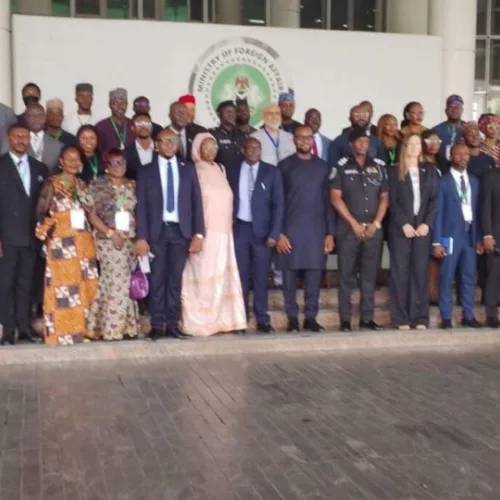
The two-day seminar, themed “From Awareness to Activation: Operationalising AI, Cyber and Digital Statecraft for Nigeria’s Foreign Policy,” brought together diplomats, policymakers, security agencies, technology experts, development partners, academia and members of the diplomatic corps to examine how emerging technologies can be integrated into Nigeria’s foreign policy framework.
ALSO READ: Tech4Dev earns ITU global recognition as WSIS prizes 2026 champion
Enikanolaiye said the newly created AI and Cyber Diplomacy Unit, domiciled in the Ministry’s International Organisations Department, was one of the key outcomes of the maiden edition of the seminar held in 2025.
According to him, the unit will coordinate Nigeria’s engagement on emerging technological issues, strengthen the country’s participation in global digital governance processes and ensure that diplomatic engagements adequately reflect the strategic implications of technological advancement.
“This seminal event builds on the success of its maiden edition in 2025, which initiated an important conversation on the interface of diplomacy, emerging technologies and global governance. A significant outcome of the inaugural seminar was the establishment of the Artificial Intelligence and Cyber Diplomacy Unit within the Ministry. When fully operationalised, the Unit will serve as a focal point for coordinating Nigeria’s engagement on emerging technological issues and strengthening our participation in global digital governance processes,” he said.
The minister observed that advances in artificial intelligence, cybersecurity and digital technology are fundamentally changing international relations, making it imperative for Nigeria to modernise its diplomatic institutions.
“The contemporary international system is undergoing a profound transformation, such that the boundaries between diplomacy, economics, security, science and technology are becoming fluid. Advances in artificial intelligence, cybersecurity and digital technology are reshaping the manner in which states engage, communicate, negotiate and pursue their national interests,” Enikanolaiye said.
He stressed that anticipatory diplomacy requires governments to move beyond reacting to global developments and instead prepare proactively for emerging technological realities.
“Anticipatory diplomacy requires a shift from reactive approaches to proactive engagement. It calls for stronger institutional readiness, enhanced digital capabilities within our diplomatic service and deeper cooperation among government institutions, academia, technology experts and international partners,” he said.
Enikanolaiye urged participants to focus on practical recommendations that would strengthen Nigeria’s diplomatic institutions and position the country as a leader in digital diplomacy on the continent.
Also speaking, the Minister of Communications, Innovation and Digital Economy, Dr. Bosun Tijani, said digital capability has become as important as military strength and economic power in determining a nation’s global influence.
“The foundations of national power are changing. A nation’s ability to build digital infrastructure, develop digitally secure spaces, harness artificial intelligence and shape global technology standards is increasingly determining its competitiveness, resilience and influence. Digital capability is becoming as important to national influence as diplomacy, economic strength and defence,” Tijani said.
He noted that Nigeria has emerged as a strategic digital hub in West Africa, being the only country in the sub-region with communication satellites and the highest number of subsea internet cables.
Tijani disclosed that the Federal Government is investing in about 90,000 kilometres of fibre-optic infrastructure to improve broadband connectivity across Nigeria and neighbouring countries, adding that the National Digital Cloud Policy would soon be unveiled to attract global investment into the country’s digital infrastructure.
The minister further announced the establishment of a Ministerial Advisory Council on Cybersecurity to improve intelligence sharing between government and the private sector and strengthen the protection of critical national infrastructure.
He also revealed that Nigeria had developed the first government-backed large language model capable of understanding Yoruba, Hausa, Igbo, Ibibio and accented English, while the Federal Executive Council had approved the creation of a National AI Trust to oversee responsible development and governance of artificial intelligence.
Tijani added that nearly 300,000 young Nigerians had already been trained under the Three Million Technical Talent (3MTT) programme to prepare the country’s workforce for the digital economy.
Earlier, Chairman of the African Union Cybersecurity Experts Group and lead facilitator of the seminar, Abdul Hakeem Ajijola, said the programme was designed to move Nigeria from awareness to implementation of anticipatory cyber and digital diplomacy.
“AI is no longer coming; AI is here. The question for Nigeria is how we anticipate these developments, prepare for them, take advantage of the opportunities they present and, more importantly, mitigate the risks they may create,” Ajijola said.
He explained that cyber diplomacy had become increasingly important because cyber conflicts often precede conventional wars, while digital diplomacy provides nations with platforms to project their interests globally.
In a goodwill message, Inspector-General of Police, IGP Olatunji Rilwan Disu, said the increasing exploitation of digital platforms by criminal networks makes stronger cyber capabilities and digital diplomacy essential to national security.
“The Nigeria Police Force remains committed to safeguarding Nigeria’s digital ecosystem through capacity building, intelligence-led operations and public awareness.”
“We must proactively identify threats, build resilient systems and strengthen partnerships across government, the private sector and international allies,” the police chief said.
Comments
Start the conversation about this story.