





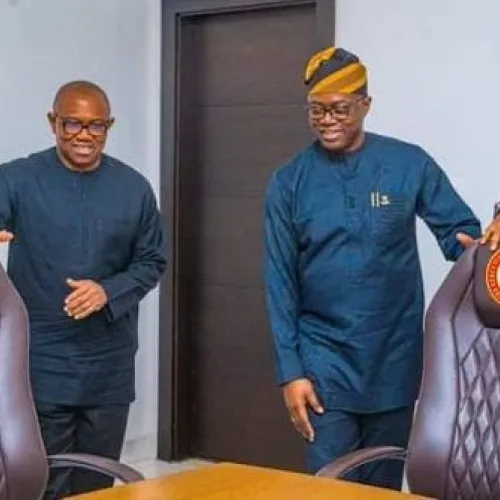
The duo of Oyo State Governor, Seyi Makinde, and the presidential candidate of the Nigeria Democratic Congress (NDC), Mr Peter Obi, have flayed Nigeria’s leadership and governance challenges, bordering on poor economic reforms, in spite of the country’s abundant human and natural resources.
Leaning on this challenge on Wednesday, in Ibadan, the Methodist Church Nigeria also called on the Federal Government to take decisive action against insecurity, inflation, the falling value of the naira and worsening hardship across the country.
The occasion was the opening session of the Methodist Church Nigeria’s 50th/15th Biennial Conference in Ibadan, Oyo State, where delegates from across Nigeria and the diaspora gathered under the theme: “I Will Fight For You” (Exodus 14:14), with discussions centring on national security, governance, economic recovery, leadership, justice and the future of the country.
Governor Makinde paid glowing tributes to the Methodist Church for what he described as over a century of nation-building through evangelism, education, healthcare, community development and moral instruction, saying, “For well over a century, this church has not only preached the gospel, but has invested in education; has invested in healthcare; has invested in community development, and has invested in the moral formation of generations of Nigerians.
“Nations are not built by government alone. They are built by institutions that shape values, strengthen families and inspire hope. The Methodist Church has remained one of those institutions,“ the governor said, while particularly commending the church’s readiness to hold public office holders accountable.
“From the speech I have just heard from the Prelate, there is one more thing to be added. The Methodist Church now speaks truth to power”, Makinde said, drawing from the conference theme, and maintaining that faith in God must go hand- in- hand with responsible leadership. He insisted that public office holders at every level must create a just and equitable society.
“Those entrusted with leadership must ensure a fair and just society. We must pursue peace. We must seek and stand up for truth, just as the Prelate demonstrated in his address. We must ensure opportunities that allow every child, regardless of background, to realise their God-given potential.
“Public office is a call to service rather than privilege. Leadership is not about privilege. It is about responsibility. It is measured not by the promises we make but by the lives we improve.”
According to him, while governments could provide roads, hospitals, security and public policies, genuine nation-building depended on integrity, compassion and shared values continually nurtured by faith communities.
“Government can build roads and hospitals. It can provide security and create policies. But building a nation requires integrity, compassion and a shared sense of purpose. Those are values that faith communities continue to nurture every day.”
Noting that his administration had deliberately focused on improving the lives of ordinary citizens instead of concentrating on political office holders, Makinde said, “People talk about 2027 and who is contesting for what office.
Yet, throughout Nigeria there are only about 1,520 elective leadership positions. We have about 1,000 delegates in this conference alone.“
“Even if all those positions were shared among us, millions of Nigerians would still be left behind. Our responsibility is to touch the lives of ordinary Nigerians”, he said, maintaining that Nigeria’s challenge was not a lack of talent or resources but the quality of leadership.
“Our nation does not lack talent. It does not lack resources. What Nigeria needs now more than ever is leadership that brings people together around a common purpose and the courage to place service above self.”
He then openly declared his intention to seek Nigeria’s highest office, noting, “It is no secret that I am running to be the President of the Federal Republic of Nigeria.
This is the type of leadership I will offer if I am given the opportunity to serve Nigeria. I use this opportunity to solicit your support, and I am confident that with faith in God and commitment from all of us, our best days as a nation are still ahead.”
Peter Obi, in his remarks, thanked the Methodist Church for its contributions to national development, adding,
Nigerians should stop deceiving themselves about the country’s challenges, insisting that the nation’s greatest problem remained leadership.
“There is nothing wrong with Nigeria. The only thing wrong with Nigeria is leadership. We have enough land to cultivate the food we need. We have enough human capital to develop like any nation.
“We have enough natural resources to generate enough revenue. There is absolutely nothing lacking in this country except responsible leadership”, he said.
Citing food insecurity as evidence of governance failure, the ex-Anambra state governor said, “The World Bank has stated that millions of Nigerians are facing active hunger.
It should never be so. Bangladesh produces almost ten times more rice than Nigeria despite occupying a far smaller land area. Israel exports food, yet Sambisa Forest alone is about three times the size of Israel. Our problem is not land. Our problem is leadership”.
Obi accused Nigerian politicians of placing personal enrichment above national development, noting that: “We politicians do not want to do anything apart from stealing public money, even money we do not need. That is our problem”. He urged governments to invest heavily in agriculture, education and healthcare rather than waste public resources.
“We need leaders who have competence, capacity and compassion. We must move Nigeria from consumption and stealing to production and value creation”.
“Obi also narrated his conversations with Governor Makinde following the abduction of pupils, teachers and their Principal in Oriire Local Government Area, expressing disappointment over what he described as the Federal Government’s inadequate response.
“I visited Governor Makinde and asked him how things were progressing. He told me he had not received a call from the President. I said that was wrong because the incident happened in Nigeria. If criminals can enter a forest to kidnap innocent citizens, the Nigerian state should be able to enter that same forest and ensure that no criminal comes out alive.”
According to him, insecurity persisted because corruption had weakened the country’s institutions, saying: “Non-state actors cannot be stronger than the state unless corruption is involved.”
Obi further urged religious leaders to remain fearless in confronting those in authority, stressing, “You are among the few remaining voices that can still tell politicians the truth. Please continue to stand up because if this country descends into anarchy, nobody will be spared.”
Earlier, the Prelate of the Methodist Church Nigeria, His Eminence, Dr Oliver Ali Aba, thanked God for preserving the church since its establishment in Badagry on September 24, 1842, describing the biennial conference as the denomination’s highest decision-making gathering where ministers and lay delegates deliberate on national and church affairs.
He commended Governor Makinde and the people of Oyo State for hosting the conference, while celebrating Ibadan’s rich historical, educational and cultural heritage, including the University of Ibadan, Immanuel College of Theology, Cocoa House and Africa’s first television station: NTA.
Focusing on the conference theme, the Prelate said the biblical account of God’s deliverance of Israel remained relevant to present-day Nigeria, where insecurity had become a major threat to national survival.
To him, “Banditry, kidnapping and killings have turned flourishing farming communities in states such as Borno, Benue and Plateau into theatres of sorrow. Farmers have been displaced, women raped, food production disrupted and human blood now flows like rivers. I call on the Federal Government to rise to one of its primary constitutional responsibilities of securing human lives and property.”
The church leader described the rescue of schoolchildren, teachers and their Principal abducted in Oriire Local Government Area after 56 days in captivity, as one of the few encouraging security successes recorded recently.
“We thank Jesus Christ for the rescue of the 46 Nigerians abducted in Oyo State. Their freedom was made possible through the combined efforts of praying Christians and security agencies. But we remain deeply saddened that Mr Michael Oyedokun and Mr John Ola never returned home because they were murdered by the kidnappers.”
Reviewing Nigeria’s economic situation, the Prelate lamented the continued rise in inflation, the depreciation of the naira and escalating energy costs. “These remain trying times for Nigerians. The rising cost of living continues to affect education, healthcare and businesses across the country.”
He appealed directly to President Bola Tinubu’s administration to take meaningful steps to reverse the trend, adding that “The Methodist Church joins other well-meaning Nigerians in appealing to the Federal Government led by President Bola Ahmed Tinubu to meaningfully address inflation, the free fall of the naira and the unrealistic cost of energy.”
The Prelate also urged leaders across the three tiers of government to demonstrate sacrifice and accountability. “Our governments must not abdicate the responsibilities for which they were elected. It is good to pray, but leaders must perform their duties creditably.”
He warned against negotiating with criminals, insisting that government should strengthen security operations instead. To him, “Governments must stop paying ransom to kidnappers. The Federal Government must become proactive on issues relating to banditry, kidnapping and insecurity.”
He called on Christians to remain steadfast in prayer while demanding accountability from leaders, saying, “We need prayers to overcome our personal and national problems. We pray that God will grant Nigeria mercy, justice, prosperity and leaders who will faithfully serve the people.”
The conference continues in Ibadan till Saturday, with delegates expected to deliberate on national development, security, economic reforms, moral leadership and the role of the Church in promoting justice, peace and national unity.
Please follow and like us:
Comments
Start the conversation about this story.