





- Advertisement -
From Accra’s sprawling urban landscape to Bunso’s thickening forest canopy, the journey of 117 kilometres felt like a passage into another Ghana; one where every breath carried the pulse of the forest with tangible richness.
Bunso, near Koforidua in the Abuakwa South Municipality, is not just a town; it is home to the Council for Scientific and Industrial Research Plant Genetic Resources Research Institute (CSIR‑PGRRI), a living archive where science, tradition, and advocacy converge.
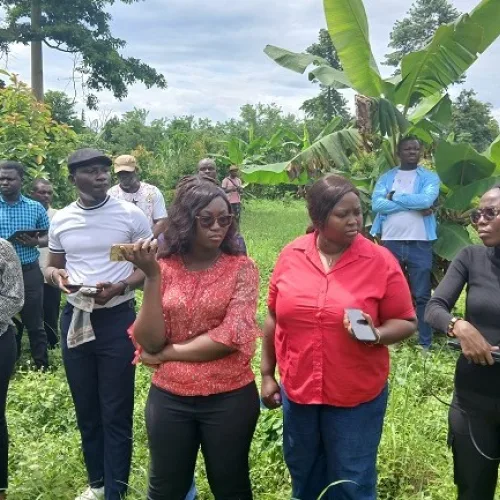
On June 23, 2026, Bunso became the meeting ground for scientists, journalists, and advocates during a “Capacity Building Workshop for Environmental Journalists, Reporters, and Content Creators.” Organised by CSIR‑PGRRI in collaboration with the World University Service of Canada (WUSC) and supported by the International Union for Conservation of Nature (IUCN), the event formed part of the broader Nature‑Based Climate Adaptation in the Guinean Forests of West Africa Project (NbS Project). Implemented in Ghana, Côte d’Ivoire, and Guinea, the project seeks to strengthen biodiversity conservation and promote gender‑transformative climate adaptation strategies.
The Workshop Atmosphere
The workshop carried a shared mission: to translate biodiversity science into compelling narratives that resonate with communities and policymakers. Scientists spoke of species under threat, while facilitators urged journalists to craft stories capable of mobilising action. The event unfolded in three parts: a visit to the gene laboratory of extinct and threatened indigenous food crop species, a field trip to the three‑acre live tree gene bank, and a plenary session where reflections converged.
For CSIR‑PGRRI, the workshop was an opportunity to showcase its pioneering work in conserving Ghana’s plant genetic resources. Established in 1964 as the Plant Introduction and Exploration section of the Crops Research Institute, PGRRI now conserves 81 out of 101 neglected and underutilised crop species, including bambara beans and indigenous leafy vegetables identified globally as “opportunity crops.” Yet, the institute also faces the looming threat of biopiracy – the unauthorized use of plant genetic resources.
PGRRI’s Director, Dr. Daniel Ashie Kotey, emphasised that biopiracy is not merely a technical concern but an investigative story waiting to be told. He explained that the Nagoya Protocol, adopted in 2010 under the Convention on Biological Diversity, serves as Ghana’s legal shield against exploitation. It requires prior informed consent and mutually agreed terms before external parties can access genetic material. For Ghana, this means enacting legislation that ensures communities benefit fairly from their resources.
Yet resource constraints weigh heavily. PGRRI needs about US$500,000 annually to maintain its gene banks at international standards. Staffing has dropped from an approved ceiling of 170 to just 110, while infrastructure struggles to keep pace. The institute’s frontline role in enforcing the Nagoya Protocol is overstretched, underscoring the urgency of sustained investment.
Other Perspectives
Senior Research Scientist, Dr. Matilda Bissah, highlighted women’s central role in conserving neglected and underutilised crop species. Many indigenous crops survive largely because women preserve seeds, maintain planting materials, and pass on traditional knowledge across generations. “While men often pursue larger cash crops, women despite limited land and resources continue to nurture species vital for household nutrition, food security, and resilience.”
Dr. Bissah lamented that these crops receive little research, funding, or policy support, despite their potential to strengthen food systems and address climate vulnerabilities.
Senior Research Scientist and Plant Pathologist, Dr. Edmund Owusu, issued a stark warning: “Illegal mining, deforestation, and climate change are eroding our biodiversity. If we don’t act now, future generations may inherit empty forests.”
Conducting participants around the live tree gene bank, he pointed to species such as Odum, Wawa, Mahogany, Baku, Kusia, Asanfena, and Cola Boxiana being nurtured and protected.
“This gene bank is our insurance policy,” he stressed. “It conserves the diversity we have, and when mature, these trees will serve as seed sources for future restoration.” His words underscored the institute’s message to the media: tell the story of seeds and trees before they vanish.
Beyond conservation, CSIR‑PGRRI is passionate about unlocking biodiversity’s economic potential. Head of Commercialisation, Victor Nketia, cited nutmeg as an example. Though Ghana imports large quantities, the crop thrives locally and could anchor a profitable industry.
“The last time I checked, a bag of nutmeg was around GHS7,000 to GHS8,000,” he noted, stressing that investment in research, commercialisation, and farmer awareness could create jobs, reduce imports, and boost incomes.
IUCN’s Ghana Project Coordinator, Mrs. Dorcas Owusuaa Agyei, added a regional perspective. “Species loss in one country affects the ecological balance of the entire region. Conservation must be collaborative, because biodiversity does not respect borders.”
She highlighted gains under the NbS Project, including the restoration of nearly 2,893 hectares of degraded land between 2024 and 2025, with an additional 2,000 hectares targeted for 2026. Her reminder was poignant: “If we ignore women’s role, we ignore half of our resilience. This is not just Ghana’s struggle. It is West Africa’s struggle, and it requires solidarity.”
WUSC Facilitator, Rusmond Didewuyem Anyinah, reminded participants that conservation cannot succeed without public awareness.
“We need journalists who can translate technical reports into narratives that communities understand and policymakers cannot ignore,” he said.
Over the past three years, WUSC and its partners have worked with CSIR‑PGRRI to establish two gene banks, one at the institute and another within project communities. His hope was clear: that journalists would leave Bunso with sharper tools to give forests a voice.
Emerged Themes and Reflections
Several themes emerged across the interventions. Biodiversity loss as crisis driven by human activity and weak enforcement of laws; seed conservation as resilience while gene banks serve as living testimony that extinction is not inevitable; and recognising women’s custodianship role as primary stewards of neglected species. Others are policy gapsrevealing the frustration that existing laws are not enforced effectively; and the transboundary challenge that conservation requires collective regional action.
Walking through Bunso’s grounds, I felt the weight of both fragility and resilience. Fragility, because the species conserved here are threatened. Resilience, because conserving them is a declaration that extinction can be resisted. CSIR‑PGRRI spoke with scientific urgency, WUSC with communicative passion, and IUCN with regional foresight. Together, they painted conservation as both a technical and social endeavor.
As an environmental communicator, I was challenged to reflect on how best media actors can carry these concerns into public narratives that inspire action. The Bunso workshop underscored three priorities for environmental journalism in Ghana. “Go beyond surface reporting to capture the lived realities of biodiversity loss; centre the custodian especiallywomen, farmers, local leaders, and scientists whose actions sustain resilience; and expose policy gaps between laws on paper and enforcement on the ground.”
Environmental journalism must tell the story of seeds and trees before they vanish. Our reportage should not only document biodiversity loss but also highlight efforts to resist it. We must amplify women’s custodianship, the urgency of scientists, and the collaborative vision of international partners. Only then can our narratives inspire the action that conservation demands.
So, the task of the journalists is clear: to give biodiversity a voice, to tell stories that communities understand, and to ensure policymakers cannot ignore. If we succeed, then the forests themselves will have gained a voice and Ghana’s ecological future will remain alive.
By Ama Kudom‑Agyemang
Comments
Start the conversation about this story.