





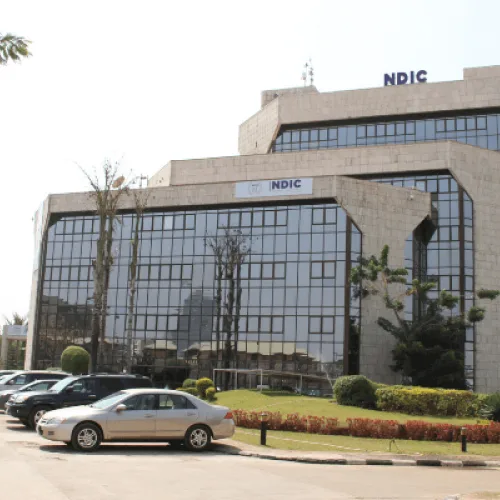
The Nigeria Deposit Insurance Corporation (NDIC) has commenced payment of insured deposits to customers of the 46 microfinance banks whose operating licences were revoked by the Central Bank of Nigeria (CBN), while intensifying efforts to recover loans and dispose of assets to reimburse depositors whose balances exceed the insured limit.
Thompson Oludare Sunday, managing director and chief executive officer of the NDIC, disclosed this on Wednesday in Lagos at a retreat organised for members of the House of Representatives Committee on Insurance and Actuarial Matters, themed “Strengthening the Financial Safety Net in an Era of Banking Sector Recapitalisation and Fintech Innovation.”
Speaking with journalists on the sidelines of the event, Sunday said the Corporation had immediately commenced the liquidation process after the CBN revoked the licences of the microfinance banks and appointed the NDIC as provisional liquidator.
“We’ve started paying depositors of those banks, and gradually, we intend to cover all the insured depositors,” he said.
He explained that beyond reimbursing insured depositors, the Corporation was pursuing outstanding debts owed to the failed institutions and disposing of their assets to enable payment of depositors with balances above the insured limit.
“Our function as liquidator would involve payment of guaranteed sums. Thereafter, what we do is we go after those who are owing the institutions and have not paid. We also make sure that we sell the assets that are available and realise their investments towards paying the uninsured portion of the deposits,” Sunday said.
The NDIC boss said the Corporation had also transformed its reimbursement process by partnering with the Nigeria Inter-Bank Settlement System (NIBSS) to pay depositors automatically through their Bank Verification Number (BVN), eliminating the need for many customers to file claims before receiving their money.
“Hitherto, we used to depend on people to come and file for payment, but now, in collaboration with the Nigeria Inter-Bank Settlement System, what we do is, for every account that has a BVN, we trace your alternative account in other institutions and make payments to you automatically. The more we discover those, the more we start payment,” he said.
Providing an update on the liquidation of Heritage Bank, Sunday said approximately 700,000 depositors had already received their insured deposits, while efforts were continuing to locate others whose records could not easily be traced.
According to him, Heritage Bank inherited customer accounts from several legacy institutions, including Enterprise Bank, Spring Bank and Guardian Express Bank, making it difficult to identify some depositors because of outdated records that predated the introduction of the BVN.
“There are depositors that we have not been able to trace, and this is an opportunity for them to also come forward. Once they come forward, and those we’ve seen in the databases of the institution, we have been paying,” he said.
He added that proceeds from loan recoveries and disposal of the failed bank’s assets would be used to settle uninsured depositors.
“If you look at our website, sometimes in newspapers and through electronic media, we advertise properties for sale. It is all towards making sure that we get money to pay the uninsured portions of the deposits,” he said.
In his welcome address, Sunday said the recent banking sector recapitalisation exercise had strengthened the capacity of banks to support economic growth but warned that higher capital alone would not guarantee financial stability.
“The recently concluded banking sector recapitalisation programme represents a significant milestone in strengthening the capacity of Nigerian banks to support economic development,” he said.
“However, while recapitalisation enhances the resilience of financial institutions, it must be complemented by effective regulation, sound governance practices, strong risk management frameworks and good compliance culture, all attributes of a reliable financial safety net.”
He noted that the rapid growth of fintech had expanded financial inclusion by bringing millions of previously unbanked Nigerians into the formal financial system but had also increased exposure to cyber threats, fraud, operational risks and data breaches.
According to him, regulators must strike the right balance between innovation, consumer protection and financial stability.
Sunday said the NDIC remains a critical pillar of Nigeria’s financial safety net, disclosing that more than 98 percent of depositors, representing over 281 million accounts across insured institutions, are fully protected under the Corporation’s deposit insurance scheme.
He added that the Corporation had significantly improved its reimbursement process, citing the recent revocation of the licences of Aso Savings and Union Homes Savings and Loans, where insured depositors began receiving payments within 72 hours, well below the statutory requirement of 30 days and faster than the seven-day international benchmark.
“This achievement reflects our commitment to operational excellence and enhancing depositor confidence,” he said.
The NDIC boss said the Corporation was also strengthening bank supervision and surveillance in collaboration with the CBN, enhancing public awareness on deposit insurance, modernising currency and payment infrastructure, and improving crisis resolution mechanisms to reinforce confidence in the financial system.
Speaking at the retreat, Ahmadu Usman Jaha, chairman of the House Committee on Insurance and Actuarial Matters, said Nigeria’s financial safety architecture must evolve to keep pace with banking recapitalisation, fintech innovation and emerging digital risks.
He said while the recapitalisation programme would produce stronger and more resilient banks capable of supporting Nigeria’s aspiration of becoming a $1 trillion economy, stronger capital must be complemented by effective deposit insurance, sound corporate governance, enhanced crisis management and closer coordination among financial safety-net institutions.
Jaha also noted that the rapid expansion of fintech had accelerated financial inclusion and payment efficiency but introduced new challenges relating to cybersecurity, digital fraud, consumer protection and the scope of deposit insurance, requiring sustained legislative attention and stronger collaboration between regulators and lawmakers.
He reaffirmed the House of Representatives’ commitment to providing the legislative support needed to strengthen depositor protection and preserve confidence in Nigeria’s financial system.
Hope Moses-Ashike is an Associate Editor, Banking and Finance, with more than a decade of experience reporting on Nigeria’s financial system and broader economy. She closely tracks market movements, monetary policy decisions, company disclosures, regulatory actions, economic indicators, and global developments, and interprets what they mean for businesses, investors, policymakers, and households. Her reporting helps readers understand complex issues such as inflation trends, foreign exchange market dynamics, interest rate decisions, bank performance, and investment risks. She also covers major international events and periodically travels to Washington, D.C., to report on the World Bank/IMF Spring and Annual Meetings. Her dedication to financial journalism has earned her multiple recognitions and invitations to high-level professional development programmes. She is an alumna of the International Visitors Leadership Programme (IVLP) in the United States and holds an Advanced Financial Journalism Certificate from the Press Association Training in London, UK. Her other notable achievements include completing the Lagos Business School CMC Programme, the Bloomberg Media Africa Initiative Programme, and a Master Class in Journalism at Rhodes University in South Africa.

Comments
Start the conversation about this story.