





Financial experts, policymakers and business leaders have called for a rethink of how capital is deployed in Nigeria, urging a shift from extractive capital to productive investment to drive sustainable economic growth, create jobs and build long-term wealth in Nigeria.
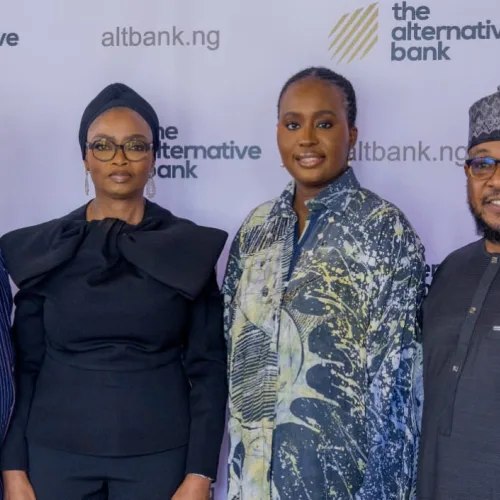
The call was made at an executive intelligence forum themed “Beyond Interest: Capital, Innovation, and the Future of Wealth,” organised by The Alternative Bank, Lagos.
Muhtar Bakare, chairman of The Alternative Bank said Nigeria’s economic future depends on redirecting capital into enterprises and assets that generate lasting value rather than merely extracting profits.
According to him, extractive capital focuses on harvesting value from the economy with little long-term benefit, while productive capital strengthens businesses, creates employment, expands supply chains, increases government revenue and delivers sustainable returns for investors.
“Extractive capital treats the economy chiefly as a place from which value is harvested. It may reward its owner, but it rarely leaves the economy stronger,” Bakare said.
He explained that productive capital creates wealth that extends beyond individual businesses, strengthening the broader economy by supporting workers, suppliers and communities.
Read also: Your personal brand is now a business asset
“It becomes productive wealth because the value it creates does not stop at the company’s gate. It puts down roots and improves the ground in which it is planted,” he added.
Babajide Sanwo-Olu, Lagos State Governor, represented by the Commissioner for Finance, Abayomi Oluyomi, said governments have a critical role in creating an environment that attracts private investment through infrastructure development, policy consistency and strong institutions.
He cited the state’s Blue and Red Line rail projects as examples of infrastructure investments that reduce logistics costs, expand markets and improve business viability.
“The future of finance will belong to capital that is more purposeful, innovative and closely connected to productive economic activity,” the governor said.
Sanwo-Olu added that development finance would increasingly rely on instruments such as green bonds, sukuk and other ethical, non-interest financing structures that link capital to real assets and measurable economic outcomes.
He also stressed that while governments cannot eliminate every investment risk, they can reduce uncertainty by providing quality infrastructure, clear regulations, effective coordination and predictable policies.
Babatunde Fashola, Former Lagos State Governor and former Minister of Works and Housing, also urged investors to prioritise investments that generate long-term economic and social benefits rather than focusing solely on short-term financial returns.
He said funding decisions should consider their broader impact on communities and national development.
Other speakers at the forum included Abubakar Suleiman, Board Member of Sterling Financial Holdings Company Plc; Dr. Stanley Jacob, Group Chief, Innovation and Technology at Meristem; and Ajibola Tobi-Osho, Executive Director of Tugrande Alliance Limited, who spoke on ethical capital, pan-African payment systems, asset tokenisation and Nigeria’s macroeconomic outlook.
The forum attracted senior investors, business executives and public-sector leaders, who explored the role of patient capital, ethical finance and innovation in supporting Nigeria’s long-term economic transformation.


Comments
Start the conversation about this story.