





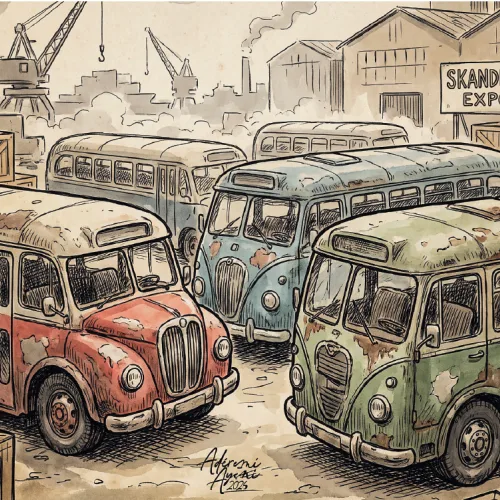
In August 1970, a Nigerian newspaper reported that four senior officials of the Lagos City Transport Service had travelled to Sweden to procure buses for a city urgently in need of reliable public transportation. What they approved, according to the report, were 98 buses already seventeen years old.
The buses had reportedly been withdrawn from service after Sweden switched from left-hand to right-hand traffic in 1967. A Swedish official quoted in the report said they had been sold for dismantling and were never expected to return to the road. A private company bought them for 175,000 Swedish kronor, then about £12,000, and resold them to Lagos for about one million kronor, or nearly £69,000. The Swedish company made its profit. Nigerian taxpayers inherited the buses.
The transaction prompted a Lagos State tribunal of inquiry in late 1970, with its official report published the following year. One of the prominent figures associated with the affair was Chief Augustus Meredith Adisa Akinloye. The scandal did little to halt his political ascent. By 1978, Akinloye had become national chairman of the National Party of Nigeria, which governed under President Shehu Shagari until it was overthrown in the December 1983 military coup that brought Major GeneralMuhammadu Buhari to power.
After the coup, Akinloye left Nigeria amid corruption allegations. Security agents searching his home reportedly found a bottle of French champagne labelled as specially reserved for Chief A.M.A. Akinloye. The military displayed it as evidence of the displaced political class’s extravagance. Newspapers christened him Adisa “Champagne” Akinloye, and the bottle reportedly entered the National Museum in Lagos.
In a 1987 interview with New Nigerian, Akinloye dismissed the champagne as a Christmas gift that had cost “next to nothing.” The controversy was never really about its price. It was about what it represented. A personalised bottle reserved for the chairman of the governing party symbolised exclusivity, indulgence and proximity to privilege in a country grappling with economic crisis.
The buses and the champagne tell different parts of the same story. The buses represented the machinery through which public resources could be wasted: questionable procurement, corrupt politicians, foreign intermediaries, inadequate scrutiny and weak accountability. The champagne represented the culture surrounding that machinery of entitlement, conspicuous consumption and an elite insulated from the conditions experienced by most citizens. While the buses caused direct, material loss to the public, the champagne laid bare the exact mentality driving that waste. This scenario is neither simply historical nor symbolic; it concerns how Nigerians are governed today.
More than five decades later, that political distance remains recognisable. In 2023, amid worsening hardship, the National Assembly procured luxury sport utility vehicles for federal legislators, reportedly costing more than N100 million each. They were defended as necessary even as citizens were urged to accept painful reforms.
In June 2026, a Federal High Court declared unlawful the National Assembly’s N110 billion vehicle and support-allowance arrangements, including N40 billion reportedly spent on 465 vehicles. The political question is unavoidable: why does sacrifice travel downwards while privilege travels upwards?
Government requires official vehicles, residences and equipment. Public officials need not perform poverty to demonstrate integrity. The problem begins when the government asks citizens to bear sacrifices from which political leaders exempt themselves. Government cannot preach patience from the comfort of a new luxury vehicle while treating elite comfort as an unquestionable cost of governance.
This imbalance directly violates the foundational principles of the social contract. Citizens surrender taxes, obedience and political authority to the state in exchange for security, public services, fairness and accountable government. Public office is therefore not a reward detached from obligation. Its privileges are defensible only when they enable service to the people who finance them.
Nigeria’s political culture has steadily inverted this relationship. Roads, boreholes, food distributions and school supplies are presented as gifts from benevolent office holders rather than services purchased with public resources. Politicians expect gratitude for performing fragments of their duties. Citizens are repeatedly told that the cost of government is unavoidable even when its benefits remain uncertain.
This inversion helps explain why elite extravagance generates anger but rarely produces lasting consequences. Outrage gathers around the visible object: the champagne, convoy, mansion or luxury vehicle, while the structures financing and protecting the privilege remain intact. A bottle can be seized and displayed. An official can be ridiculed. A government can fall. Yet procurement practices, political incentives and elite expectations survive.
The reported fate of Akinloye’s champagne offers an almost too-perfect conclusion. After being displayed in the National Museum as an emblem of Second Republic excess, it apparently disappeared. The symbol vanished; the political culture it represented did not.
Nigeria must hold the champagne and the buses in the same frame. Accountability must confront both the extravagance through which political entitlement advertises itself and the institutional arrangements through which public wealth is wasted or converted into private advantage. This requires transparent procurement, enforceable limits on discretionary expenditure and consequences that survive changes of government and party allegiance. It also requires citizens to reject the notion that public provision is a favour for which politicians deserve personal gratitude.
The buses revealed what elite impunity costs the public. The champagne revealed how comfortably that impunity can be worn. Nigeria’s challenge is no longer recognising these symbols. It is dismantling the institutions and political culture that continue to produce them.
Get Newsletter Updates
Enjoying our column?
Subscribe to our specialised **Who Is Thinking For Nigeria** feed to receive fresh reports and analyses directly in your inbox.

Comments
Start the conversation about this story.