





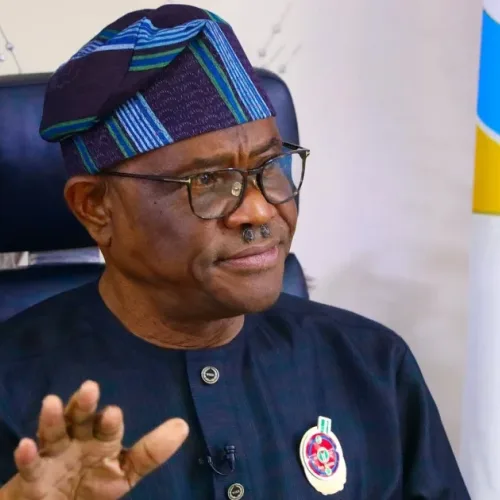
The Minister of the Federal Capital Territory, Nyesom Wike, on Wednesday declared Abuja “open for business,” assuring local and foreign investors that the Federal Capital Territory Administration would protect genuine investments while taking action against land speculators, fraudulent developers and businesses that violate development regulations.
Speaking at the opening of the Abuja Business and Investment Expo 3.0 organised by the Abuja Investments Company Limited, Wike said the administration’s ongoing infrastructure drive and reforms in land administration were positioning the nation’s capital as Nigeria’s leading investment destination and one of Africa’s most competitive cities for business.
Speaking on the theme, “Building Nigeria’s Capital: Investment as a Catalyst for Economic Growth,” the minister said the FCT Administration had moved beyond making promises to investors by delivering visible infrastructure projects across the territory.
He said, “The Federal Capital Territory is open for business. The FCT Administration is ready to partner with investors who possess the technical capacity, financial strength, experience and integrity required to deliver successful projects. We will continue to provide the infrastructure necessary for businesses to operate and grow. In return, investors must fulfil their obligations, meet agreed standards, deliver projects within established timelines and ensure that their investments create value for the people of the Federal Capital Territory.”
Wike, however, warned that the administration would not compromise the Abuja Master Plan in its quest to attract investment.
He said, “The FCT Administration remains committed to creating a transparent, efficient and rules-based business environment. However, ease of doing business does not mean the absence of regulation.”
The minister added, “Every investor and developer must respect the Abuja Master Plan, environmental standards, building regulations, tax obligations and the terms of their development approvals. We will support and protect genuine investors, but we will not protect land speculators, fraudulent developers or businesses that disregard the law. Our commitment is to an investment environment that is both business-friendly and properly regulated.”
Highlighting reforms introduced by the administration, Wike disclosed that the FCT ranked fourth nationally in the 2025 Presidential Enabling Business Environment Council’s Subnational Ease of Doing Business Assessment with a score of 61 per cent.
According to him, “The reforms being implemented by the FCT Administration are already producing measurable results. In the 2025 Subnational Ease of Doing Business assessment conducted by the Presidential Enabling Business Environment Council, the Federal Capital Territory was ranked fourth nationally, with a performance score of 61 per cent. However, we are not satisfied with being fourth. Our objective is to make the Federal Capital Territory the leading destination for investment and enterprise in Nigeria and one of the most competitive investment destinations in Africa.”
He said investors would ultimately judge the administration by their experience in accessing land, obtaining approvals and operating businesses without unnecessary bureaucratic obstacles.
The minister described infrastructure as central to the FCT’s investment strategy, noting that roads, bridges, schools, hospitals, water supply and other public services were essential in attracting investors.
According to him, “Investors do not make decisions based on speeches or promises. They invest where there are good roads, reliable public services, access to land, security, efficient institutions, transparent processes and a government that honours its commitments.”
Wike added that development was expanding beyond Abuja’s city centre into satellite towns and Area Councils through road construction and rehabilitation projects linking communities, markets, schools, health facilities and agricultural clusters.
Urging investors to verify ongoing projects before making investment decisions, he said, “We are not asking investors to rely on promises. We are asking them to examine the evidence, recognise the progress and participate in the next phase of Abuja’s development.”
He identified investment opportunities in housing, transportation, agriculture, healthcare, tourism, education, renewable energy, technology, entertainment, waste management and urban infrastructure.
Also speaking, the Director-General of the Securities and Exchange Commission, Emomotimi Agama, said Nigeria’s capital market could provide sustainable financing for Abuja’s infrastructure ambitions through innovative investment instruments.
Describing Abuja as “the most eloquent argument” for investment-led development, Agama said, “Abuja is proof that investment is a catalyst for economic growth. Abuja is what happens when a country stops describing its future and starts funding it.”
He proposed the establishment of an FCT Infrastructure Bond Programme, green bonds, a Real Estate Investment Trust, the listing of Abuja Investments Company Limited and asset recycling to finance critical infrastructure projects.
On the abandoned Millennium Tower project, Agama said, “The question is not whether Nigeria can afford the Millennium Tower. The question is whether we will let ordinary Nigerians own it.”
Earlier, the Group Managing Director and Chief Executive Officer of Abuja Investments Company Limited, Ambassador Maureen Tamuno, said the expo had evolved from an annual gathering into a platform for attracting investment commitments.
She said, “Since it was first introduced, the Abuja Business and Investment Expo has become more than an annual event. It has grown into a meeting point for ideas, partnerships and investment opportunities. This year’s edition is about moving from conversations to concrete action.”
Comments
Start the conversation about this story.