





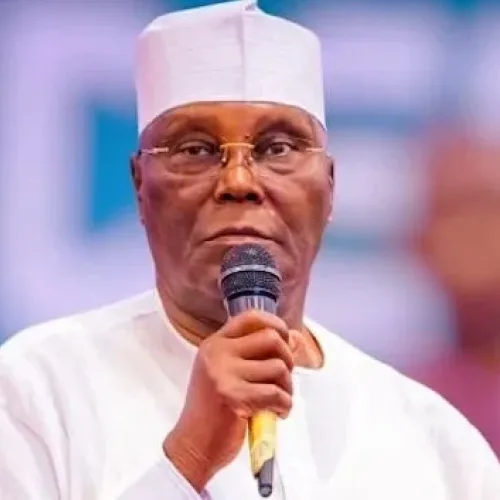
The presidential candidate of the African Democratic Congress, Atiku Abubakar, has described the freezing of the Osun State Government’s statutory allocation account by the Economic and Financial Crimes Commission as a dangerous assault on democracy.
Atiku said the anti-graft agency’s decision to impose a restriction on the account just days before the August 15 governorship election in the state raises serious concerns about the neutrality of institutions expected to uphold the rule of law and protect the integrity of the electoral process.
In a statement issued on Thursday by his Senior Special Assistant on Public Communication, Phrank Shaibu, the former Vice President, who served from 1999 to 2007, said the timing of the action was capable of eroding public confidence in the credibility of the forthcoming governorship election.
“It is impossible to ignore the implications of freezing a state’s principal operational account on the eve of a governorship election. Such an action could disrupt governance, delay salary payments, impede essential public services and create an atmosphere of intimidation that has no place in a democratic society,” Atiku said.
He argued that while anti-corruption agencies have a constitutional responsibility to investigate allegations of financial misconduct, such investigations must follow due process and should not be carried out in a manner that creates the impression of political interference.
“If there are legitimate concerns requiring investigation, the law provides due process. Anti-corruption agencies must not conduct themselves in a manner that creates the perception that they are being deployed to influence political outcomes or weaken elected governments at critical electoral moments,” he stated.
The ADC presidential candidate further alleged that there is a growing pattern of what he described as the selective deployment of federal institutions against opposition-controlled states.
According to him, the latest development, coming after what he described as the prolonged withholding of the state’s local government allocations, reinforces the perception that state institutions are being weaponised for political purposes rather than serving the public interest.
“The selective and politically convenient deployment of state institutions diminishes public trust and weakens the democratic order. Institutions established to enforce the law must never become instruments for creating fear or conferring political advantage,” he added.
Atiku called on the EFCC to immediately lift the restriction placed on the state’s allocation account, warning that ordinary residents, rather than political office holders, stand to bear the consequences of the action.
“Freezing the state’s allocation account is not merely an attack on the Osun State government; it is a direct assault on the people of Osun State, whose salaries, essential public services and daily governance stand to suffer. The anti-corruption mandate of the EFCC must never be distorted into a political weapon against opposition governments,” he argued.
He also urged all institutions involved in the conduct of the Osun governorship election to remain impartial and ensure that the will of the electorate is not undermined, saying, “The people of Osun State alone must determine the outcome of their election. No external force or institution of government should, by action or omission, cast a shadow over the credibility of that democratic choice.”
The statement comes amid controversy surrounding the EFCC’s decision to place a “Post No Debit” restriction on an Osun State Government account.
The anti-graft agency has maintained that the restriction is part of an ongoing investigation into the alleged diversion of about ₦11 billion in public funds and insisted that the action is unrelated to the August 15 governorship election.
However, Osun State Governor Ademola Adeleke has alleged that the affected account is used for the payment of workers’ salaries and accused the EFCC of attempting to cripple the state’s operations on the eve of the election.
The exchange has intensified political tensions ahead of the governorship poll, with opposition figures raising concerns over the timing of the EFCC’s action, while the commission insists it is merely carrying out its statutory anti-corruption mandate.
Comments
Start the conversation about this story.