





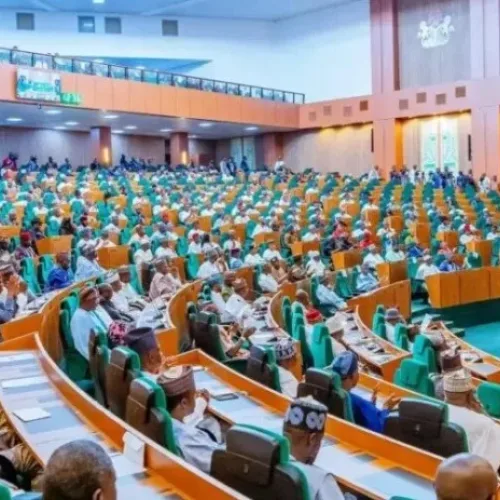
The House of Representatives Ad-hoc Committee investigating the controversial Presidential Foreign Investment Promotion Council on Thursday uncovered fresh inconsistencies in the documents used to establish the purported agency.
This is as the State House denied any involvement in requesting a budget code for the council or authorising its creation.
The latest revelations emerged during the committee’s investigative hearing at the National Assembly Complex, Abuja, where officials from the State House and the Federal Road Safety Corps appeared before lawmakers to explain their respective roles in the activities of the council, which is alleged to have operated without lawful approval.
The committee is investigating how the PFIPC was allegedly created, secured official government recognition and was integrated into aspects of the Federal Government’s administrative and budgetary processes in the 2026 Appropriation Act despite questions over its legal status.
Representing the Permanent Secretary, State House, the Director of Administration, Abdulkadri Idris, told lawmakers that the presidency neither initiated nor authorised the establishment of the PFIPC and never requested the Office of the Accountant-General of the Federation to generate a budget code for the council.
“I want to state that we did not send any correspondence nor any request to the Office of the Accountant-General in respect of this council. We don’t even know anything about this council. We never heard about this council until we started seeing it in the media,” Idris said.
He further explained that the State House has no statutory responsibility for establishing government agencies and therefore could not have issued any communication creating the council.
Idris also dismissed as fraudulent, documents presented to the committee that purportedly originated from the State House.
According to him, one of the documents allegedly signed by “Akande Adewale” as Director of Administration and Support Services could not have emanated from the presidency because neither the office nor the official ever existed.
“I presented the list of Directors of Administration in the State House from 2003 to date, and there was no name resembling Akande Adewale.
“In addition, there is no department known as Directorate of Administration and Support Services in the State House. We have only the Department of Administration. Akande Adewale has never, ever been Director of Administration in the State House,” he clarified.
To support its position, the State House submitted official records earlier forwarded to the Nigeria Police National Cybercrime Centre, including authentic letterheads and a historical list of Directors of Administration.
Following the presentation, the Chairman of the committee, Yusuf Gagdi, said the testimony exposed significant inconsistencies between documents obtained from the Accountant-General’s Office and official records produced by the State House.
“The State House has denied that it ever wrote any letter to the Accountant-General requesting budget codes. Secondly, there is no Directorate of Administration and Support Services as contained in those documents.
“The Accountant-General responded to an office that the State House says does not exist, while the name of the signatory, Akande Adewale, is absent from all official records submitted to this committee,” Gagdi said.
He described the discrepancies as a major development in the committee’s efforts to determine how official government processes were allegedly manipulated to give legitimacy to the PFIPC.
The State House also denied issuing any appointment letter to the purported Director-General of the council, Adeniyi Adeyemi, maintaining that appointments of chief executives of federal agencies are political appointments conveyed through the Office of the Secretary to the Government of the Federation.
“If the president approves any appointment, the conveyance is done by the Office of the Secretary to the Government of the Federation,” the State House representative said.
FRSC explains number plate allocation
The Federal Road Safety Corps also defended its decision to allocate seven official Federal Government vehicle number plates to the PFIPC, insisting that it acted in line with established administrative procedures based on documents and representations presented by the applicants.
In a memorandum dated August 6, 2026, and signed by Corps Marshal Shehu Mohammed, the FRSC said it followed its standard verification process before approving the request.
According to the Corps Marshal, the application originated from a letter dated April 4, 2025, signed by Prince Adeniyi Adeyemi on behalf of the Office of the Director-General of the Presidential Economic Advisory Council/Presidential Foreign Investment Promotion Council.
A follow-up reminder dated April 11, 2025, was later received alongside documents purporting to establish the council, define its mandate and identify the vehicles requiring official registration.
Mohammed disclosed that Prince Adeyemi personally submitted the request at the FRSC headquarters.
He said the Corps carried out additional verification because the PFIPC claimed to be a newly established federal agency.
According to him, officials examined the supporting documents, visited the government website supplied by the applicant—which carried a Federal Government domain name—and physically inspected the council’s office at the Federal Secretariat Complex, Phase III, Central Business District, Abuja.
“Having completed the foregoing verification processes and being satisfied with the information presented, the Corps approved and allocated seven Official Federal Government Vehicle Number Plates to the Agency,” Mohammed said.
The vehicles included a 2024 bulletproof Lexus LX, two Toyota Land Cruiser sport utility vehicles and four Toyota Hilux vehicles, which were issued official registration numbers ranging from PFIPC 01 to PFIPC 07 after their chassis numbers were verified.
The Corps Marshal, however, said the FRSC later discovered that the council was not an approved Federal Government agency.
“It therefore came as a profound shock to the Corps when it subsequently emerged that the Presidential Foreign Investment Promotion Council was not an approved Federal Government Agency and that the representations made by Prince Adeniyi Adeyemi were false,” he stated.
He added that the FRSC had commenced administrative steps to retrieve all seven official number plates issued to the purported agency and had strengthened its internal verification procedures to prevent a recurrence.
During the hearing, Gagdi questioned the thoroughness of the verification process after observing that the documents relied upon by the FRSC lacked standard government security features and unusually listed President Bola Tinubu, the Secretary to the Government of the Federation, the Head of the Civil Service of the Federation and several cabinet ministers as members of the council.
“Does this look normal to you?” Gagdi asked.
Responding, the Corps Marshal admitted, “No, not at all.”
He nevertheless maintained that the Corps acted on the information available at the time, including the operational office, official-looking documents, the government-domain website and verification of the vehicles’ chassis numbers.
The committee subsequently directed the FRSC to furnish it with the current status and location of all vehicles registered under the PFIPC.
Gagdi also announced that the committee would conclude its investigation next Wednesday and directed the Clerk of the committee to invite all relevant agencies to appear for the final phase of the inquiry.
The House had constituted the Ad-hoc panel following allegations that the PFIPC, despite lacking legal backing, operated as a Federal Government entity, obtained official documents and approvals and was allegedly integrated into government administrative processes.
Lawmakers say the investigation is aimed at establishing how the purported agency emerged, identifying those responsible and recommending measures to prevent similar breaches of public administration.
Comments
Start the conversation about this story.