





For many Nigerians, news of another collapsed building no longer shocks. It merely provokes a familiar cycle of grief, rescue operations, promises of investigation, and eventually, silence. Families bury their loved ones while government panels write reports that rarely see the light of day. Developers return to business, officials retain their positions, contractors move on to the next project, and nothing changes.
That is why the recent judgement delivered by an Italian court deserves serious attention in Nigeria (which is the reason for this article).
Eight years after the collapse of the Morandi Bridge in Genoa, which killed 43 people, an Italian court sentenced former motorway executive Giovanni Castellucci to 12 years’ imprisonment for negligence and manslaughter. More than 30 other officials were also convicted after prosecutors proved that warning signs had been ignored and maintenance sacrificed despite known structural defects.
The message from Italy is unmistakable: infrastructure failure caused by negligence is not merely an engineering error; it is a criminal offence. Nigeria should be asking itself one uncomfortable question: can such accountability ever happen here? The answer, sadly, is difficult to give with confidence.
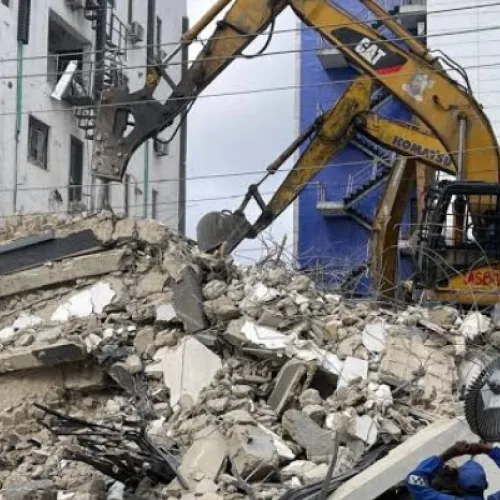
Nigeria has become one of the nations with the highest incidence of building collapse in Africa. Professional bodies estimate that between 1974 and 2024, well over 600 building collapses were recorded nationwide, claiming more than 1,500 lives. Lagos alone accounts for more than half of these incidents. The statistics become even more painful when translated into human stories.
In September 2014, the guesthouse belonging to the Synagogue Church of All Nations (SCOAN) collapsed in Lagos, killing about 115 people, including dozens of South Africans.
In March 2016, a five-storey building under construction in Lekki collapsed, killing at least 34 workers. In 2019, a three-storey building housing a primary school in Ita-Faji, Lagos Island, collapsed, killing about 20 people, most of them schoolchildren.
In November 2021, the 21-storey apartment under construction on Gerrard Road, Ikoyi, collapsed, killing at least 42 people, including the developer himself, Femi Osibona.
Abuja has recorded several fatal collapses in Kubwa, Gwarinpa and other districts, while Kano, Port Harcourt, Jos, Onitsha, Ibadan and numerous other cities continue to witness similar tragedies.
Each incident follows an almost identical script – the government dispatches emergency responders, a committee of inquiry is constituted, and officials promise that “those responsible will be brought to justice” as families mourn.
Months later, Nigerians hear nothing again. At best, a few officials are suspended. Occasionally, a developer is arrested briefly before being granted bail, and rarely does anyone face criminal conviction. Even more rarely does anyone serve a lengthy prison sentence, and often, the result is predictable.
Developers continue to violate approved building plans, unqualified artisans undertake specialised construction work, and corrupt inspectors approve defective structures.
Politicians interfere with regulatory agencies whenever influential individuals are involved, and the consequence is a culture where negligence carries almost no personal risk.
This is particularly troubling because many public infrastructure projects in Nigeria are politically motivated. Roads are hurriedly commissioned before elections. Bridges are inaugurated under intense political pressure. Public buildings are completed to satisfy campaign promises rather than engineering standards.
When politics overtakes professional judgement, quality inevitably suffers, and the danger extends beyond private developers. Public officials who knowingly approve unsafe designs, ignore failed integrity tests or certify substandard construction should equally face criminal prosecution.
Nigeria already possesses many of the laws required to enforce accountability. The challenge has never been legislation but implementation.
Professional councils investigate engineers, state governments establish judicial panels, coroners conduct inquiries, and anti-corruption agencies occasionally investigate procurement fraud, yet convictions remain extraordinarily rare.
Contrast this with nations where infrastructure disasters trigger criminal investigations involving engineers, contractors, regulators and corporate executives alike.
There, negligence has consequences, and here, negligence often receives political protection, a difference that explains why the same mistakes are repeated repeatedly.
The financial implications are equally enormous, as every collapsed building destroys billions of naira in investments, increases insurance costs, discourages foreign investors and erodes public confidence in Nigeria’s construction industry.
Beyond economics lies an even greater tragedy; lives lost through preventable structural failures are not accidents but casualties of regulatory failure.
No parent should send a child to school wondering whether the classroom roof will collapse. No worker should fear dying because a contractor substituted reinforcement rods with cheaper materials. No home buyer should question whether a newly completed apartment can survive the rainy season.
The government must therefore move beyond issuing demolition notices after disasters occur. Nigeria needs a comprehensive accountability framework that includes mandatory criminal prosecution for proven negligence, blacklisting of erring contractors, lifetime professional sanctions against compromised engineers, digital monitoring of construction approvals, independent structural audits for high-rise buildings, and public disclosure of investigative reports. And most importantly, political office should never shield anyone from prosecution.
The Italian judgement offers an important lesson; justice may take years, but it eventually arrives, and Nigeria cannot continue normalising avoidable deaths as unfortunate acts of God.
Most collapsed buildings are not acts of God but products of human decisions (poor engineering, compromised regulation, political interference, corruption and greed).
And where human decisions kill innocent citizens, justice demands more than condolences; it demands accountability.
Until those whose negligence causes buildings and public infrastructure to collapse begin to face prison sentences rather than press conferences, Nigeria will continue to mourn victims of tragedies that should never have happened in the first place.


Comments
Start the conversation about this story.