





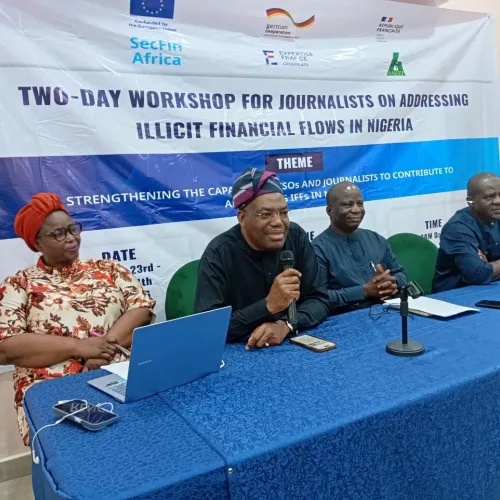
Nigeria’s battle against illicit financial flows (IFFs) received a fresh boost as journalists, civil society organisations and anti-corruption experts gathered in Lagos to strengthen investigative reporting aimed at exposing financial crimes that continue to rob the nation of billions of naira needed for development.
The two-day capacity-building workshop, organised by the Africa Network for Environment and Economic Justice (ANEEJ) with support from the European Union (EU) through the SecFin Africa Programme, equipped media practitioners with practical skills to investigate money laundering, tax evasion, procurement fraud, trade misinvoicing, beneficial ownership secrecy and other illicit financial activities.
Speaking at the opening session, ANEEJ Executive Director, Rev. David Ugolor, described illicit financial flows as one of Nigeria’s greatest development challenges, warning that corruption and illegal movement of funds continue to divert resources meant for education, healthcare, infrastructure, environmental sustainability, social protection and job creation.
“IFFs weaken public institutions, deepen poverty and inequality, and erode public trust in governance,” Ugolor said.
He stressed that while Nigeria has enacted several anti-corruption laws and established institutions to tackle financial crimes, their success depends largely on active citizen participation and an independent media capable of holding public officials accountable.
According to him, the workshop was designed to strengthen journalists’ understanding of money laundering, financial intelligence, beneficial ownership, access to information, digital security, media ethics and data-driven investigative reporting.
“The fight against illicit financial flows is a shared responsibility involving government, civil society, the media and citizens,” he added, urging participants to build partnerships that would produce evidence-based investigations capable of driving reforms.
Among resource persons at the training are Prof. Abdullahi Shehu, representing the SecFin in Africa Project; the Head, Strategic Communications at the Nigerian Financial Intelligence Unit (NFIU), Aishatu Bantam, who represented Hafsat
Abubakar Bakari, the CEO of NFIU; the Editor-in-Chief/Chief Operating Officer of Premium Times, Muskilu Mojeed, among others.
One of the lead resource persons, former Director of Proceeds of Crime Recovery and Management at the EFCC, Aliyu M. Yusuf (Esq.), provided a comprehensive assessment of Nigeria’s legal and institutional framework for combating illicit financial flows.
He highlighted key laws, including the Money Laundering (Prevention and Prohibition) Act 2022, EFCC Act, ICPC Act, Companies and Allied Matters Act 2020, Nigeria Revenue Service Act 2025, Nigeria Customs Service Act 2023, Petroleum Industry Act, NEITI Act and Investment and Securities Act 2025.
Yusuf acknowledged that Nigeria possesses a relatively robust legal framework but said enforcement remains weak due to poor inter-agency coordination, inadequate technological capacity, shortage of forensic investigators, slow judicial processes and limited transparency in beneficial ownership disclosures.
He also warned that the rapid adoption of cryptocurrencies presents new opportunities for money laundering and illicit cross-border financial transfers if regulatory oversight remains inadequate.
Participants were reminded that exposing illicit financial flows goes beyond uncovering corruption. Recovering stolen assets and preventing capital flight would increase government revenue for schools, hospitals, roads, social welfare programmes and economic growth while restoring public confidence in governance.
The workshop equally underscored the need for journalists and civil society organisations to track recovered assets, including the historic Abacha loot, to ensure such funds are transparently utilised for public benefit rather than diverted again.
Among the major lessons from the training was that combating financial crimes requires collaboration, digital investigative skills, access to public information, financial intelligence, international cooperation and persistent investigative journalism.
The resource persons called for stronger enforcement of existing laws, enhanced funding and independence for anti-corruption agencies, integrated databases for information sharing, expanded use of forensic accounting and financial technology, improved customs oversight, stronger tax administration and faster prosecution of financial crime cases.
Participants are expected to apply the knowledge gained by producing high-quality investigative reports capable of exposing illicit financial networks, influencing public policy and promoting greater accountability.
As Nigeria intensifies efforts to curb illicit financial flows, the workshop reinforced a clear message: every recovered naira represents another opportunity to invest in healthcare, education, jobs and national development, while investigative journalism remains one of the country’s strongest weapons against corruption and financial crime.
Please follow and like us:
Comments
Start the conversation about this story.