





…after successful Portugal demonstration
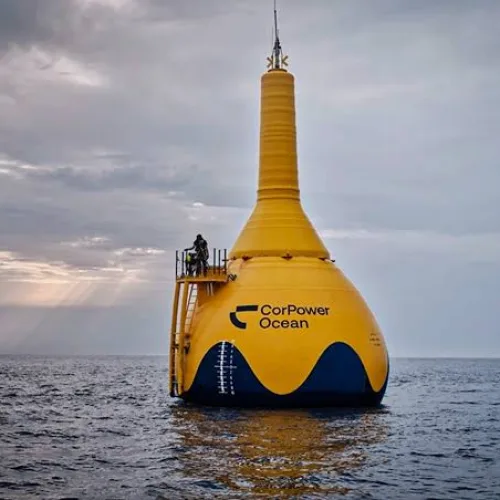
CorPower WaveSpring Technology has unveiled what could become one of the most significant breakthroughs in renewable energy, following the successful deployment of its WaveSpring-powered wave energy converter off the coast of Portugal.
The company said its technology, inspired by the pumping mechanism of the human heart, has demonstrated the ability to efficiently convert ocean waves into electricity while surviving some of the harshest conditions in the Atlantic Ocean, which is a challenge that has plagued the wave energy industry for decades.
Wave energy has long been considered one of the world’s largest untapped renewable energy resources. However, despite billions of dollars invested globally over the past three decades, the sector has struggled to commercialise due to high costs, low energy output and equipment failures caused by powerful ocean storms.
CorPower believes its patented WaveSpring technology could change that.
Unlike conventional wave energy devices that either maximise electricity production or prioritise durability, the WaveSpring system combines both.
The technology stores and releases energy using a pneumatic mechanism that mimics the elastic function of the human heart, allowing the floating buoy to move in resonance with incoming waves and absorb significantly more energy.
During periods of calm seas, the system amplifies its movement to maximise electricity generation. When severe storms arrive, it automatically adjusts its motion to reduce stress on the structure, helping it withstand waves exceeding 60 feet before resuming normal operations once conditions improve.
The company’s latest full-scale demonstration in Portugal marked an important milestone after the device successfully exported electricity to the Portuguese power grid while validating its performance under real offshore conditions.
According to CorPower, a single WaveSpring unit generated enough electricity to supply approximately 300 to 400 homes, although actual output varies depending on local wave conditions and electricity consumption.
The company also claims the system delivers up to five times greater energy capture per tonne of equipment than earlier wave energy designs. CorPower’s technology addresses one of the industry’s biggest engineering challenges, which is balancing maximum energy capture with long-term survivability.
Previous wave energy projects often failed because devices designed to extract large amounts of energy became vulnerable during storms, while stronger structures sacrificed efficiency.
The WaveSpring mechanism seeks to overcome this trade-off by continuously adapting to changing sea conditions through advanced control systems.
The breakthrough comes as governments and energy companies diversify renewable energy sources beyond solar and wind.
Unlike solar power, wave energy can generate electricity day and night. It is also considered more predictable than wind because ocean swells can often be forecast several days in advance, making it attractive for improving grid stability.
The company has attracted more than €32 million in recent funding to accelerate commercialisation and expand projects across Europe, with development activities already underway in Portugal, Scotland, Ireland and Norway.
If successfully commercialised, the technology could also present new opportunities for African coastal nations such as South Africa, Morocco, Namibia, Ghana and Senegal, where strong Atlantic wave resources could complement existing renewable energy generation and support coastal industries, ports and desalination facilities.
While CorPower’s latest demonstration does not yet guarantee commercial success, it represents one of the strongest indications in years that wave energy may finally be moving from decades of experimental research toward becoming a viable component of the global clean energy mix.
Get Newsletter Updates
Enjoying our column?
Subscribe to our specialised **Tech Pulse** feed to receive fresh reports and analyses directly in your inbox.


Folake Balogun is a technology journalist covering Africa’s digital economy, with a focus on startups, fintechs, venture capital, artificial intelligence, and emerging technologies. Her work explores the intersection of technology, business, and society, highlighting how innovation is reshaping industries and everyday life across Africa and global markets. She translates complex trends into insightful and impactful stories for a wider audience.
Comments
Start the conversation about this story.