





Exactly on August 1, 2016, Muslim Television Ahmadiyya Africa (MTA Africa) was inaugurated by the World Head of the Ahmadiyya Muslim Community, Hazrat Mirza Masroor Ahmad.
The broadcast signal was officially switched on by the global Islamic leader from the MTA International Studios in Gressenhall, London, opposite the first London mosque, marking the beginning of a new era in faith-based broadcasting across Africa.
At inception, MTA Africa transmitted programmes in English, Yoruba, Twi, French, Kiswahili, Wolof, Jula and Fulah, reflecting the network’s commitment to reaching diverse audiences across the continent.
The regional broadcast hub was established in Ghana, while all productions were undertaken by a dedicated team of volunteers and committed staff members.
The first African production studio was built in Mauritius, where the team initially handled translations, fillers and documentary productions. Today, several other regional studios undertake these responsibilities, reflecting the network’s remarkable growth over the past decade.
Fondly known as MTA Africa, the station provides continuous 24-hour religious, educational and cultural broadcasting, significantly impacting communities through live Friday sermons, regional health discussions and localised faith-based programmes across several African countries.
Among its flagship programmes are Friday Sermons, This Week with Huzoor, Inspirational Africans, English and Mathematics on Television, Stories of Devotion, Journey to Islam, Faith Matters, Village Documentaries, Contemplations, among others.
MTA Africa also broadcasts major international events, including Jalsa Salana, in multiple local and international languages. In Nigeria, MITV, a private television station, rebroadcasts selected MTA Africa programmes, including the Friday Sermon, Ohun Islam and documentaries, each aired for 30 minutes on Fridays, Saturdays and Sundays.
Local productions
Feature programmes are produced by regional studios in Nigeria, Uganda, Mali, Kenya, Sierra Leone and Ghana in Yoruba, Krio, Twi, Hausa, Kiswahili, Bambara, Jula, Wolof and Mandinka.
Promoting community values
MTA Africa promotes educational achievement, moral guidance and health awareness through targeted programming in several African languages. Popular productions include Ohun Islam (Yoruba), Mahdi Don Come (Krio) and Koyarwar Musulunci (Hausa). In Mali, Burkina Faso and Côte d’Ivoire, programmes are broadcast in Bambara, Jula, Wolof and Mandinka.
Digital connectivity and social reach
In response to the rapidly evolving media landscape of the 21st century, MTA Africa embraced digital multimedia platforms to expand its audience and accessibility.
READ ALSO: Ahmadiyya’s Minaret University warns against fraudulent admission activities
Through platforms such as the MTA Africa YouTube Channel, viewers are able to watch programmes at their convenience. During the annual Jalsa Salana Islamic Convention, the network’s social media platforms recorded a combined audience reach of about 40 million.
Mass engagement
During major religious gatherings, MTA Africa reaches tens of millions of viewers through its terrestrial broadcasts and digital media platforms.
The network has also expanded its regional presence with projects in Nigeria, Sierra Leone, Tanzania, Uganda and Kenya. Earlier this year, MTA Africa opened its South African office, further strengthening its footprint on the continent.
Strategic collaborations
MTA Africa has established collaborations with state and international broadcasters across Africa. Countries benefiting from these partnerships include Ghana, Sierra Leone, Malawi, Tanzania, Nigeria and The Gambia.
A major milestone was the station’s admission into the African Union of Broadcasting (AUB). Its induction during the AUB Conference in Botswana marked a significant breakthrough following a formal presentation by Dr. Qasim Akinreti of the MTA Nigeria Studios.
Since then, MTA Africa has participated in three AUB conferences hosted by Botswana, Côte d’Ivoire and The Gambia.
At these conferences, MTA Africa offered to train, share expertise and co-produce broadcast content with member organisations. Television corporations in Ghana, Sierra Leone and Malawi have already benefited from these training programmes.
The World Head of the Ahmadiyya Muslim Community commended the volunteers and staff of MTA Africa for their selfless service, dedication to professionalism and commitment to propagating Islam, as well as the message of the Founder of the Ahmadiyya Muslim Community, Hazrat Mirza Ghulam Ahmad.
He also emphasised the importance of continuous training for MTA Africa staff and volunteers to keep pace with the evolving global media ecosystem.
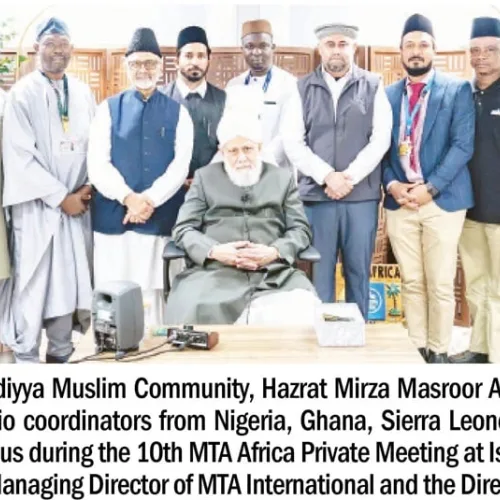
Similarly, the Managing Director of MTA International, Sir Munir Shams, offered prayers for the staff and volunteers and organised a special appreciation gathering in London in honour of the coordinators of MTA Africa and members of staff.
The coordinators include Dr. Qasim Akinreti (Nigeria), Chouhoud Wasif Shahbad (Benin Republic), Soro Allasane (Mali and Côte d’Ivoire), Asif Ahmad Bautt (Tanzania), Abdul Rahman Cham (The Gambia), Hafiz Ismail Adusie (Ghana), Mubiru Haruna (Uganda), Idris Kassim Bangura (Sierra Leone), Toraubally Noormuhammad (Mauritius), alongside representatives from Kenya.
To commemorate the network’s 10th anniversary, a special gift from Africa was presented to the World Head of the Ahmadiyya Muslim Community during the anniversary celebration held at the Islamabad Islamic Centre in Guildford, United Kingdom, in recognition of a decade of MTA Africa’s contribution to religious broadcasting, education and community development across the African continent.
.Dr. Akinreti, who serves as Coordinator, MTA Nigeria Studios, writes from London.
Comments
Start the conversation about this story.