





Nigeria’s conversation about young people almost always originates at the point where problems have already become obvious. It begins when graduates cannot find jobs, when employers complain that young recruits lack workplace skills, or when governments launch new employment and entrepreneurship programmes to tackle rising youth unemployment. These interventions respond to genuine challenges, but they also expose a fundamental weakness in public policy.
Nigeria has largely built its youth development strategy around adulthood, intervening only after young people have entered the labour market. That may be the country’s biggest policy mistake. By the time a young Nigerian attends an entrepreneurship workshop, completes the National Youth Service Corps or begins searching for work, many of the qualities that determine future success, discipline, resilience, emotional maturity, curiosity, integrity and the ability to work with others, have already been shaped.
Successive governments have introduced programmes such as YouWiN, N-Power, digital-skills initiatives, innovation hubs and other youth employment schemes to improve opportunities for young Nigerians. Although each addresses an important need, they all rest on the same assumption that youth development begins during youth. It does not. Long before a young person enters university, acquires digital skills or applies for a job, the foundations of learning, behaviour, relationships and personal discipline have already begun to form. This is why Nigeria’s challenge is bigger than youth unemployment. It is a delayed human capital strategy that invests heavily in repairing outcomes during adulthood while paying far less attention to the years that shape them.
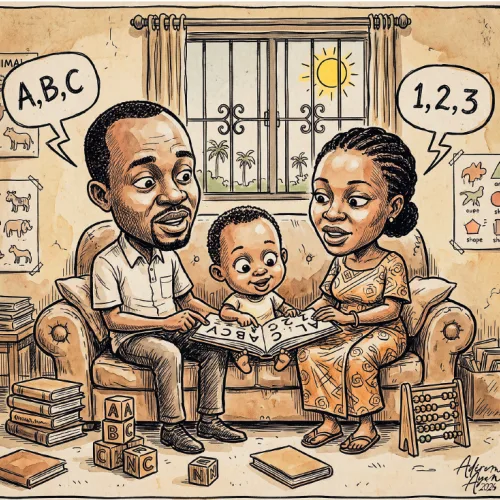
Before every Nigerian enters a classroom, sits for an examination or applies for a job, another institution has already begun shaping that individual’s attitudes, behaviour and capacity to learn. The family is where language is first acquired, where children begin to understand responsibility, self-control, honesty, empathy and relationships with others. Schools certainly develop knowledge and skills, but they do not start with a blank slate. They inherit children whose earliest years have already influenced how they think, respond to authority, solve problems and interact with others.
Nigeria’s own child-development indicators shows why these early years deserve greater attention in public policy. According to a 2026 World Bank assessment, nearly 40 per cent of Nigerian children under the age of five are stunted, while 52 per cent are not developmentally on track by the time they begin school, falling short of expected cognitive, physical or socio-emotional milestones. The same report notes that investments in early childhood development generate annual returns of between 7 and 13 per cent through better educational outcomes and higher lifetime earnings. These findings suggest that many of the challenges governments attempt to address during adulthood are influenced by experiences that begin much earlier.
This is why the family should not be viewed only as a private social institution. It also performs one of the country’s most important economic functions by helping to produce human capital. Employers often complain that graduates struggle with teamwork, emotional discipline, punctuality and the ability to accept criticism. Universities did not create those differences. They inherited them. Skills training can improve competence, but qualities such as resilience, self-discipline and responsibility usually begin to develop long before employment.
The evidence also shows that many Nigerian families receive very little institutional support during these formative years. UNICEF estimates that only 35.6 per cent of children aged three to five have access to early childhood education, while Nigeria continues to have the world’s largest population of out-of-school children. Maternity protection remains limited, paternity leave exists only in parts of the public sector, and affordable childcare is beyond the reach of many households. These are investments in national productivity. The consequences eventually surface in the labour market, where graduates with similar qualifications often perform very differently. Universities rarely create those differences, they inherit them from the years before formal education began.
This is why Nigeria’s youth challenge cannot be solved through employability programmes alone. Coding academies can teach programming, entrepreneurship centres can explain business models, and artificial intelligence can personalise learning. But no short-term intervention can compensate for years of missed cognitive, emotional and social development. Skills do matter, but they deliver the greatest value when built on stronger human foundations. Therefore, early childhood development should sit at the centre of economic policy, as a long-term investment in national productivity rather than social welfare.
Nigeria already recognises the importance of childhood through investments in immunisation, nutrition and basic healthcare. The same thinking should extend to the institutions that shape children before they enter school. Stronger parental support, better access to quality early childhood education, improved childcare systems and greater investment in family wellbeing should be viewed as investments in national productivity, institutional quality and future economic competitiveness.
The country will, of course, continue to require employment programmes, entrepreneurship schemes and digital-skills initiatives. But these interventions should complement, not replace, investment in the years when human capabilities are first formed.
Nigeria will continue to invest in youth employment schemes, entrepreneurship programmes and digital-skills initiatives because they remain necessary. However, these arrangements cannot replace the years when human capabilities are first formed. A country that waits until graduation to begin developing its people is already responding too late. To build a more productive workforce and stronger institutions, family support, early childhood development and foundational education must be treated as national development priorities. That is where a truly long-term human capital strategy begins.
Get Newsletter Updates
Enjoying our column?
Subscribe to our specialised **Who Is Thinking For Nigeria** feed to receive fresh reports and analyses directly in your inbox.


Oluwafemi Mayowa OLUSOLA is the Opinion Page Editor at BusinessDay. He writes provocative essays on youth development, governance, and strategic partnerships in Nigeria, highlighting the intersections of education, economic policy, and national transformation through pragmatic and data-driven analysis.
Comments
Start the conversation about this story.