





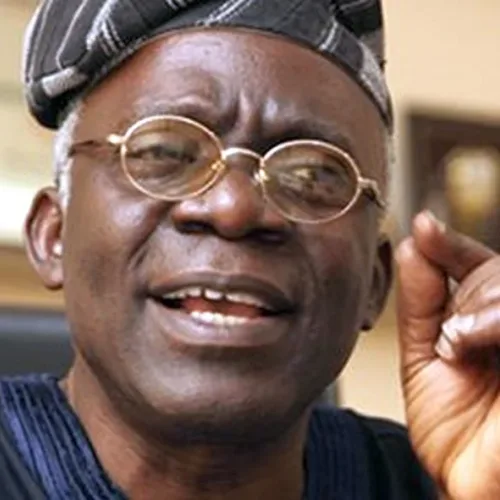
File: Human rights lawyer, Femi Falana
Human rights lawyer and Senior Advocate of Nigeria, Femi Falana, has said the Economic and Financial Crimes Commission has not acted illegally by freezing the Osun State Government’s account.
Falana said the EFCC had the legal authority to freeze the account of a state government, provided it obtained a court order within the stipulated period.
He stated this on Friday while speaking on Channels Television’s Politics Today.
The SAN said the legality of the commission’s powers had been settled by the courts, citing a 2022 Court of Appeal judgment in a case involving the Benue State Government and the EFCC.
“Well, as far as the law is concerned, the EFCC has not acted illegally. As a matter of fact, that came out in the statement of the President: ‘We are… I’m not questioning your mandate and the exercise of your power. However, I’m embarrassed,'” Falana said.
He explained that the EFCC could place a Post No Debit restriction on a government account for not more than 72 hours before obtaining a court order.
“Under the law, the EFCC has the power to freeze the account of the federal government or of any state or local government in Nigeria,” he said.
Falana recalled that in 2019, the Federal High Court in Benue State had ruled that the EFCC lacked the power to freeze the state’s account and awarded N50m in damages against the commission.
He said the EFCC appealed the decision and that the Court of Appeal, in a judgment delivered in September 2022, held that the commission had the power to freeze the account and place a PND restriction for not more than 72 hours before obtaining a court order.
“That remains the law in Nigeria today,” he said.
The SAN also cited a 2024 Supreme Court judgment arising from a challenge by the Kogi State Government and other states to the powers of anti-corruption agencies to investigate state accounts.
“In 2024, the Kogi State government, joined by many state governments, challenged the investigation—probing of state accounts by EFCC, ICPC, or NFIU. And in a historic judgment, the Supreme Court examined all the relevant laws and came to the conclusion that these agencies have the power to probe the accounts of any organization, either at the federal, state, or local government [level]. That remains the law in Nigeria,” he said.
Falana said anyone seeking a change to the existing legal position should approach the National Assembly.
“If Nigerians—those who are concerned—want the law changed, they can go to the National Assembly. But for now, as of today, EFCC has the power to freeze the account of any state and, in not more than 72 hours, has to go to court,” he said.
According to him, the EFCC went to court in the Osun case, and the Federal High Court acted on information provided by the commission.
“In this instance, the EFCC went to court, and the Federal High Court intervened based on information provided by the EFCC,” he said.
The comments come amid controversy over the EFCC’s restriction of an Osun State statutory allocation account.
The commission said the action followed suspicious movement of funds during an ongoing investigation into the alleged fraudulent handling of about ₦11 billion in Ecology Funds, Intervention Funds and Federation Account Allocation Committee allocations.
It maintained the restriction was temporary, limited to one account, and based on its powers under the EFCC Act and the Money Laundering (Prevention and Prohibition) Act, 2022.
President Tinubu later directed the EFCC to approach the court to vacate the order and discontinue the action, citing the inappropriate timing so close to the August 15 Osun governorship election.
Falana said the Osun State Government had challenged the legality and validity of the court order, rather than its timing.
“The President referred to the order obtained by the EFCC. And as should be done, the Osun State government has challenged the legality, the validity of the order, not the timing,” he said.
He cautioned against creating the impression that anti-corruption agencies should suspend investigations whenever elections are approaching.
“Because we must also be very careful that we don’t give a dangerous impression that when elections are 10 days away, 20 days away, 30 days away, the anti-graft agencies must turn the other eye—’Don’t look at the state or the federal government.’ And so if funds are being moved to the tune of billions of naira, ‘Don’t look at them—I mean, don’t look at those funds because elections are coming.’ It’s a very dangerous impression that is being created,” Falana said.
Comments
Start the conversation about this story.