





Nigeria grows enough plantain to feed its 242 million population and supply the West African region. Yet, within the broader $31.4 billion global market, the country’s footprint remains virtually nonexistent.
With an annual output of over 3 million metric tonnes, Nigeria easily ranks among Africa’s top five plantain growers. The country sits in a region that accounts for over 30 million of the 70 million tonnes demanded globally each year. However, while African peers like Uganda, the Democratic Republic of Congo, Cameroon, and Ghana capture the bulk of domestic value on the continent, and nations like Myanmar, Guatemala, and Ecuador command 46 percent of the global export market, Nigeria ships out next to nothing.
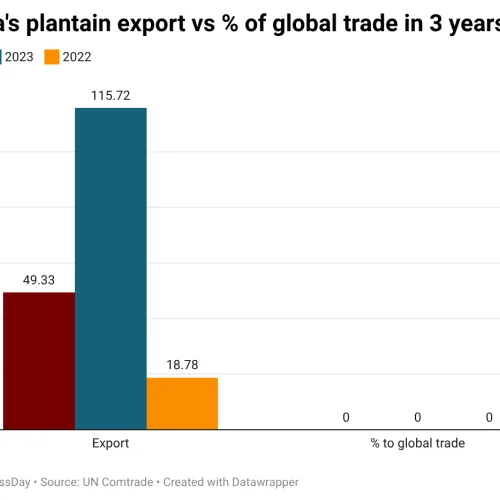
The numbers highlight a missed economic opportunity. According to the most recent UN trade data, Nigeria earned a mere $49,327 from plantain exports in 2024. The scale of this underperformance becomes glaring when measured against Côte d’Ivoire, the continent’s top earner, which generated a commanding $57.7 million over the same period. Despite its massive domestic yield, Nigeria’s footprint in the international market is essentially a rounding error, accounting for less than one percent of the total export value for the period.
“We earn almost zero revenue from plantain export despite the enormous potential in production of the tuber,” said Stanley Adimabua, national president of the Banana and Plantain Farmers Association of Nigeria (BAPFAN) in a telephone response to questions.
“With the right training and support for the subsector, it can become a major foreign earner,” he noted. “Plantain is a crop that supports millions of rural jobs, and yet it hasn’t become an export industry,” he added.
Nnanyelugo Ike-Muonso, director-general of the Raw Materials Development Council (RMRDC), said plantain production could become a major foreign earner for the country if properly harnessed.
“In 2022, Africa’s total plantain production was 30.08 million tonnes, out of which Nigeria produced 3.1 million tonnes, with most of the production consumed domestically with or without value addition,” Muonso said at a 2025 Delta agro investment summit.
Processing creates export opportunities
Plantain processing is where Nigeria’s $31. 4 billion missed opportunity morphs into a compelling investment case. Currently, farmers lose 30 percent of their crop to post-harvest rot every year.
Meanwhile, demand for processed plantain products like chips and flour is surging across the U.S., the EU, and diaspora markets. Establishing processing factories offers the clearest path for investors to transform this local staple into a lucrative export commodity.
Read also: Nigeria’s agric trade returns to surplus after 6 months of deficit
A report by the Bill and Melinda Gates Foundation puts Nigeria’s plantain flour production at 25, 200 metric tons (MT) and estimated demand at 125,000MT.
This means that there is a 99,800MT demand and supply gap in production, indicating a huge potential in the subsector for investment opportunities.
“There is a strong demand for the flour and chips,” Amusan Ayobami, CEO of Syobam Farms and Agro Services, said. According to him, plantain processing helps in reducing post-harvest losses for the crop.
Besides cocoa, cashew and sesame, plantain is another crop in Nigeria with huge export potential.
Plantain can be eaten raw when ripe, processed into flour to make ‘elubo’, a local meal consumed in Nigeria with soup and also serves as an industrial raw material in firms producing sanitary pads, fabrics, and for the food and beverage industry for making baby foods, biscuits, bread and cakes.
Its nutritional benefits include being low-fat, good for blood pressure, a key source of vitamins and minerals, high in fibre and rich in protein. This makes the consumption of plantain a great option for diabetic patients.
Tackling post-harvest losses is crucial
To unlock this value, the industry must tackle its glaring infrastructural deficits. The plantain supply chain remains highly informal, deeply fragmented, and starved of post-harvest handling facilities.
“We usually experience high post-harvest losses yearly, and this is owing to the lack of proper post-harvest handling infrastructure,” Adimabua said.
“The country is yet to realise the full potential in the production of plantain because activities in the subsector are still largely informal and unregulated,” he added.
He called for the proper organisation and coordination of activities in the subsector to explore opportunities in plantain production, create jobs and generate income.
Adimabua added that the industry has the potential to generate millions of dollars for export.
The plantain fruit is an all-year crop, but its main seasons are August through December.
It can be grown in 17 states across the country, with major production occurring in the humid forest agro-ecological zones, which align with the South-South and South-West. Oyo, Bayelsa, Edo, Ondo, Ogun, Taraba, Ekiti, Osun, Cross River and Akwa Ibom account for over 60 percent of Nigeria’s total annual production.


Josephine Okojie-Okeiyi is a journalist with over five years’ reporting experience. She writes on industry, agriculture, commodities, climate change, and environmental issues. She is fellow of Thomson Reuters Foundation and Bloomberg Media Initiative for Africa.
Comments
Start the conversation about this story.